
How Technology Aids Clinical Decision-Making
According to research, 61% of autism diagnostic centers report wait times of four months or longer, and families often wait much longer to access a qualified diagnostician.
These constraints have accelerated interest in objective, technology-assisted tools that can aid traditional approaches and provide insights similar to the ADOS-2. Among the most clinically advanced is biomarker-based assessment using eye-tracking technology.
The Role of Eye-Tracking Biomarkers
Eye-tracking technology measures how children visually engage with social and non-social scenes, capturing gaze patterns that serve as biomarkers of social and cognitive development. Over two decades of research have shown that children with autism demonstrate measurably different patterns of visual attention compared to typically developing peers, particularly in how they attend to faces, eyes, and social interactions.
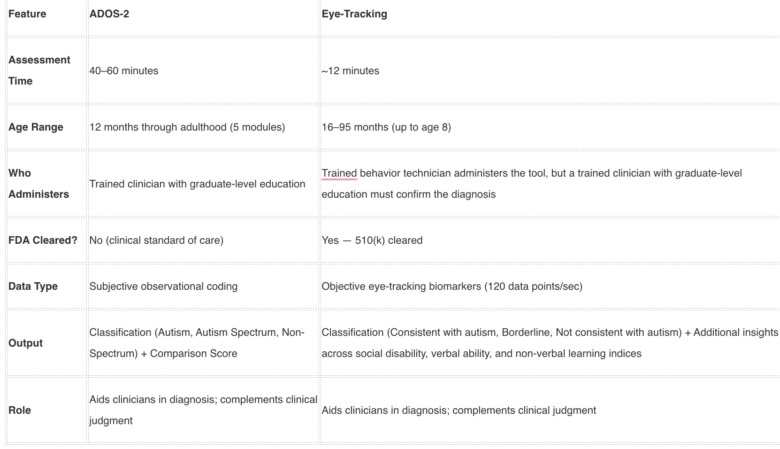
Quick Comparison: ADOS-2 vs. Objective Eye-Tracking Assessment
What This Means for Your ABA Practice
For ABA practice owners and clinical directors, understanding the ADOS-2 landscape is about more than clinical knowledge; it’s about strategic planning. Diagnostic services represent a significant growth opportunity for ABA practices, but the traditional model of relying exclusively on ADOS-2 or similar tools creates staffing and throughput constraints that many practices struggle to overcome.
A multi-tool diagnostic approach, combining the clinical depth of observational assessments like ADOS-2 when there is diagnostic uncertainty with the speed, objectivity, and accessibility of FDA-cleared technology allows practices to serve more families, reduce wait times, and differentiate their offerings in an increasingly competitive market.
Whether you are building diagnostic capacity from scratch or enhancing an existing program, the key is understanding how these tools work together to produce the most accurate, efficient, and clinically defensible outcomes for the children and families you serve.
Watch our Webinar: How Two Researchers Turned Eye-Tracking Science Into a Breakthrough for Autism Diagnosis and Assessment
Frequently Asked Questions
What is the difference between ADOS and ADOS-2?
The ADOS-2 is the second edition of the original Autism Diagnostic Observation Schedule, published in 2012. It includes revised scoring algorithms for Modules 1–3, updated norms, the addition of Comparison Scores that allow clinicians to track symptom severity over time, and a new Toddler Module designed for children aged 12–30 months. The core administration and coding procedures remain similar, but the ADOS-2 provides more accurate and clinically useful results.
Can a BCBA administer the ADOS-2?
It depends on the state and setting. ADOS-2 requires specialized training, and administration is typically conducted by psychologists, developmental pediatricians, or other licensed clinicians with graduate-level education and supervised experience. Some BCBAs may be trained to administer ADOS-2 in certain contexts, but they would generally work under the supervision of a qualified diagnostician. Check your state’s scope-of-practice requirements for specific guidance.
How long does ADOS-2 training take?
Clinical training typically involves a two-to-three-day workshop, followed by at least ten supervised practice administrations. The realistic timeline from initial training to clinical competency is approximately three to six months. Research reliability training requires additional steps, including video submissions and achieving inter-rater agreement of 80% or higher.
Is ADOS-2 the only tool needed to diagnose autism?
No. While ADOS-2 is widely considered the gold standard in observational assessment, best practice calls for a comprehensive diagnostic evaluation that includes developmental history (often gathered through the ADI-R or similar parent interviews), cognitive and language assessments, and integration of all findings using clinical judgment. ADOS-2 is one important piece of a multi-method diagnostic approach.
How does objective eye-tracking assessment differ from ADOS-2?
ADOS-2 is an observational assessment administered by a trained clinician over 40–60 minutes. Objective eye-tracking assessment is an FDA-cleared biomarker-based device that assesses social visual engagement in children aged 16–95 months during a 12-minute video-based session. Eye-tracking provides quantitative data that aids clinicians and complements clinical judgment and tools like ADOS-2. It does not replace them.
Related:
- Don’t Wait to Act: Spot the Signs of Autism Before Your Child Turns 3
- Local SEO for ABA Therapy Providers: A Step-by-Step Guide
Like MediaFeed’s content? Be sure to follow us.
This article originally appeared on Earlipointhealth.com and was syndicated by MediaFeed.org