Inspiring pictures of the world’s greatest cathedrals
Cathedrals are more than religious monuments or the seat of a bishop. They are deep repositories of history, art, politics, and culture—many of them with roots that stretch back into time in a way that’s nearly impossible to imagine. The Cologne Cathedral in Germany, for example, was founded in the 13th century and took hundreds of years (600, to be exact) to construct. These iconic buildings are landmarks and tourist attractions, and some are so gorgeously and intricately constructed that we have to wonder at the imagination and skill of the engineers and craftsmen who created them. Read on to take a look at some of these soaring beauties from around the world.

St. Louis Cathedral, New Orleans
The St. Louis Cathedral, originally built in 1727 and reconstructed in 1850, is a historic Roman Catholic cathedral located in New Orleans’ French Quarter that holds the distinction of being the oldest continuously active cathedral in the United States.

Canterbury Cathedral, Kent, England
Canterbury Cathedral in Kent, England, is a UNESCO World Heritage site. Founded initially in 597, the current structure began in 1070 following a fire, with major Gothic developments added after 1174, including the choir and Trinity Chapel.

Washington National Cathedral, Washington, D.C.
The Washington National Cathedral in Washington, D.C., was built over 83 years, beginning with a foundation stone laying ceremony on September 29, 1907, and finishing on September 29, 1990. It is a Neo-Gothic Episcopal cathedral in D.C. known for the Darth Vader grotesque on its northwest tower.

Westminster Abbey, London, UK
The Westminster Abbey we know today was primarily built between 1245 and 1269 by King Henry III, who rebuilt the original 11th-century church in the Gothic style. While the current structure dates to the 13th century, a Benedictine monastery was founded on the site around 960 AD, and a previous church was consecrated there in 1065.

Cathedral of Our Lady of the Angels, Los Angeles
The Cathedral of Our Lady of the Angels (COLA) is a modern Roman Catholic cathedral in downtown Los Angeles, and the mother church for the Archdiocese of Los Angeles. Opened in 2002, and known for its contemporary architecture designed by Rafael Moneo, featuring unique alabaster windows, and a 6,000-pipe organ.

Catedral de Sevilla, Spain
The Seville Cathedral is a massive Gothic Roman Catholic cathedral located in Andalusia, Spain. It was built between 1401 and 1506.

Cathédrale Notre-Dame de Chartres, France
Built primarily between 1194 and 1220, the Chartres Cathedral is a high Gothic Roman Catholic cathedral located in Chartres, France, renowned for its remarkably preserved 13th-century stained glass windows and its west facade featuring two contrasting spires.

St. Basil’s Cathedral, Moscow
Built between 1555 and 1561 by order of Ivan the Terrible, St. Basil’s Cathedral is an Orthodox church, located in Moscow’s Red Square.

St. Patrick’s Cathedral, New York
Construction of St. Patrick’s Cathedral in New York began in 1858, was paused during the Civil War, and was completed in 1878.
The cathedral is a Neo-Gothic Roman Catholic cathedral located in Midtown Manhattan, New York City, that occupies an entire city block and stands as a major landmark directly across from Rockefeller Center.

Florence Cathedral, Italy
Construction of the Cathedral began in 1296 under architect Arnolfo di Cambio and was completed in 1436 with the completion of the iconic dome designed by Filippo Brunelleschi.
The cathedral is a Gothic and Renaissance Roman Catholic cathedral located in Tuscany, Italy.

St. Paul’s Cathedral, London
The current St. Paul’s Cathedral in London, designed by Sir Christopher Wren, was built between 1675 and 1710.
The cathedral is an Anglican cathedral designed in the English Baroque style, located on Ludgate Hill in London, England, and is famous for its iconic dome.

Santiago de Compostela Cathedral, Galicia, Spain
Construction of the current Romanesque Santiago de Compostela Cathedral began in 1075 under King Alfonso VI and Bishop Diego Peláez. The Santiago de Compostela Cathedral is a Romanesque and Baroque Roman Catholic cathedral that serves as the final destination for the famous Camino de Santiago pilgrimage and is believed to have the remains of the Apostle Saint James the Great.

Kölner Dom, Cologne, Germany
Construction of the Kölner Dom began in 1248, but it took 632 years to complete, officially finishing in 1880. The cathedral is a High Gothic Roman Catholic cathedral located in Cologne, Germany. It survived fourteen aerial bomb hits during World War II and remains one of the tallest churches in the world with its twin spires reaching 157 meters.

Image Credit: ventdusud/istockphoto.
Duomo di Milano, Italy
Construction of the Duomo di Milano began in 1386 and was not fully completed until 1965. Ordered by Gian Galeazzo Visconti, the cathedral took nearly 600 years to build. The Duomo di Milano is a masterpiece of Flamboyant Gothic architecture, featuring 135 spires and over 3,400 statues.

Alexander Nevsky Cathedral, Sofia, Bulgaria
The Alexander Nevsky Cathedral in Sofia was constructed between 1904 and 1912 to honor Russian soldiers who died during the Russo-Turkish War. The foundation stone was laid in 1882, but the majority of the construction occurred later in 1924. The cathedral is one of the largest Eastern Orthodox cathedrals in the world and features a gold-plated central dome that can be seen from throughout the city.

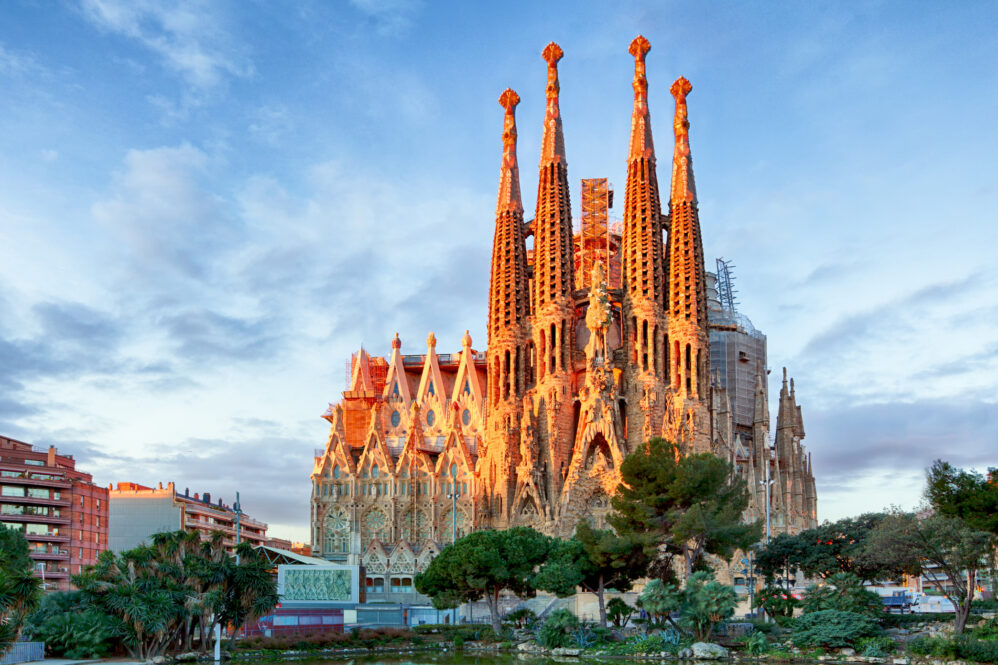
La Sagrada Familia, Barcelona, Spain
Construction of the Sagrada Família began in 1882 and remains ongoing today, designed as a unique Gothic-Art Nouveau Roman Catholic basilica in Barcelona, Spain, that is famously the masterpiece of architect Antoni Gaudí. The project marks 144 years of construction in 2026, with major milestones aimed for the centenary of Gaudí’s death.

Saint Sophia’s Cathedral, Kiev, Ukraine
Built between 1011 and 1037, Saint Sophia’s Cathedral is a world-renowned monument of Kievan Rus’ located in Kyiv, Ukraine, that functions as a museum and features the most complete ensemble of original 11th-century mosaics and frescoes in the world. The cathedral is a UNESCO World Heritage Site.

Bourges Cathedral, Bourges, France
Bourges Cathedral is a UNESCO World Heritage site. This Gothic masterpiece was built to showcase modern design and is known for its unique lack of a transept.
It built primarily between 1195 and the late 13th century, with major construction completed around 1245–1255, and final dedication in 1324.

Palermo Cathedral, Sicily, Italy
Built between 1185 and the 18th century, the Palermo Cathedral is a Roman Catholic cathedral located in Sicily, Italy. The Cathedral is famous for its architectural style, featuring a unique blend of Western, Islamic, and Byzantine influences.

St. Charles Cathedral, Vienna
Vienna’s Karlskirche was built between 1716 and 1739, commissioned by Emperor Charles VI as a votive church following a plague epidemic, and is famous for its two massive flanking columns inspired by Trajan’s Column in Rome.

Salisbury Cathedral, Salisbury, England
Salisbury Cathedral was built in a short period between 1220 and 1258. The main body was completed in just 38 years, with the famous tower and spire added later, around 1330.
The cathedral is an Anglican cathedral located in Salisbury, England, that is home to the best-preserved of the four original copies of the Magna Carta and boasts the tallest church spire in the United Kingdom at 123 meters.

York Minster, England
The current Gothic cathedral of York was built over approximately 252 years, with construction beginning in 1220 and finishing in 1472.
It is renowned for its vast medieval stained glass, including the Great East Window, and its role as a major center of Christianity since the 7th century.

Mexico City Metropolitan Cathedral, Mexico
Metropolitan Cathedral is the oldest and largest cathedral in Latin America. Constructed between 1573 and 1813.
The cathedral is a blend of Gothic, Baroque, and Neoclassical architecture, built directly over part of the ancient Aztec sacred precinct, Templo Mayor.

St. Vitus Cathedral, Prague, Czech Republic
St. Vitus Cathedral took nearly 600 years to complete, with final construction finishing in 1929. Initiated by Charles IV on the site of a 10th-century rotunda, the Gothic masterpiece was built over several centuries.
The cathedral is the largest in the Czech Republic and contains the tombs of Bohemian kings and the Czech Crown Jewels.

Basilica San Marco, Venice, Italy
The basilica was consecrated in 1094, replacing earlier churches on the site, built in 829 and rebuilt in 978. The first, smaller basilica was started in 829 to house the remains of St. Mark the Evangelist, brought from Egypt.

Cathedral of Brasília, Brasília, Brazil
The construction of the Cathedral of Brasília began in 1958, and it was inaugurated and consecrated on May 31, 1970.
It’s a masterpiece of modern architecture designed by Oscar Niemeyer. It’s made of 16 curved concrete columns representing hands rising to heaven, and 2,000 square meters of stained glass.

Nidarosdomen, Trondheim, Norway
Nidarosdomen construction began around 1070 and finished around 1300, making it the world’s northernmost medieval Gothic cathedral and a major historical pilgrimage site. It was built over the tomb of St. Olav, the Viking king who brought Christianity to Norway.

Hagia Sophia, Istanbul, Turkey
Built by Byzantine Emperor Justinian I between 532 and 537 AD, Hagia Sophia is world-famous for its massive dome and its history as a premier cathedral that was turned into a mosque.

Metropolitan Cathedral of Rio de Janeiro, Brazil
The Metropolitan Cathedral of Rio de Janeiro, built between 1964 and 1979 and designed by Edgar de Oliveira da Fonseca. It is famous for its unique modernist, cone-shaped architecture inspired by Mayan pyramids, featuring four 64-meter-high stained glass windows and a capacity for 20,000 people.

Cathedral of Saint John the Divine, New York
Construction began in 1892, and it remains officially unfinished, earning it the nickname “St. John the Unfinished.”
Located in Morningside Heights, it is famous as one of the world’s largest cathedrals and an example of Gothic Revival architecture in the U.S.
Ask us! What questions do you have about content, strategy, pop culture, lifestyle, wellness, history or more? We may use your question in an upcoming article!
Like MediaFeed’s content? Be sure to follow us.
This article was syndicated by MediaFeed.co .