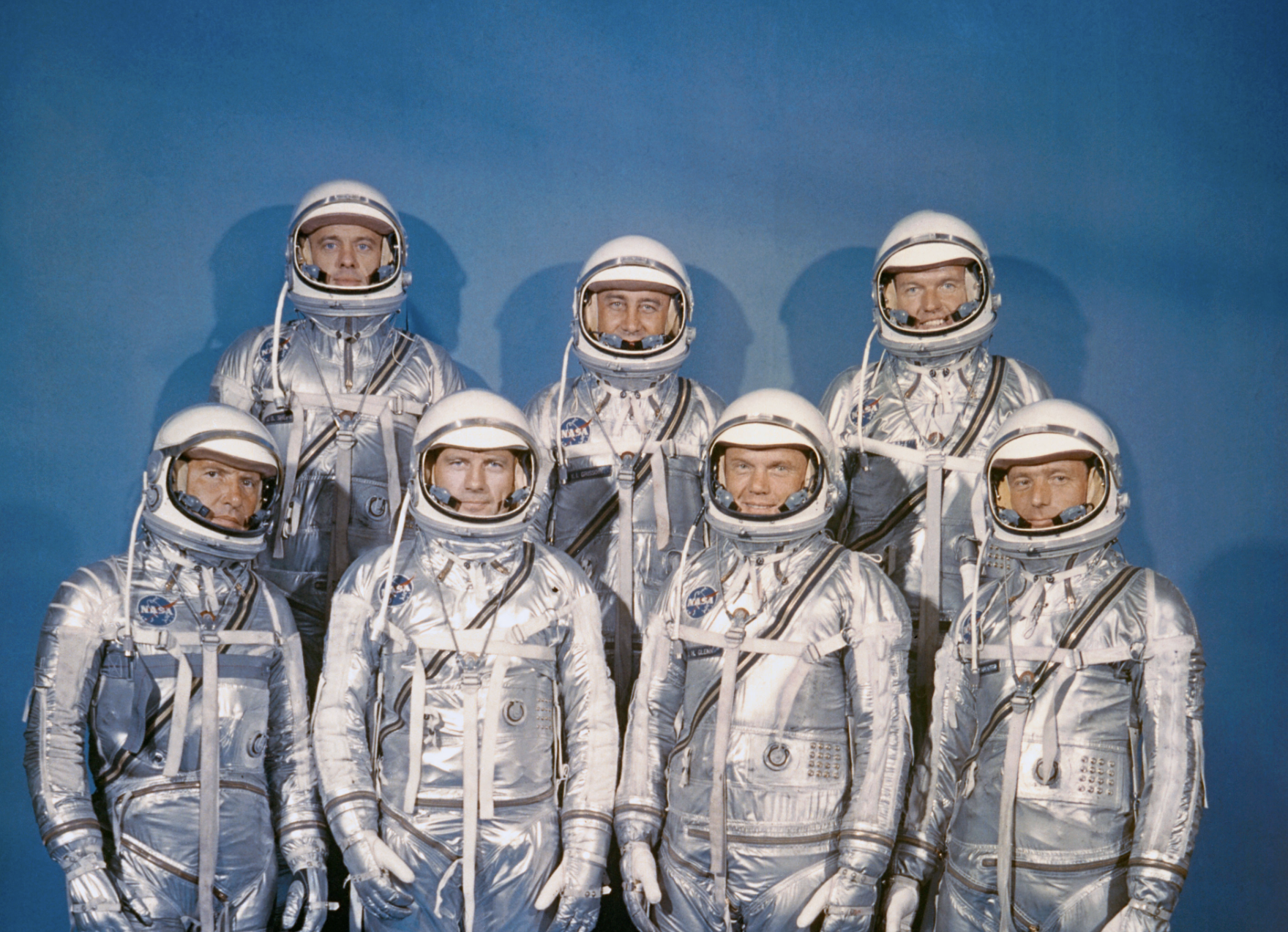
On April 9, 1959, the National Aeronautics and Space Administration (NASA) introduced its first group of astronauts to the world. Known as the “Mercury 7,” these seven men were chosen to lead Project Mercury, America’s first program to send humans into space.
The announcement took place in a crowded ballroom at the Dolley Madison House in Washington, D.C. The seven men, Scott Carpenter, Gordon Cooper, John Glenn, Gus Grissom, Wally Schirra, Alan Shepard, and Deke Slayton, sat at a long table on a makeshift stage.
After the Soviet Union launched Sputnik in 1957, the U.S. felt great pressure to catch up in the space race. NASA began by reviewing records of over 500 military test pilots. They were looking for people with exceptional piloting skills and high physical fitness.
Initially, they chose 110 candidates. The candidates were divided into three groups; the first two groups reported to Washington. Because of the high rate of volunteering, the third group was eliminated.
Candidates traveled to the Lovelace Clinic in New Mexico for intense medical and psychological exams. From there, they went to the Wright Aeromedical Laboratory in Ohio, where they faced intense tests to see how they handled stress. They were placed in heat chambers reaching 130 degrees Fahrenheit and in pressure chambers simulating high altitudes. Out of the final 32 candidates, these seven men stood out as the strongest.
Each member of the Mercury 7 went on to achieve incredible things. Alan Shepard became the first American in space on May 5, 1961. He later became the only one of the group to walk on the moon during the Apollo 14 mission. John Glenn became the first American to orbit the Earth in 1962. In 1998, at age 77, he returned to space to study the effects of aging. Gus Grissom flew the second suborbital mission but tragically died in the Apollo 1 fire in 1967. Wally Schirra made history as the only person to fly in the Mercury, Gemini, and Apollo programs. Deke Slayton was away from the scene for years due to a heart condition but finally flew in 1975 during the Apollo-Soyuz project.
LIFE magazine played a unique role in the early days of the Space Race by providing the public with access to the Mercury 7 astronauts and their families. While the men were already seen as stars for their daring military backgrounds, LIFE helped build a more familiar image of them by reporting on the personal side of their journey through exclusive stories and photos. Their coverage was so intimate that long-time photographer Ralph Morse was famously nicknamed the “eighth astronaut” by John Glenn because he spent so much time documenting their training and private lives.
Ask us! What questions do you have about content, strategy, pop culture, lifestyle, wellness, history or more? We may use your question in an upcoming article!
Like MediaFeed’s content? Be sure to follow us.
This article was syndicated by MediaFeed.org.