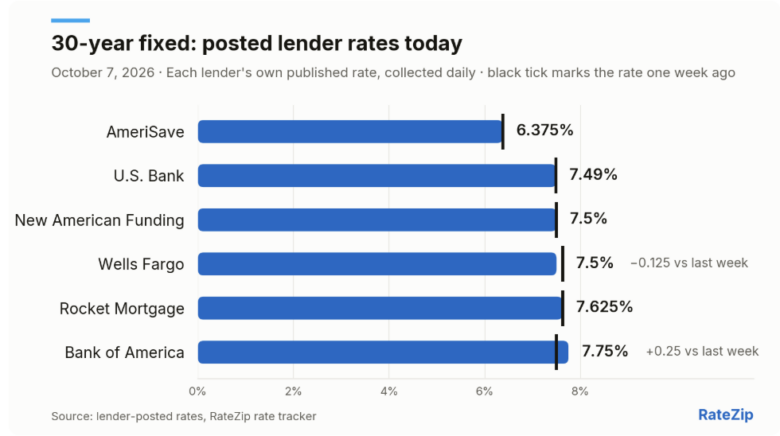
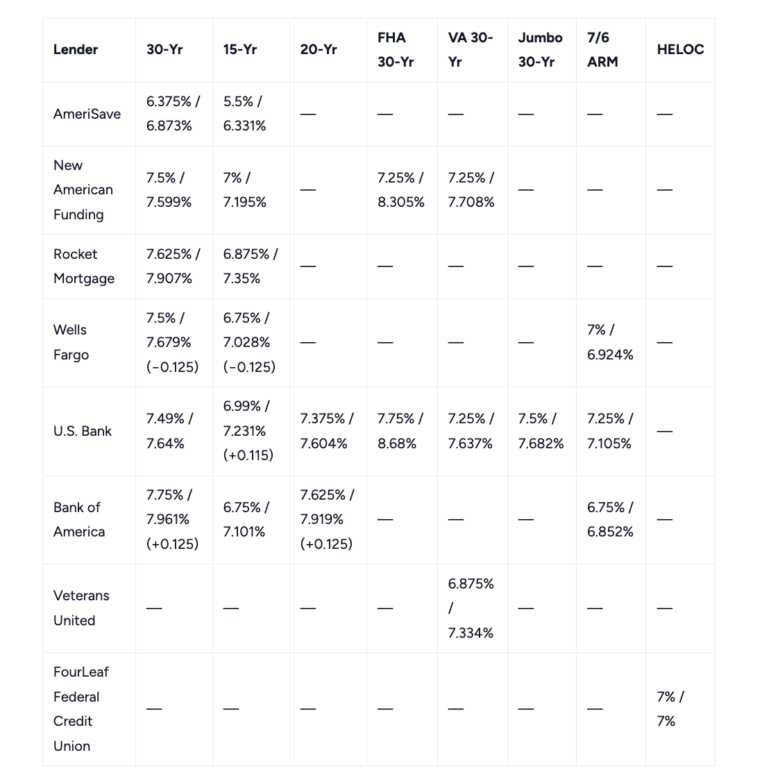
Posted rates moved on Wednesday: AmeriSave 15-Year Fixed Refinance to 5.99% (−0.135), Wells Fargo 30-Year Fixed to 7.5% (−0.125), Bank of America 30-Year Fixed to 7.75% (+0.125), Wells Fargo 15-Year Fixed to 6.75% (−0.125), and 2 more posted rates. The full table and the 30-day trend are below.
How we collect and publish this: our rate methodology.
AmeriSave also posts refinance pricing: 30-year fixed at 6.75% (7.267% APR) and 15-year fixed at 5.99% (6.869% APR), −0.135 today.
Today’s cut is AmeriSave’s fifth in the past three weeks; its posted 15-Year Fixed Refinance is down 0.24 points over that stretch.
The gap between the cheapest and most expensive posted 30-year rate in our tracked set is 1.375 points (AmeriSave at 6.375% vs Bank of America at 7.75%). On a $400,000 loan that spread is about $370 a month — on any given morning, the difference between lenders is far larger than the day-to-day movement of any one of them.
Over the past week the biggest move in the set is Bank of America’s posted 30-Year Fixed, up 0.25 points.
Nationally, Freddie Mac’s Primary Mortgage Market Survey put the average 30-year fixed mortgage rate at 7.28% in the week ending October 1, 2026, up from 7.03% a week earlier — the highest since November 2023. Source: Freddie Mac Primary Mortgage Market Survey via FRED®, Federal Reserve Bank of St. Louis.
Related: Today’s mortgage rates
Payment illustration, not an actual borrower or offer: a $400,000 30-year fixed loan at 7.28% has monthly principal and interest of $2,736.85, compared with $2,669.27 at 7.03%, a difference of $67.58 (higher). Calculated on the same loan amount and term; excludes taxes, insurance, mortgage insurance, points, fees and closing costs. The benchmark is an interest-rate average, not APR or a personalized rate quote.
In the broader market, the 10-year Treasury yield — the benchmark long-term mortgage pricing most closely tracks — stood at 5.31% at its most recent close (Monday, October 5, per FRED), up 3 basis points from the prior close and up 7 basis points over the past week. That is not a move that repriced the market: there is no clear macro driver behind today’s posted-rate changes, and day-to-day adjustments of this size are routine lender-level pricing.
Where borrower demand is heading: RateZip’s Mortgage Demand Index — built from the mortgage inquiries consumers submit across our network — shows September 2026 inquiry volume 4% lower than August 2026’s and 99% higher than September 2025’s. Behind the total: home-equity products (HELOC plus reverse) drew 90% of inquiries over the three months through September 2026, versus 72% in the same months a year earlier; refinance went from 11% to 1% of the mix. Product-level detail and the full series are on the index page.
Read more
RateZip is operated by Peklava LLC, DBA RateZip, a licensed mortgage broker (NMLS ID 1592292). We are compensated by some of the partners shown on this page, which may affect which offers appear and where. It does not affect our reporting or our recommendations. Rates shown were last updated October 7, 2026 at 11:01 a.m. ET. See our editorial standards and how we use AI.
How we track rates: methodology. Found an error? Tell us.
Ask us! What questions do you have about content, strategy, pop culture, lifestyle, wellness, history or more? We may use your question in an upcoming article!
Like MediaFeed’s content? Be sure to follow us.
This article originally appeared on RateZip and was syndicated by MediaFeed.co.