
Key takeaways
- There are four main parts to Medicare. Parts A and B make up Original Medicare, the federal base. Part C replaces that base with a private plan. Part D handles drugs and attaches to whichever structure the beneficiary ends up in.
- Part A covers inpatient and hospital care, and most beneficiaries pay no monthly premium after having completed 40 qualifying quarters of Medicare-covered work. The $1,736 deductible in 2026 is what trips people up. It resets per benefit period, meaning it restarts every time a new inpatient admission begins rather than on January 1, not per calendar year. Two hospitalizations in the same year, separated by 60 days, each carry their own deductible.
- Part B covers physician services, outpatient care, and preventive services (the non-hospital half of Original Medicare). Most enrollees pay $202.90 per month in 2026, with a $283 deductible and 20 percent coinsurance that carries no annual cap. That uncapped 20 percent is the structural gap that supplemental coverage was built to close.
- Part C, Medicare Advantage, must cover at least as much as Original Medicare and often adds dental, vision, or hearing coverage on top. The in-network out-of-pocket cap in 2026 is $9,250. Nothing equivalent exists in Original Medicare.
- Part D covers prescription drugs through private plans approved by CMS, and it attaches to whichever Medicare structure the beneficiary uses. The average standalone premium is $34.50 per month in 2026, and once annual out-of-pocket drug spending reaches $2,100, catastrophic coverage kicks in and covered drugs cost nothing through the end of the calendar year.
Medicare is not one entity. It is four, and the four parts do not all work the same way, come from the same place, or protect against the same risks. Parts A and B are the federal program most people picture when they hear the word. Part C is a private alternative sold by insurers the Centers for Medicare and Medicaid Services (CMS) has approved and oversees. It replaces Parts A and B rather than adding to them. Part D is prescription drug coverage, structurally separate from everything else, and attached to whatever coverage structure the beneficiary selects.
Delay the wrong enrollment without qualifying coverage, and the financial penalty runs permanently. Understanding each part individually before making enrollment decisions is the only leverage point available.
Hospital insurance (Part A)
Most people receive Part A without paying a monthly premium. The qualifying condition is 10 years of work history, whether consecutive or not, during which Medicare payroll taxes were withheld from their paycheck. Anyone who has held a standard W-2 job in the United States for a decade or more has almost certainly met this threshold without realizing it
Go Further: Whether Part A is premium-free depends entirely on work history. Medicare.gov’s eligibility tool at medicare.gov/basics/costs/medicare-costs/part-a-costs walks through how qualifying quarters are calculated and what options exist for those who fall short.
What Medicare Part A covers
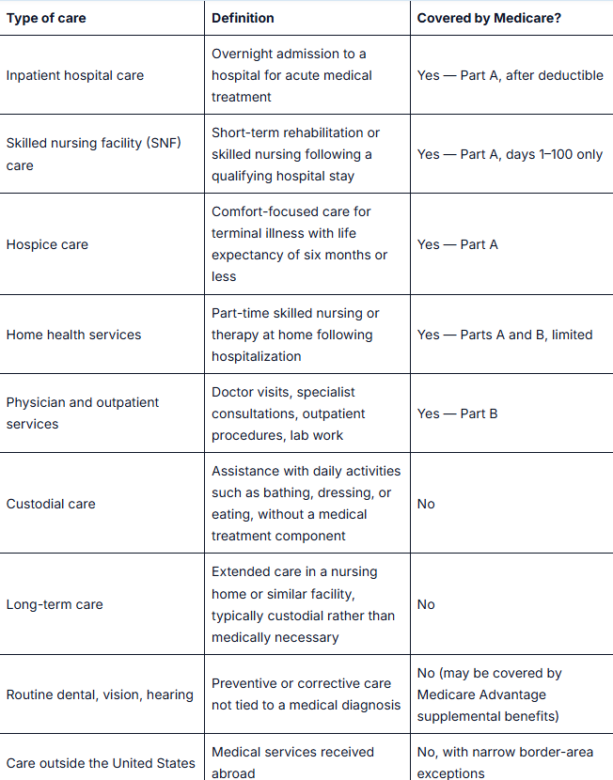
Medicare Part A covers inpatient hospital stays, skilled nursing facility care following a qualifying admission, hospice care, and some home health services. Custodial care is not covered. Long-term care is not covered. Both exclusions are larger than most new enrollees realize, and neither is addressed by any other part of Medicare.
How Part A benefit periods work
The 2026 deductible is $1,736, per CMS. It does not function like a standard insurance deductible. It resets per benefit period: a window that opens on the first day of an inpatient admission and closes only when 60 consecutive days have passed without any inpatient or skilled nursing facility care. Not January 1. The gap between stays is what resets the clock.
The February/September scenario illustrates how the mechanism plays out. Admitted in February, discharged, readmitted in September after more than 60 days outside any inpatient or skilled nursing facility: two separate benefit periods, two separate $1,736 deductibles, same calendar year. That distinction tends to arrive as a surprise on the second bill.
Costs for extended hospital stays
Extended stays generate additional costs on a structure most beneficiaries never see until they need it. Days 1 through 60 of a benefit period are covered after the deductible is met. Days 61 through 90 cost $434 per day. Medicare provides 60 lifetime reserve days for stays beyond that, at $868 per day in 2026. Use them, and they are gone. They do not replenish.
Go Further: The 60 lifetime reserve days are a one-time bank of extra inpatient days available to any beneficiary for their entire lifetime, not per year or per benefit period.
Skilled nursing facility coverage limits
Skilled nursing facility coverage follows its own cost schedule. The first 20 days after a qualifying hospital stay cost nothing. Days 21 through 100 run $217 per day in 2026, per CMS. Day 101 is where Medicare coverage for skilled nursing stops entirely. No gradual taper, no partial coverage. It ends. Anyone planning for an extended post-surgical recovery or rehabilitation needs to know where that boundary lies before it arrives.
Medical insurance (Part B)
Part B covers the outpatient half of Medicare: physician visits, outpatient hospital services, preventive care, durable medical equipment, mental health services, and certain home health services; everything that does not involve an inpatient admission. The 2026 standard premium is $202.90 per month, per CMS, for most enrollees.
The Part B late-enrollment penalty
Skipping Part B without holding creditable coverage (defined below) elsewhere triggers the late enrollment penalty: 10 percent added permanently to the monthly premium for each full 12-month period without coverage. Three uncovered years before enrolling means a 30 percent surcharge for the life of the coverage. The penalty does not expire.
Go Further: Creditable coverage means health or drug insurance that meets Medicare’s minimum adequacy standard, typically employer-sponsored insurance for those who are still working past age 65. Employers are required to notify employees annually whether their coverage is creditable. Beneficiaries can also contact Medicare directly at 1-800-MEDICARE (1-800-633-4227) to verify whether a specific plan qualifies
How income affects Part B premiums
For higher-income beneficiaries, the premium itself increases through the Income-Related Monthly Adjustment Amount (IRMAA), a surcharge based on tax returns filed two years prior rather than current income. In 2026, IRMAA adds between $81.20 and $487 per month to the standard premium. It is worth taking time to understand that lookback structure. Income from a high-earning final work year, a business sale, or a large Roth conversion can produce surcharges two full years after the triggering event, by which point the income is long gone and cannot be adjusted. There is an appeals process for certain qualifying life events, but it is not automatic and requires documentation.
Deductibles, coinsurance and out-of-pocket exposure
The premium understates the real cost exposure. After a $283 annual deductible in 2026, Part B covers 80 percent of the Medicare-approved amount for covered services. 20% accrues to the beneficiary, with no annual cap. A prolonged course of outpatient treatment, infusion therapy, and a series of specialist visits: the coinsurance accumulates without a ceiling. t. That structural gap is what created the market for Medigap, the supplemental private insurance designed specifically to cover what Original Medicare leaves behind.
Go Further: Medigap vs. Medicare Advantage covers the two main approaches to limiting out-of-pocket exposure under Parts A and B. The tradeoffs are distinct enough to warrant a separate evaluation before committing.
Advantage plans (Part C)
The most important thing to understand about Medicare Advantage, formally Medicare Part C, is that it serves as a replacement for Original Medicare rather than a supplement to it. A beneficiary who enrolls, exits the federal Parts A and B program entirely and receives equivalent coverage through a private insurer CMS has approved. It does not supplement Original Medicare. It replaces it.
What Medicare Advantage costs
Switching to Medicare Advantage does not change what a beneficiary owes for Part B. The $202.90 monthly Part B premium in 2026 continues going to CMS, the federal government, exactly as it would under Original Medicare. Medicare Advantage does not absorb or replace that payment. What changes is that the private insurer now delivers the coverage instead of the federal program.
In addition to the Part B premium, the Medicare Advantage plan may charge a separate premium, paid directly to the private insurer. Most plans currently set that additional premium at zero. For plans that do charge one, particularly those that bundle drug coverage, the 2026 average runs $11.50 per month, per CMS, though the range by location and carrier is wide.
The short version: a beneficiary in Medicare Advantage with no additional plan premium is paying $202.90 per month, same as before, just with a private insurer now managing the coverage. A beneficiary in a plan that charges an additional premium is paying $202.90 to CMS plus whatever the plan charges on top
How drug coverage works in Medicare Advantage
Most Medicare Advantage plans bundle drug coverage into a single plan, which is why the label MA-PD, standing for Medicare Advantage Prescription Drug plan, appears in enrollment materials. Not every plan includes Part D or the bundled drug coverage. Assuming it does without confirming is a specific error that can result in coverage gaps for beneficiaries.
Go Further: Medicare.gov’s plan finder at medicare.gov/plan-compare allows beneficiaries to filter specifically for MA-PD plans by zip code and cross-reference their current drug list before enrolling.
Cost-sharing and supplemental benefits
Inside each plan, cost-sharing (meaning the combination of deductibles, copayments, and coinsurance a member pays out of pocket) varies by carrier within CMS-established limits. The out-of-pocket cap for in-network services in 2026 cannot exceed $9,250, and most plans set theirs lower. Supplemental benefits covering dental, vision, and hearing are common but not standardized. Those supplemental benefits can be reduced or eliminated when the plan’s file is updated each fall. A plan’s 2026 benefits are not a reliable guide for its 2027 benefits, which is why annual review during open enrollment is essential.
Prior authorization and provider networks
Two features of Medicare Advantage plans generate the most friction in practice:
Prior authorization requirements: The plan must approve certain treatments, procedures, or specialist referrals before they are covered. Approval is not guaranteed and can delay care.
Provider network restrictions: Coverage applies only to doctors and facilities inside the plan’s approved network. Out-of-network care either costs more or is not covered at all, depending on the plan type
Switching back to Original Medicare
Original Medicare has neither prior authorization requirements nor network restrictions. Medicare Advantage plans have both, and the specifics vary by carrier and plan. For beneficiaries who find those features create too much friction and want to return to Original Medicare, there is an important catch: Medigap guaranteed issue rights, the federal protections that require insurers to sell supplemental coverage without medical underwriting, do not apply in most states after the initial enrollment window closes. Someone returning to Original Medicare after years in a Medicare Advantage plan may find they cannot qualify for Medigap at any price due to health conditions developed during that time.
Go Further: Guaranteed issue rights are time-limited and state-specific. Medicare.gov’s Medigap information outlines exactly when those protections apply and what happens when they do not.
Prescription drugs (Part D)
Medicare Part D provides prescription drug coverage through private plans approved by CMS. Unlike Parts A and B, which have nationally standardized cost structures, Part D plans vary significantly by carrier, geography, and the specific medications a beneficiary takes; which means two people in different states or with different drug needs can face very different costs and coverage under the same program name. Comparing plans against an actual drug list before enrolling produces results that a premium comparison alone cannot.
The Part D late-enrollment penalty
Part D enrollment is not optional in any practical sense. Beneficiaries who do not enroll when first eligible and do not have creditable drug coverage from another source, such as employer-sponsored insurance, are subject to a permanent late enrollment penalty. Delay Part D enrollment without holding creditable drug coverage and the penalty begins accumulating.1 percent of the national base beneficiary premium, a CMS-set benchmark figure currently $38.99 per month in 2026, for every full month without coverage
To illustrate how this accumulates: 12 months without creditable drug coverage produces a 12 percent surcharge on the plan premium. At the 2026 base rate of $38.99, that is roughly $4.68 added to the monthly premium, permanently. Twenty-four uncovered months doubles the surcharge to 24 percent. Because the national base beneficiary premium rises each year, the dollar cost of that fixed percentage increases automatically, even if no additional coverage gaps occur. A retiree who went 36 months without Part D coverage before enrolling would carry a 36 percent surcharge for the rest of their life; a cost that grows annually with the base rate.
Part D premiums, deductibles and cost-sharing
The average standalone Part D premium in 2026 is $34.50 per month. Individual plans range from near zero to over $100, depending on the drug formulary and geography. Deductibles run up to $615, though some plans waive them. After any applicable deductible, enrollees pay 25 percent coinsurance on covered drugs. Once annual out-of-pocket drug spending reaches $2,100, catastrophic coverage begins and covered drugs cost nothing through December 31.
The prescription drug out-of-pocket cap
That $2,100 cap reflects a structural change that took full effect in 2025, when the coverage gap, sometimes called the donut hole, was eliminated entirely. Previously, beneficiaries paid the full cost of drugs after initial coverage ran out and before catastrophic coverage kicked in. The out-of-pocket cap was set at $2,000 when the gap closed in 2025 and rose to $2,100 for 2026. For anyone managing multiple maintenance prescriptions, eliminating that gap represents a concrete reduction in annual drug cost exposure.
How income affects Part D premiums
High-income beneficiaries pay an IRMAA surcharge on Part D as well, ranging from $14.50 to $91 per month in 2026, based on 2024 income data and added to the plan premium.
How a financial advisor can help
An advisor can help add up the costs of Medicare before assuming the headline premium captures the real cost. Part B alone is $2,434.80 annually at the 2026 standard rate. The Part A deductible can be met twice in one calendar year if hospitalizations are spaced appropriately. Part B’s uncapped 20 percent coinsurance has no floor. Part D premiums, IRMAA surcharges for higher earners, and any Medigap or Advantage plan premiums all stack on top. For a household with meaningful retirement income, total Medicare spending in a given year can run well into five figures before any of those costs become unusual.
What a qualified financial advisor brings to this is the ability to model those costs as real expenditures rather than vague line items. IRMAA exposure is particularly worth addressing before it materializes. Roth conversion strategies, required minimum distributions, business sale proceeds, and deferred compensation events all affect modified adjusted gross income in ways that can cross IRMAA thresholds and generate Part B and Part D surcharges for two full coverage years. The income event that triggered the surcharge may be years in the past by the time the Medicare bill reflects it.
Planning around the lookback window must occur before the triggering income event. Not after. A fee-only fiduciary working alongside a tax professional can model multiple IRMAA scenarios in the years immediately before Medicare enrollment begins, when the window is still open.
FAQs
When does Medicare enrollment begin?
The Initial Enrollment Period runs for seven months, centered on the month of the 65th birthday: three months before, the birthday month itself, three months after. Enroll in the first three months and Part B coverage starts the first of the birthday month. Wait until the birthday month or after and the start date is pushed back. Beneficiaries already collecting Social Security at 65 are generally enrolled in Parts A and B automatically, but what that automatic enrollment does not cover is any decision about Part C or Part D. Both require a separate active choice.
What does Medicare not cover?
Routine dental, vision, and hearing generate the most frequent complaints, but the coverage gap with the largest financial consequence is long-term custodial care. Medicare does not cover it, not partially, not in limited circumstances. Care that assists with activities of daily living, rather than treating a medical condition, falls entirely outside the program. Long-term care insurance and its alternatives address that gap, but they are separate products requiring separate planning decisions. Care outside the United States is also generally excluded, with narrow exceptions for border emergencies.
What is the difference between Medigap and Medicare Advantage?
Medigap covers the cost-sharing gaps Original Medicare leaves behind: the Part A deductible, the Part B 20 percent coinsurance, and similar exposures. It works alongside Original Medicare without replacing any of it. Medicare Advantage, by contrast, replaces Original Medicare with a private plan that covers the same minimum benefits under a different structure. The two approaches are mutually exclusive. Medigap does not apply to Medicare Advantage cost-sharing because it is tied to Original Medicare, which the beneficiary has left. Choosing between them involves trade-offs in provider access, benefit stability, cost predictability, and the options that remain if switching back becomes necessary. Medicare.gov’s plan comparison tool is the most direct way to evaluate specific options by zip code before enrollment.
Glossary
Benefit period: Part A’s cost-sharing unit. Opens on the first day of inpatient admission, closes 60 days after the last day of inpatient or skilled nursing care. Triggers a new $1,736 deductible each time it opens. Not a calendar year reset.
Catastrophic coverage: The Part D threshold stage that begins once annual out-of-pocket drug spending crosses $2,100 in 2026. After that point, covered drugs cost nothing for the rest of the calendar year. Resets January 1 and does not carry forward.
Creditable coverage: Drug or health coverage meeting Medicare’s minimum adequacy standard. Holding it while delaying enrollment keeps the late enrollment penalty from applying. Losing it without promptly enrolling starts the penalty clock, and the months count whether or not the beneficiary knows the standard applies to their specific plan.
Drug formulary: The tiered medication list each Part D plan publishes, showing which drugs it covers and what each tier costs in coinsurance. Must include at least two drugs per therapeutic category, but does not have to cover every drug available. Changes annually: a medication covered at one tier in 2025 may not hold that same position in 2026, which is why annual formulary review before open enrollment closes matters more than most beneficiaries realize.
IRMAA (Income-Related Monthly Adjustment Amount): A higher-income surcharge applied to Parts B and D premiums, calculated from tax returns filed two years prior. Adds $81.20 to $487 per month to Part B in 2026. Adds $14.50 to $91 per month to Part D. Past high-income years generate current surcharges even after income has since fallen, with a limited appeals process for certain qualifying life events.
Late enrollment penalty: Permanent premium increase for delayed Medicare enrollment without creditable coverage. Part B adds 10 percent per 12-month gap. Part D adds 1 percent of the national base beneficiary premium per month. Both grow in dollar terms as base premiums rise: the percentage stays fixed while the dollar amount does not.
Lifetime reserve days: Sixty additional inpatient days available after a benefit period’s standard 90 days are exhausted, at $868 per day in 2026. Used once and never replenished. The decision about when to apply them carries permanent consequences.
Medicare Advantage (Part C): CMS-approved private plans that replace Original Medicare Parts A and B. Must meet the same minimum coverage standards. Most include Part D. Cap in-network out-of-pocket costs at no more than $9,250 in 2026. Plan terms, networks, and supplemental benefits can change at every annual enrollment period.
Medigap: Supplemental private insurance filling gaps in Original Medicare cost-sharing, including the Part B 20 percent coinsurance and the Part A deductible. Works alongside Original Medicare only, not Medicare Advantage. Guaranteed issue rights apply at initial enrollment but not necessarily after time spent in a Medicare Advantage plan.
National base beneficiary premium: The CMS-set figure used to calculate Part D late enrollment penalties, set at $38.99 per month in 2026. Increases annually, meaning the dollar cost of a fixed-percentage penalty grows over time without any change in the underlying rate.
Original Medicare: The federal Parts A and B program administered directly by CMS. No provider networks, no prior authorization, no referrals required. No annual ceiling on out-of-pocket costs without supplemental coverage. Coverage terms are set by Congress and CMS, not by annual plan filings.
Important Information
SteadyRetire is a retirement education platform offering practical financial resources and access to a financial advisor matching service. This article is intended for informational and illustrative purposes only and does not constitute financial, legal, tax, or investment advice. The information provided does not create a professional-client relationship and should not be used as a substitute for consultation with a qualified financial advisor, tax professional, or attorney. While we strive to provide accurate and up-to-date information, rules and regulations regarding retirement are subject to change. Always consult with a certified professional regarding your specific financial situation.
Ask us! What questions do you have about content, strategy, pop culture, lifestyle, wellness, history or more? We may use your question in an upcoming article!
Like MediaFeed’s content? Be sure to follow us.
This article originally appeared on SteadyRetire and was syndicated by MediaFeed.co.