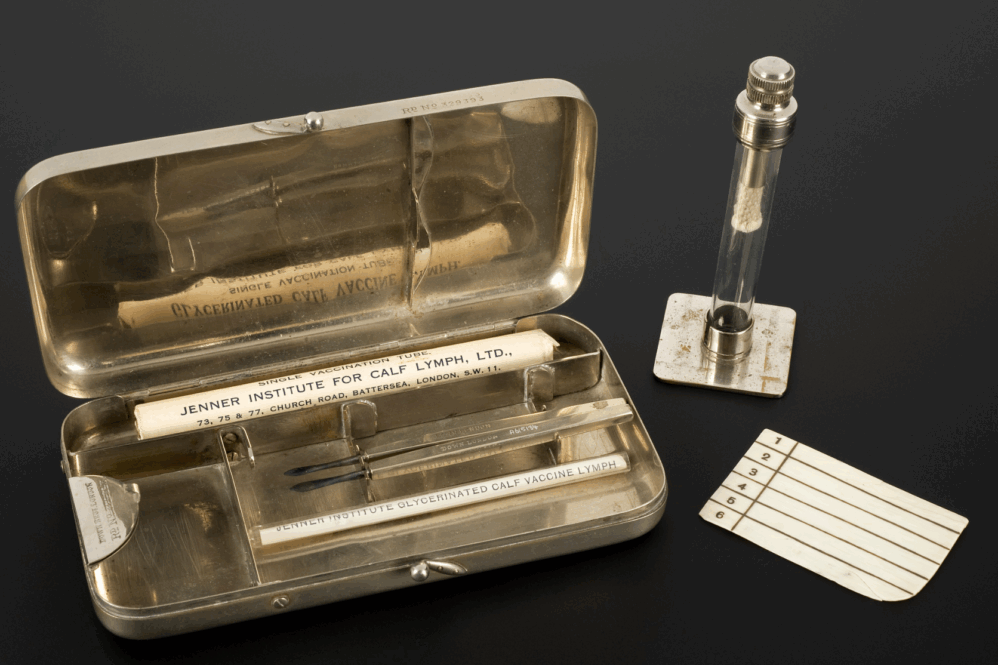
Often called the Speckled monster, Smallpox was one of the most terrifying diseases known to humanity. In 18th-century Europe alone, the disease killed an estimated 400,000 people every year, with a staggering fatality rate of up to 60% in adults and even higher in infants.
While the discovery of the vaccine began in England with Dr. Edward Jenner, its most dramatic and life-saving applications occurred in America, where it transformed from a controversial experiment into a tool for winning the Revolutionary War.
For centuries, smallpox was one of the most feared diseases. It was a highly contagious virus that caused painful sores to erupt across the body, often leading to death if it reached the heart, lungs, or brain. In the 18th century in Europe, it killed around 400,000 people every year.
When European explorers and settlers arrived, smallpox decimated local populations leading to a sharp decline in indigenous populations across North America.
People used a risky method called variolation, also known as smallpox inoculation. This involved taking pus from a smallpox victim and scratching it into the skin of a healthy person. The goal was to cause a mild case of smallpox that would leave the person immune.
While variolation was safer than catching the disease naturally, it was still dangerous. About 2% to 3% of people died from the procedure, and inoculated individuals remained contagious, often starting new outbreaks.
In 1721, when Dr. Zabdiel Boylston and the Reverend Cotton Mather tried to introduce variolation in Boston, the public was so outraged that a small bomb was thrown into Mather’s house.
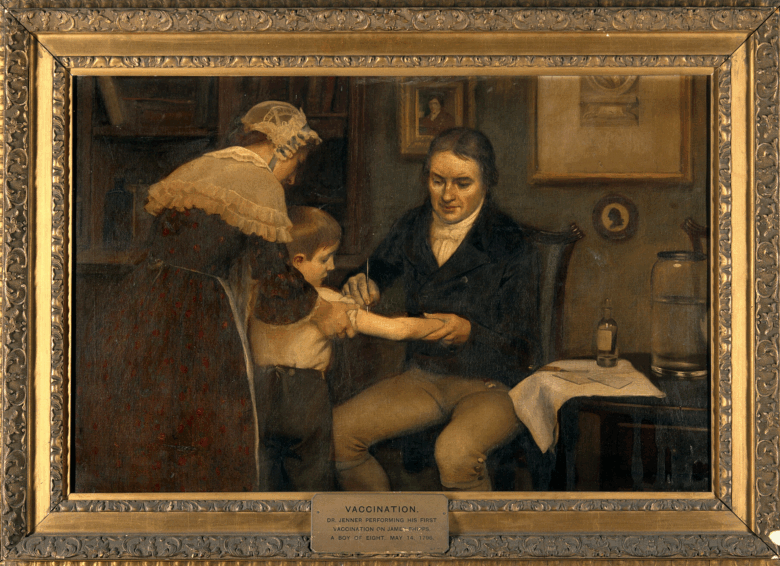
In May 1796, Edward Jenner found a young dairymaid, Sarah Nelms, who had cowpox lesions on her arms . Using matter from Nelms’ lesions, he inoculated an 8-year-old boy, James Phipps. The boy developed mild symptoms and around nine days after the procedure he felt cold and lost his appetite, after that he started feeling so much better.
In July 1796, Jenner exposed James to actual smallpox matter. The boy did not get sick. This proved that cowpox could provide immunity without the deadly risks of variolation. Jenner called his method “vaccination,” from the Latin word vacca, meaning cow.
While Jenner’s discovery began in Europe, its implementation in America was even more significant. During the Revolutionary War, smallpox was a major threat to the Continental Army. British soldiers were often already immune because the disease was more common in England.
General George Washington, who bore his own smallpox scars from a trip to Barbados, realized the virus could destroy his army more effectively than fighting against the British. In early 1777, despite a prohibition by the Continental Congress, Washington ordered the mass inoculation of all soldiers. This daring move saved the army from being wiped out by an epidemic and is credited by historians as a crucial factor in winning the war for American independence.
Following the war, the vaccine spread quickly through the United States. Dr. Benjamin Waterhouse, a professor at Harvard, introduced the Jennerian vaccine to New England and sent samples to Thomas Jefferson. Jefferson became a strong supporter, eventually appointing Waterhouse as a vaccine agent for a national program.
Over the next two centuries, vaccine technology evolved through several generations. First-generation was grown on the skin of live animals like calves or sheep. Second-generation was grown in sterile cell cultures for greater purity (e.g., the modern ACAM2000). And third-generation uses weakened viruses that are even safer for the public.
By 1967, the World Health Organization (WHO) launched a global campaign to eliminate the disease. Because the vaccine was so effective, smallpox was officially declared eradicated in 1980. While it is the only human disease to be completely wiped out, the virus is still retained in two high-security laboratories in the U.S. and Russia for research purposes.
Ask us! What questions do you have about content, strategy, pop culture, lifestyle, wellness, history or more? We may use your question in an upcoming article!
Like MediaFeed’s content? Be sure to follow us.
This article was syndicated by MediaFeed.co.