What is the VA pension? Eligibility, income limits and 2026 rates
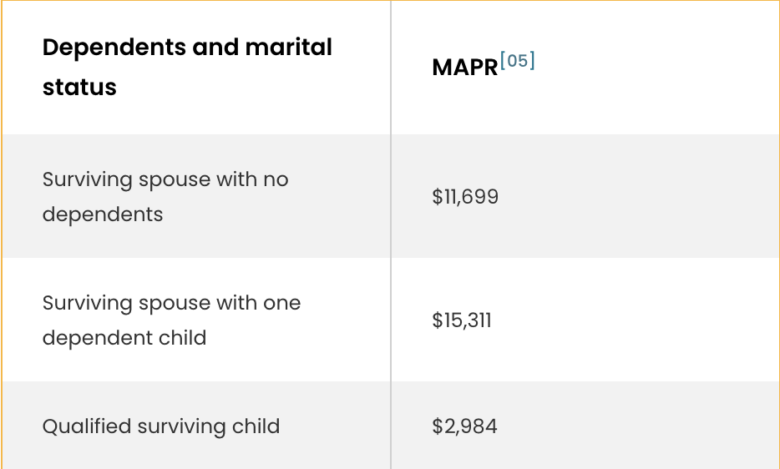
The U.S. Department of Veterans Affairs (VA) offers two need-based pension programs for wartime veterans and certain family members. The Veterans Pension and Survivors Pension provide tax-free monthly payments, with amounts based on income and family size. In 2026, maximum annual benefit amounts range from $17,441 to $22,839 for a veteran and from $11,699 to $15,311 for a surviving spouse. Some veterans and survivors may receive higher payments if they qualify for programs such as the Aid and Attendance benefit or Housebound allowance. This article focuses specifically on the VA Veterans Pension and VA Survivors Pension.

Who’s eligible for the VA pension?
The VA Veterans Pension is for low-income wartime veterans who have not been dishonorably discharged from the military.
To qualify, a veteran must meet at least one of the following criteria:
- Be 65 or older
- Have a permanent and total disability
- Be a patient in a care setting because of a disability
- Be receiving Social Security Disability Insurance (SSDI) or Supplemental Security Income (SSI)
Eligible veterans must also meet one of the following service criteria:
- Started active duty before September 8, 1980, and served at least 90 days on active duty with at least 1 day during wartime
- Started active duty as an enlisted person after September 7, 1980, and served at least 24 months or the full period for which they were called or ordered to active duty (with some exceptions) with at least 1 day during wartime
- Started on active duty after October 16, 1981, as an officer, and hadn’t previously served on active duty for at least 24 months
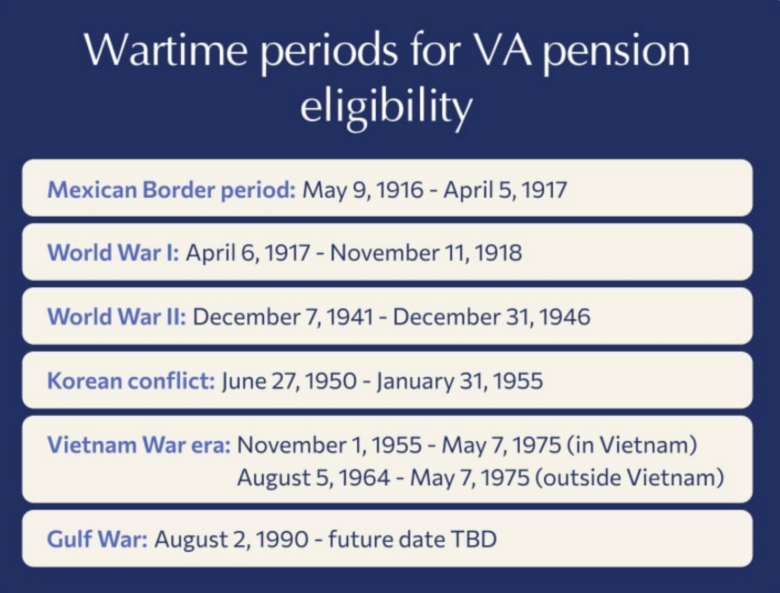
See the VA’s recognized wartime periods in the graphic below.
Lastly, an eligible veteran’s total net worth can’t exceed $163,699. Net worth includes income and all assets (minus any mortgages). Net worth also includes their spouse’s income and assets, if applicable. However, a veteran’s primary home, one car, most home furnishings are not counted as part of a veteran’s net worth. Additionally, any qualifying educational expenses and nonreimbursable medical expenses can be deducted to reduce a veteran’s income and therefore net worth.
Complete information about what the VA considers income can be found in Form 21P-0969. Common sources of income include:
- Wages and business earnings
- Retirement payments
- Social Security benefits
- Interest and dividends
- Unemployment compensation
- Rental property
It’s important to note that the VA reviews a veteran’s financial records from the three years immediately preceding their application date for pension benefits. This is known as the look-back period. The VA does this to check for any assets that a veteran may have transferred for less than fair market value to achieve financial eligibility for VA pension benefits. Applicants who are found to have transferred assets during the look-back period may be subject to a penalty period of up to 5 years. During this period, they are ineligible for VA pension benefits.

How is the VA pension rate calculated?
The monthly Veterans Pension rate is calculated by subtracting the veteran’s annual income from their maximum annual pension rate (MAPR) and dividing by 12.
As an example:
MAPR $22,839
Annual income – $10,000
VA pension = $12,839 per year ($1,069 per month)
A veteran’s MAPR depends on how many dependents they have, whether they’re married to a veteran who also qualifies for pension benefits, and whether they or their spouse qualify for an increased pension through the Aid and Attendance benefit or the Housebound benefit.

2026 Maximum Annual Pension Rates for Veterans Pension
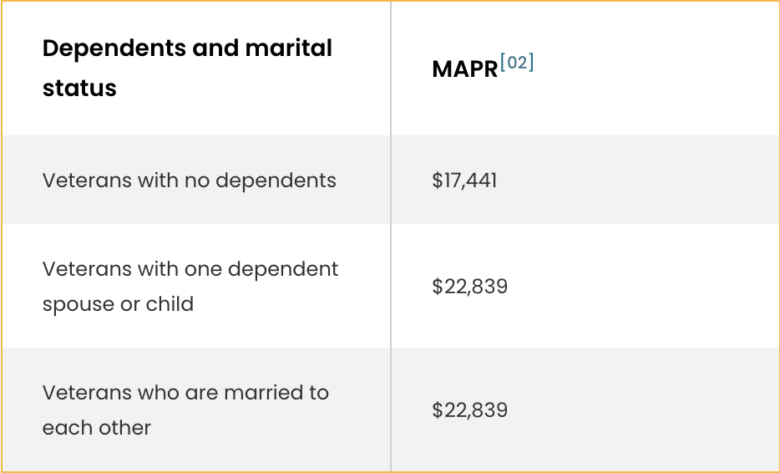
A veteran’s MAPR also increases by $2,984 for each additional dependent child.

How does the VA pension work with other types of benefits?
The VA Veterans Pension can be combined with some, but not all, federal benefit programs. For example, the Veterans Pension may be combined with:
- Social Security retirement benefits
- Social Security Disability Insurance (SSDI)
- Supplemental Security Income (SSI)
- Medicare
- Medicaid
However, if a veteran qualifies for VA pension and for VA disability compensation, the VA won’t pay both. They’ll pay whichever benefit is greater.

Using a VA pension to pay for senior care
Because eligible veterans and survivors receive VA pension benefits directly, they are free to use the money however they see fit — including to pay for care at home or in a senior living community. If you believe your loved one may qualify, the next step is applying for the benefit.

How to apply for the VA pension
There are 5 ways to apply for the Veterans Pension. Most forms and applications are available online at VA.gov. Completed forms may be uploaded online, mailed in, or submitted in person at a VA regional office. Applicants can also seek help from a trained professional to complete and submit their application. Whichever route you choose, prepare by following the steps below.
Check eligibility
Research the eligibility requirements for the specific benefit(s) your loved one may qualify for. Even if they don’t qualify now, this initial research can help determine if they might be eligible in the future if their circumstances change.
Gather documents
Make a list of which documents you’ll need and start collecting them. You can request a copy of a veteran’s DD Form 214 (also known as discharge papers or report of separation) online through the National Archives. Be ready to furnish personal details such as their name, service branch, dates of service, and more for verification.
Seek an assessment
If applicable, make an appointment for your loved one to see physician to document any health conditions, disabilities, and/or functional limitations.

Who’s eligible for the VA Survivors Pension?
Surviving spouses and unmarried dependent children who have low incomes are eligible for the VA Survivors Pension as long as their late veteran relative received or qualified for the Veterans Pension. In 2026, an eligible survivor’s total net worth cannot exceed $163,699.
Note that the same income and asset rules, three-year look-back period, and penalty period discussed above also apply to the Survivors Pension.

How much does the VA Survivors Pension pay?
Survivor’s Pension amounts are based on a survivor’s relationship to the late veteran, how many dependents they have, and their annual income. A survivor’s pension amount is calculated by subtracting their income from their MAPR. If a surviving spouse meets additional criteria, they may qualify for an increased pension through the Aid and Attendance benefit or the Housebound benefit.
2026 Maximum Annual Pension Rates for Survivors Pension
How does the VA Survivors Pension work with other types of benefits?
The VA Survivors Pension can be combined with other benefit programs, including:
- Social Security retirement
- Social Security Disability Insurance (SSDI)
- Supplemental Security Income (SSI)
- Medicare
- Medicaid
If the survivor is also eligible for VA Dependency and Indemnity Compensation (DIC) benefits, the VA won’t pay both. They’ll pay whichever benefit is higher.

How do you apply for a VA Survivors Pension?
There are 4 ways to apply for a VA Survivors Pension:
- Online using the VA’s QuickSubmit tool
- By mail using VA Form 21P-534EZ
- In person at a VA regional office near you
- With help from a VA-accredited representative or Veterans Service Organization

How to get help with VA pension applications and claims
There are many resources that can assist with the application process for VA benefits like pensions:
- The VA itself can help with your application. Contact MyVA411 by phone at 800-698-2411 or the VA benefits hotline at 800-827-1000. You can also get help in person at a VA office near you.
- Other veterans organizations, such as the VFW, American Legion, and DAV, may be able to provide benefits counseling and help prepare applications free of charge.
- For a fee, accredited VA consultants can help families assess eligibility for VA benefits and assist with applications. They can also help families whose benefit applications have been denied by determining why an application wasn’t successful and recommending changes to improve the chances of approval upon resubmission.
- Elder law attorneys can help with financial planning and the VA benefits application process. When seeking advice, look for a reputable attorney who has experience with VA benefits. Additionally, attorneys must be accredited to prosecute claims with the VA.
- A Place for Mom’s trusted VA-accredited partner Patriot Angels provides expert advice on veterans benefits for a fee. (Note: A Place for Mom may be compensated if you choose to use Patriot Angels’ services.)
Whether your loved one needs companion care, independent living, or another type of senior care, A Place for Mom’s Senior Living Advisors are knowledgeable about VA pensions and other important VA benefits.
Related:
- Social impact bond ETFs that support Veterans & minority borrowers
- What to know about mesothelioma veterans’ benefits
Ask us! What questions do you have about content, strategy, pop culture, lifestyle, wellness, history or more? We may use your question in an upcoming article!
Like MediaFeed’s content? Be sure to follow us.
This article originally appeared on A Place for Mom and was syndicated by MediaFeed.co.