Something has changed in what homeowners are asking lenders for. Home-equity products — HELOCs plus reverse mortgages — drew 76% of the mortgage inquiries consumers submitted across our network over the three months through August 2026, up from 43% in the same months a year earlier, according to RateZip’s Mortgage Demand Index. Refinance requests went the other way over that stretch, from 39% of the mix to 2%. Total inquiry volume in August ran 157% above August 2025.
The rate backdrop explains why that pivot is worth a homeowner’s attention. Freddie Mac’s weekly survey put the average 30-year fixed mortgage rate at 6.95% in the week ending September 17, up from 6.76% a week earlier. The Federal Reserve, meanwhile, moved the other way from the easing many borrowers had been waiting on: the FOMC raised the federal funds target range by a quarter point to 3.75%–4% on a unanimous 12-0 vote on September 16, citing elevated inflation and solid economic activity and saying the move supports a timelier return to its 2% goal. The 10-year Treasury yield, which long-term mortgage pricing most closely tracks, closed at 5.01% on Friday, September 18, per FRED.
A sluggish market for buyers, a busy one for equity
For people trying to buy rather than borrow against a home they already own, the picture is slower. Pending home sales edged up 0.3% in August but sat about 2.2% below a year earlier, the National Association of Realtors said, with year-over-year declines in all four regions.
“However, the housing market is still sluggish, with contract signings below last year. This is due to higher mortgage rates offsetting the increased buying power created by job gains and income growth outpacing home price growth,” said Lawrence Yun, the association’s chief economist.
Builders see the same hesitation. NAHB’s builder confidence index fell three points to 32 in September, its weakest reading since September 2025, with builders pointing to weaker buyer traffic, higher material and fuel costs, tight lending, and labor shortages.
The spread between lenders dwarfs the daily moves
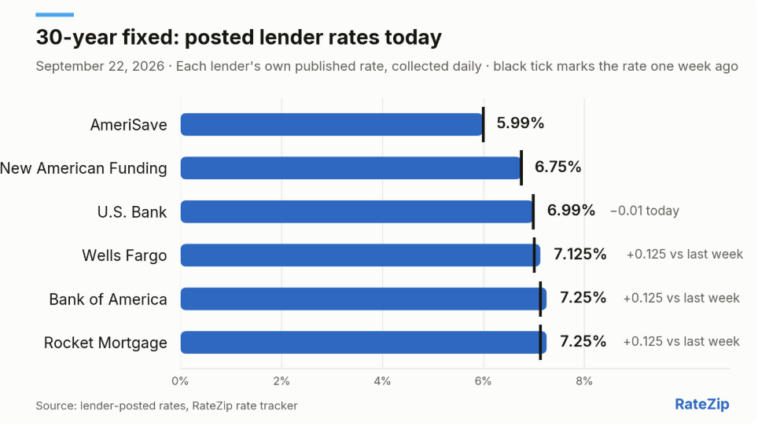
Whatever the product, the widest variable in the market on Tuesday morning was not the market — it was the lender. Posted 30-year fixed rates in our tracked set ran from 5.99% at AmeriSave to 7.25% at Rocket Mortgage, a spread of 1.26 points, or about $333 a month on a $400,000 loan. Wells Fargo raised its 30-year rate 0.125 points on the day. Rocket cut its posted 15-year fixed to 6.49%, its third reduction to that product in three weeks, leaving it down 0.5 points over the stretch.
Whether buyers come off the sidelines may hinge on what the Fed does next. Speaking before the September meeting, Zonda chief economist Ali Wolf put it this way: “All eyes are on the upcoming Fed meeting, as a rate cut might have buyers pressing play on home shopping,”
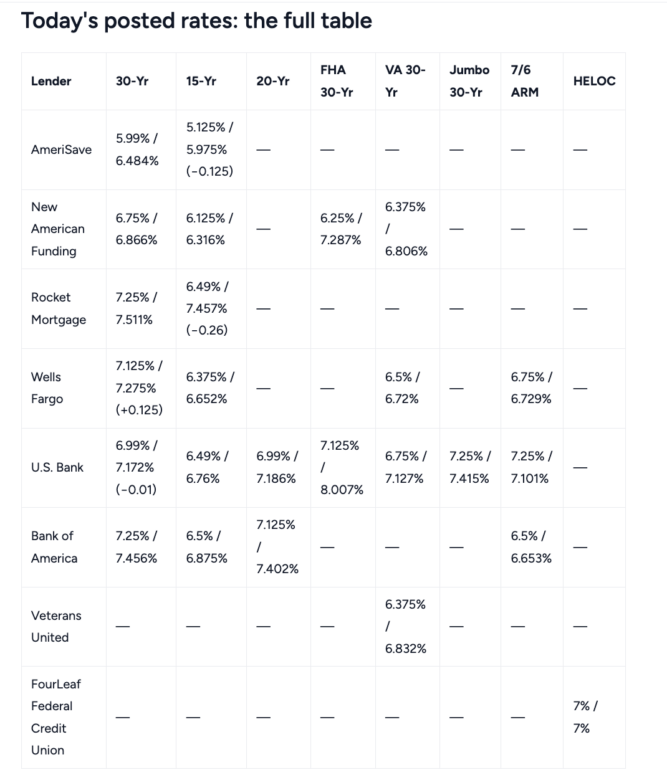
Rates are each lender’s own published rate as of 9:50 a.m. ET, collected from their public rate pages and feeds. The APR is the better cross-lender comparison; a figure in parentheses is today’s change; a ‘—’ means the lender doesn’t post that product. How we collect and publish this: our rate methodology.
Read more
RateZip is operated by Peklava LLC, DBA RateZip, a licensed mortgage broker (NMLS ID 1592292). We are compensated by some of the partners shown on this page, which may affect which offers appear and where. It does not affect our reporting or our recommendations. Rates shown were last updated September 22, 2026 at 9:50 a.m. ET. See our editorial standards and how we use AI.
How we track rates: methodology. Found an error? Tell us.
Ask us! What questions do you have about content, strategy, pop culture, lifestyle, wellness, history or more? We may use your question in an upcoming article!
Like MediaFeed’s content? Be sure to follow us.
This article originally appeared on RateZip and was syndicated by MediaFeed.co.