

Key takeaways
- A Registered Investment Advisor is a firm or individual that provides investment advice for compensation. RIAs are registered with either the SEC or a state securities regulator under the Investment Advisers Act of 1940, which means the firm has filed disclosures with regulators, is subject to compliance examinations, and can be looked up in a public database, but it does not indicate the quality of the advice provided.
- Whether an RIA registers with the SEC or a state regulator depends on how much money the firm manages. Firms managing less than $110 million generally register with the state. Those managing $110 million or more must register with the SEC.
- All RIAs are held to a fiduciary standard, which requires them to act in the client’s best interest continuously across the advisory relationship. That legal obligation distinguishes RIAs from broker-dealers, whose recommendations are governed by Regulation Best Interest at the time of a specific transaction.
- A Registered Investment Advisor is not a job title and not a credential. It is a regulatory designation that applies to any firm or individual that provides investment advice for compensation and meets the definition established by the Investment Advisers Act of 1940.
The primary disclosure document for any Registered Investment Advisor is Form ADV, which is publicly accessible through the SEC’s IAPD database at no cost. It describes the firm’s services, fees, conflicts of interest, and any disciplinary history.
Understanding what RIA registration covers, and what it does not, helps anyone evaluating an advisory relationship ask the right questions before engaging.
Looking for the right financial advisor? Take a short matching quiz to explore financial professionals based on your goals and preferences.
How does RIA registration work at the state and federal levels?
Registration as an investment advisor happens at either the state or federal level, depending on how much money the firm manages. This boundary was set by the 2011 Dodd-Frank Act. Knowing which authority oversees your advisor matters because it dictates where you check their credentials, how they are examined, and what oversight rules protect your assets.
What AUM thresholds determine an RIA’s regulator?
Firms managing less than $100 million in assets under management register with the securities regulator in each state where they have clients. Firms managing between $100 million and $110 million can choose to register with the SEC but are not required to. Firms managing $110 million or more must register with the SEC unless a specific exemption applies. A buffer zone between $90 million and $110 million prevents firms from constantly switching between state and federal registration as their AUM fluctuates near the threshold.
Why is New York an exception?
New York does not conduct routine examinations of state-registered investment advisors. Because of that, the SEC requires advisors managing $25 million or more who are subject to New York registration to register at the federal level instead, unless an exemption applies.
What does state RIA registration require?
State-registered RIAs file through the Investment Adviser Registration Depository (IARD) system and comply with the securities laws of each state where they are registered. Those laws vary. Some states impose different advertising rules, custody requirements, or bonding standards than the SEC does under the Advisers Act. A firm registered in multiple states must track and comply with each state’s specific requirements.
What does SEC registration require?
SEC-registered RIAs file Form ADV through the IARD system and are subject to periodic examination by the SEC’s Division of Examinations. The Advisers Act governs their conduct, including rules on advertising, custody of client assets, proxy voting, and code-of-ethics requirements. SEC registration also requires filing Form CRS, the Client Relationship Summary, which must be delivered to retail clients.
Go Further: What is a Form ADV? How to read an advisor’s disclosure covers how to read the Form ADV, which sections carry the most weight, and how to use the SEC’s IAPD database to verify any advisor’s registration and disciplinary history.
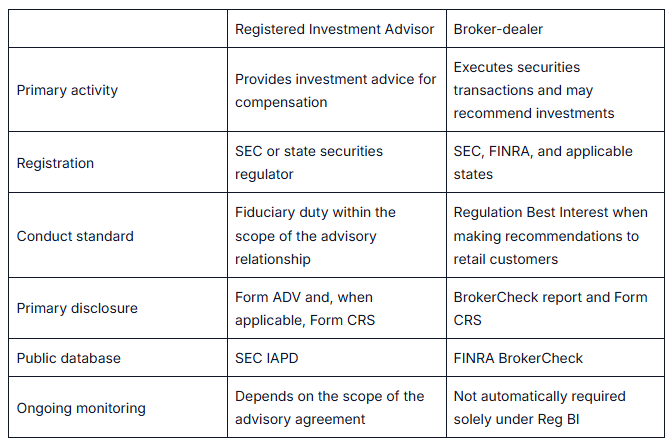
How does an RIA differ from a broker-dealer?
An RIA and a broker-dealer are two distinct regulatory categories, governed by different laws and held to different standards of conduct. The distinction matters because the two types of firms can look similar from the outside while operating under very different legal obligations.
How does a broker-dealer operate?
A broker-dealer executes securities transactions on behalf of clients and may also recommend securities products. FINRA and the SEC regulate broker-dealers under the Securities Exchange Act of 1934, not the Investment Advisers Act. When a broker-dealer makes a recommendation to a retail client, Regulation Best Interest governs it and requires the recommendation to be in the client’s best interest at the time it is made.
Why does the timing of the legal obligation matter?
The critical difference between the two standards is timing. A broker-dealer’s Regulation Best Interest obligation applies at the moment of a recommendation and does not extend to ongoing monitoring after the transaction is complete. An RIA’s fiduciary obligation applies continuously across the entire advisory relationship, within the scope agreed upon with the client. An advisor who recommended an appropriate strategy in 2023 and never revisited it as the client’s circumstances changed has not fulfilled the ongoing component of that obligation.
What does dual registration mean for clients?
Many financial professionals hold both an RIA registration and a broker-dealer registration simultaneously. In that arrangement, the applicable standard shifts depending on which capacity the advisor is operating in for any given interaction. When providing financial planning advice, they may be acting as a fiduciary RIA. When recommending a specific commissionable product, they may shift to their broker-dealer role and Regulation Best Interest applies. The Form CRS that every SEC-registered firm must provide to retail clients clarifies which standard applies to which services.
Go Further: What is a fiduciary? Why the legal standard matters covers the duty of care and duty of loyalty that make up the fiduciary obligation, and how to verify which standard governs any specific advisory relationship.
Why are RIAs held to a fiduciary standard?
Every RIA, whether registered with the SEC or a state regulator, is held to a fiduciary standard under the Investment Advisers Act. That obligation has two components: the duty of care and the duty of loyalty.
What does the duty of care require?
The duty of care requires that an advisor provide advice genuinely suited to the client’s specific financial objectives, risk tolerance, time horizon, and circumstances. It also requires ongoing monitoring where the advisory relationship includes ongoing investment management. A one-time engagement does not automatically trigger a continuous monitoring obligation, but an ongoing investment management relationship does.
What does the duty of loyalty require?
The duty of loyalty requires the advisor to eliminate conflicts of interest or make full and fair disclosure of any conflicts that cannot be eliminated. A conflict exists when the advisor has a financial incentive that is not aligned with the client’s interest. Common examples include revenue-sharing arrangements with fund companies, affiliated investment products, and compensation tied to specific product recommendations. Disclosure must be specific enough for the client to understand what the conflict is and how it affects the advice being given.
What does fiduciary status not guarantee?
The fiduciary standard defines the legal obligation an advisor must meet. It does not determine the quality of the investment decisions made within that obligation. An advisor who acts in good faith based on reasonable investigation can still produce advice that in hindsight was not the best available option. This is because the fiduciary standard governs conduct and process rather than the outcomes those decisions produce.
Go Further: Fee-only vs. commission-based advisors: The differences covers how compensation structure relates to the fiduciary standard and what it looks like when an advisor eliminates versus discloses conflicts of interest.
What does RIA registration require in practice?
Every RIA must file Form ADV through the IARD system, with the SEC for SEC-registered firms, or with the relevant state regulator(s) for state-registered firms. The form has three parts. Part 1 covers the firm’s legal structure, ownership, client types, regulatory history, and assets under management. Part 2A, called the Brochure, is a plain-English narrative covering services, fees, investment strategies, conflicts of interest, and disciplinary history across 18 mandatory items for SEC-registered firms. Part 2B, the Brochure Supplement, covers the specific individual advisor who works with the client. All parts are publicly accessible through the SEC’s IAPD database at no cost.
How often must Form ADV be updated?
RIAs must update Form ADV within 90 days of the firm’s fiscal year end. If a material change occurs between annual filings, an interim update is required promptly. A Form ADV that has not been updated in more than a year warrants a direct question to the advisor about what may have changed.
What code-of-ethics rules apply to RIAs?
The Investment Advisers Act requires SEC-registered RIAs to adopt a written code of ethics that governs personal trading by the firm’s personnel. The code must set standards of conduct, require pre-clearance of certain personal trades, and mandate reporting of holdings and transactions. The purpose is to prevent advisors from trading ahead of client orders or otherwise using client information for personal gain.
What happens when an RIA has custody of client assets?
RIAs that maintain custody of client assets are subject to additional requirements under the Advisers Act’s custody rule. Custody includes having authority to withdraw funds from a client account, not only physically holding assets. The custody rule requirements include:
- Maintaining client assets with a qualified custodian
- Sending quarterly account statements directly to clients
- In some cases, undergoing an annual surprise examination by an independent public accountant
How can RIA registration be verified?
The SEC’s Investment Adviser Public Disclosure database is the primary public resource for verifying any RIA’s registration status. You can search it by firm name, individual advisor name, or CRD number, the unique identifier assigned to each registered advisor and firm. The database includes the current Form ADV filing, prior filings, and any disciplinary history associated with the advisor or firm. No account is required and no fee is charged.
What should be checked in an IAPD profile?
When reviewing an IAPD profile, four elements carry the most weight for due diligence. First, the registration status confirms the advisor is currently active. Second, the Form ADV Part 2A Brochure describes services, fees, and conflicts of interest in the advisor’s own disclosed language. Third, the disciplinary history tab shows any formal enforcement actions, sanctions, or civil proceedings. Fourth, the filing date confirms whether the annual update has been completed within the required 90-day window.
When should FINRA BrokerCheck also be searched?
Advisors who also hold broker-dealer registrations appear in FINRA’s BrokerCheck database at brokercheck.finra.org. Checking both databases is the complete verification process for dually registered advisors, since each database covers a different regulatory registration.
How a financial advisor can help
For someone evaluating an advisory relationship, the difference between a state-registered RIA and an SEC-registered one, or between an RIA and a dually registered firm, is not always obvious. Understanding those distinctions shapes what questions to ask and what documents to request before proceeding. A fee-only fiduciary can explain the regulatory structure of their registration and help a prospective client understand what the Form ADV and Form CRS say about the proposed relationship.
How can an existing advisory relationship be reviewed?
For households already working with a financial professional, confirming the advisor’s registration status and reviewing the current Form ADV takes less than an hour. For a household managing $2,000,000 or more in investable assets, that review is a practical step before any major portfolio or planning decision. A second-opinion engagement with a fee-only fiduciary can also assess whether the existing relationship’s structure, fee level, and service scope remain appropriate as the household’s financial situation grows more complex.
What matters when searching for a new RIA?
Not all RIAs offer the same services or work with the same types of clients. Some specialize in retirement income distribution. Others focus on business owners, concentrated equity positions, or multi-generational estate planning. Identifying whether a prospective RIA has specific experience with the planning challenges at hand, not just the credential to manage assets in general, is the more precise due diligence question. A fee-only advisor without a commission-based product to recommend is better positioned to provide that assessment without a conflicting financial incentive.
FAQs
Is every financial advisor an RIA?
No. Financial advisor is not a regulated term, and many people who use that title are not registered as investment advisors. Brokers, insurance agents, and financial coaches can all call themselves financial advisors without holding an RIA registration. An RIA is a specific regulatory category for firms and individuals that provide investment advice for compensation and are registered under the Investment Advisers Act of 1940. Confirming registration through the SEC’s IAPD database or FINRA’s BrokerCheck is the reliable way to verify what regulatory category any specific advisor falls into.
What is the difference between an RIA and an IAR?
An RIA is the registered firm or individual entity. An IAR, or Investment Adviser Representative, is a person employed by or associated with an RIA who provides investment advice directly to clients. A large RIA firm may have dozens of IARs working under its registration. Both the firm’s registration and the individual IAR’s registration appear in the IAPD database. When evaluating an advisory relationship, reviewing both is more complete than reviewing only the firm’s record.
Does RIA registration mean the advisor is a fiduciary?
Yes, in the sense that all RIAs are held to the fiduciary standard under the Investment Advisers Act. The standard requires acting in the client’s best interest continuously across the advisory relationship, eliminating conflicts of interest or fully disclosing them. However, the fiduciary standard does not guarantee that the advice given will produce favorable investment outcomes. It governs the process and the obligation to prioritize the client’s interest, not the results. Additionally, if the advisor also holds a broker-dealer registration, the fiduciary standard applies only when they are operating in their RIA capacity.
How often does an RIA have to update its disclosures?
RIAs must file an annual update to Form ADV within 90 days of the firm’s fiscal year end. If any information in the filing becomes materially inaccurate between annual filings, the advisor must promptly file an interim update. Part 2 of the Form ADV, the Brochure, must be delivered to clients annually and any time a material change occurs. Clients can request an updated Brochure at any time, and current versions are always accessible through the SEC’s IAPD database.
What happens if an RIA drops below the AUM threshold?
An SEC-registered RIA whose assets under management drop below $90 million is generally required to withdraw from SEC registration and re-register with state regulators. The transition must be completed within 180 days of the fiscal year end. If the AUM crosses back above $90 million during that 180-day window, the firm may be able to remain SEC-registered. State re-registration requires filing in each state where the firm has clients, which can involve multiple state filings and varying requirements.
Editor’s Note: The more common American spelling of advisors is used throughout, except for when spelled differently in a proper noun or website name.
Glossary
Registered Investment Advisor (RIA): A firm or individual registered with the SEC or a state securities regulator to provide investment advice for compensation under the Investment Advisers Act of 1940. Held to a fiduciary standard of conduct. Registration is a regulatory designation, not a credential or quality certification.
Investment Advisers Act of 1940: The federal statute that established the regulatory framework for investment advisors in the United States. Governs RIA registration, fiduciary obligations, advertising rules, custody requirements, and code of ethics standards. Enforced by the SEC through regular examinations and enforcement actions.
Assets under management (AUM): The total market value of client assets that an RIA manages on behalf of clients. Used to determine whether an RIA registers with the SEC or a state regulator. The SEC registration threshold is $110 million in AUM for mandatory registration, with an optional registration window between $100 million and $110 million.
Investment Advisor Representative (IAR): An individual employed by or associated with an RIA who provides investment advice directly to clients. Both the RIA firm and its IARs are registered through the IAPD system. Reviewing both the firm’s registration and the individual IAR’s record provides a more complete picture of an advisory relationship.
Form ADV: The registration and disclosure document filed by RIAs with the SEC through the IARD system. Part 1 covers the firm’s structure and regulatory history. Part 2A, the Brochure, describes services, fees, conflicts of interest, and disciplinary history in plain English. Part 2B covers the individual advisor. Publicly accessible through the SEC’s IAPD database.
Form CRS (Client Relationship Summary): A mandatory two-to-four-page disclosure document that every SEC-registered firm must provide to retail clients. States whether the firm provides advisory services, brokerage services, or both, and describes the applicable standard of conduct and compensation structure for each.
Fiduciary standard: The legal obligation requiring an RIA to act in the client’s best interest continuously across the advisory relationship, within the agreed scope of engagement. Comprises the duty of care and the duty of loyalty. Distinct from the Regulation Best Interest standard that governs broker-dealers at the moment of a specific recommendation.
Regulation Best Interest (Reg BI): The SEC standard of conduct for broker-dealers serving retail clients, adopted in 2019 with a compliance date of June 30, 2020. Requires that recommendations be in the retail client’s best interest at the time they are made. Does not impose a continuous monitoring obligation across the relationship.
IAPD (Investment Advisor Public Disclosure): The SEC’s free public database containing Form ADV filings, disciplinary history, and registration status for all registered investment advisors. Searchable by firm name, individual name, or CRD number with no account required.
CRD number: The Central Registration Depository number assigned by FINRA to each registered advisor and firm. Provides a unique identifier for searching IAPD and FINRA BrokerCheck and eliminates ambiguity when name searches return multiple results.
Dual registration: The status of an advisor or firm that holds both an RIA registration and a broker-dealer registration simultaneously. The applicable standard of conduct shifts depending on whether the advisor is acting in an advisory or brokerage capacity for any given interaction.
IARD (Investment Adviser Registration Depository): The electronic filing system maintained by FINRA that processes Form ADV submissions for both SEC-registered and state-registered investment advisors. All RIA registrations, annual updates, and interim amendments are filed through this system.
Important Information
SteadyRetire is a retirement education platform offering practical financial resources and access to a financial advisor matching service. This article is intended for informational and illustrative purposes only and does not constitute financial, legal, tax, or investment advice. The information provided does not create a professional-client relationship and should not be used as a substitute for consultation with a qualified financial advisor, tax professional, or attorney. While we strive to provide accurate and up-to-date information, rules and regulations regarding retirement are subject to change. Always consult with a certified professional regarding your specific financial situation.
Related:
- Robo-advisors vs. human advisors: Pros and cons
- What is a fiduciary? Why the legal standard matters
- Fee-only vs. commission-based advisors: The differences
Ask us! What questions do you have about content, strategy, pop culture, lifestyle, wellness, history or more? We may use your question in an upcoming article!
Like MediaFeed’s content? Be sure to follow us.
This article originally appeared on SteadyRetire and was syndicated by MediaFeed.co.