

Key takeaways
- A fiduciary is someone legally required to act in another person’s best interest, and in financial services that obligation is enforceable under federal law. For Registered Investment Advisers, that duty flows from the Investment Advisers Act of 1940 and applies throughout the advisory relationship.
- The fiduciary standard has two distinct components: the duty of care and the duty of loyalty. The duty of care requires advice that genuinely serves the client’s financial objectives. The duty of loyalty requires eliminating conflicts of interest or fully disclosing them.
- Not all financial professionals are fiduciaries. Broker-dealers operate under Regulation Best Interest, which requires recommendations to be in the client’s interest at the time they are made but does not impose a continuous obligation across the relationship.
- Verifying whether an advisor is a fiduciary requires looking at specific documents. The Form ADV and Form CRS are the primary tools, and both are publicly accessible through the SEC’s IAPD database.
What fiduciary actually means
The word fiduciary comes from the Latin “fiducia”, which translates roughly as “trust”. In legal terms, a fiduciary is a person or entity that has undertaken to act on behalf of another in circumstances that create a relationship of trust and confidence. The law treats that relationship as carrying obligations that cannot be waived or ignored, which is what distinguishes a fiduciary duty from a general professional standard of care.
The fiduciary standard in financial services
In financial services, the fiduciary label has a specific legal meaning tied to registration category. Under the Investment Advisers Act of 1940, investment advisors registered with the SEC owe a sweeping fiduciary obligation to act in the best interests of their clients. That obligation is not a marketing claim or a voluntary commitment. It is a legal duty that the SEC can enforce through examination, sanctions, and civil action.
Why fiduciary status matters for larger portfolios
Regardless of account size, fiduciary status defines the legal obligations an advisor owes to a client. However, as portfolio complexity grows, particularly for accounts exceeding $2,000,000, the operational impact of that duty becomes increasingly vital. Fiduciary status dictates whether an advisor must provide continuous, ongoing account monitoring rather than point-in-time recommendations. It also governs how complex, multi-layered conflicts of interest are managed, ensuring full transparency around fee structures, compensation, and specialized wealth planning services.
Go Further: Fee-only vs. commission-based advisors: The differences covers how compensation structure relates to fiduciary status and what questions to ask before entering any advisory relationship.
Putting the pieces of retirement together? Explore professionals who can help connect major financial and lifestyle decisions with your broader retirement plan.
The duty of loyalty
Under the duty of loyalty, investment advisors must eliminate conflicts of interest or, at a minimum, make full and fair disclosure of conflicts so a client can provide informed consent. This is a higher bar than simply disclosing that a conflict exists. The disclosure must be specific enough for the client to understand what the conflict is and how it might affect the advice being given.
What conflicts of interest look like in practice
Conflicts of interest within financial advisory relationships manifest in several distinct ways. An advisor receiving compensation from a mutual fund company based on asset inflows holds a financial incentive misaligned with client outcomes. Similarly, an advisor earning higher compensation from recommending a variable annuity over a low-cost index fund maintains a direct incentive to favor the higher-paying product. The duty of loyalty mandates that advisors eliminate or fully disclose such incentives.
An advisor trading securities personally before executing client transactions engages in front-running, a form of self-dealing that directly violates the duty of loyalty. Because large client orders can shift market prices, buying or selling ahead of those orders allows the advisor to capture better pricing for personal gain while forcing the client to execute at a less favorable price. This practice misuses confidential client information and prioritizes personal profit over client outcomes, constituting a breach of fiduciary duty regardless of disclosure.
When disclosure satisfies the standard
Disclosure alone does not satisfy the duty of loyalty when the conflict is severe enough that a reasonable client would decline the relationship if fully informed. The duty of loyalty requires an investment advisor to eliminate or fully and fairly disclose conflicts so clients can provide informed consent. The standard requires the advisor to determine whether any given conflict can be adequately disclosed, rather than requiring the client to identify it independently.
The duty of care
An advisor’s duty of care requires the advisor to provide useful advice and conduct a reasonable investigation to ensure recommendations are not based on materially inaccurate or incomplete information. This means an advisor cannot simply recommend products they know about without understanding whether those products are appropriate for a specific client’s situation.
What a reasonable investigation looks like
A fiduciary who recommends a particular allocation strategy must have a basis for believing that strategy serves the client’s actual financial objectives, risk tolerance, time horizon, and tax situation. Recommending the same model portfolio to every client without individual assessment would not satisfy the duty of care. The investigation must be tailored to the client’s circumstances rather than driven by what the advisor finds convenient or profitable to recommend.
Ongoing monitoring as part of the duty of care
If the client-advisor relationship includes periodic review, advisors must provide ongoing monitoring as agreed upon and adjust allocations accordingly. For clients who have engaged a Registered Investment Adviser for ongoing investment management, the duty of care extends far beyond the initial recommendation. An adviser who recommended an appropriate allocation at account opening but failed to review or rebalance it as market conditions or client circumstances changed has breached the ongoing component of that fiduciary duty.
When an advisor fails to fulfill this obligation, the client has several legal and regulatory options for recourse based on the severity of the oversight. A client can first submit a formal written complaint to the firm’s Chief Compliance Officer requesting account remediation or a refund of management fees collected during the unmonitored period. If financial losses occurred, the client can file an official complaint with the SEC or state securities regulators, or pursue legal action through civil court or binding arbitration to recover unearned fees and portfolio damages resulting from the breach of fiduciary duty.
Go Further: What is a Form ADV? How to read an advisor’s disclosure explains how to read the documents that describe an advisor’s specific obligations to each category of client.
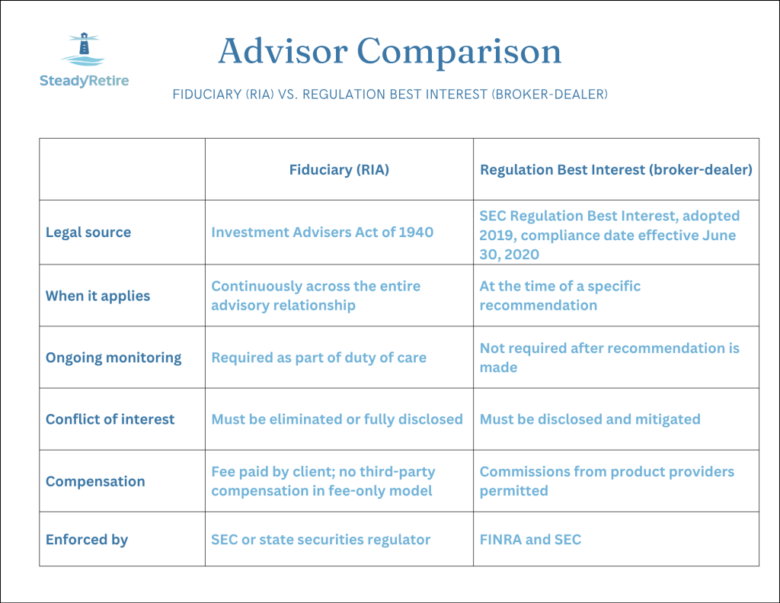
Fiduciary duty versus Regulation Best Interest
The fiduciary standard and the Regulation Best Interest standard are frequently confused, and some financial professionals deliberately use language that blurs the distinction. Understanding how they differ is the most direct protection against that confusion.
Why the timing of the obligation matters
The timing distinction matters most for ongoing account relationships. A broker-dealer under Regulation Best Interest must act in the client’s best interest when recommending a specific product or strategy. That obligation ends when the transaction is complete. A fiduciary’s obligation continues for as long as the advisory relationship exists.
An annuity recommended in 2021 that no longer serves the client’s interest in 2026 because interest rates, tax law, or the client’s circumstances have changed creates no ongoing obligation for a broker-dealer to revisit. A fiduciary advisor must monitor and flag that situation.
What Regulation Best Interest requires
Regulation Best Interest, which took effect June 30, 2020, is an upgrade from the prior suitability standard it replaced. It requires broker-dealers to act in the retail client’s best interest at the time of a recommendation, consider the costs and risks of what they recommend relative to alternatives, and disclose conflicts. It does not, however, require the broker-dealer to monitor the account after the recommendation or to restructure compensation so that no conflict exists. For a household with a long-term investment relationship rather than a one-time transaction, the fiduciary standard’s ongoing monitoring requirement is the more relevant distinction.
How to verify whether an advisor is a fiduciary
Any Registered Investment Advisor is required to file a Form ADV with the SEC. Part 2A, the Brochure, describes the firm’s services, compensation structure, conflicts of interest, and standard of conduct in plain English. The Form ADV is publicly searchable through the SEC’s IAPD database with no account or fee required.
Review the advisor’s Form CRS
Every SEC-registered firm, whether an RIA, a broker-dealer, or both, must provide clients with a Form CRS (Client Relationship Summary). This two-to-four-page document states explicitly whether the firm provides advisory services, brokerage services, or both, and describes the applicable standard of conduct for each. Requesting a Form CRS before opening any account is the most direct way to confirm in writing which legal standard governs the relationship.
Ask whether the advisor is always a fiduciary
Beyond the documents, it’s worth asking: Does the advisor act as a fiduciary 100 percent of the time across all interactions, or only at the moment of a specific recommendation? An advisor who holds dual registration as both an RIA and a broker-dealer may answer that question with ‘it depends on the transaction.’ That answer is worth understanding before proceeding, since it means the applicable standard can change from one interaction to the next. A fee-only RIA with no broker-dealer registration is in a position to answer yes without qualification.
What dual registration means in practice
Many financial professionals hold both an RIA registration and a broker-dealer registration simultaneously. In that arrangement, the applicable standard shifts depending on which role the advisor is filling at any given moment. When providing general financial planning advice, they may be acting as a fiduciary. When recommending a specific commissionable product, they may shift to their broker-dealer role and the Reg BI standard applies. That shift can be difficult to identify in real time, which is why reviewing the Form CRS and asking the question directly matters before the relationship begins, not after.
Go Further: What is elder financial abuse? Warning signs covers how violations of the duty of loyalty can shade into financial exploitation, and what documentation and reporting steps are available.
When fiduciary status is not enough
A fiduciary relationship defines the legal standard an advisor must meet, but it does not determine the quality of the advice given or the investment outcomes that result. An advisor can fulfill all their legal obligations under the fiduciary standard and still make investment decisions that underperform or, in hindsight, were not the most appropriate for a client’s situation.
When fiduciary advisors fall short
The SEC regularly brings enforcement actions against registered investment advisors for fiduciary violations. Common enforcement cases involve failure to disclose conflicts of interest, recommending proprietary products without disclosing the financial incentives involved, and front-running client trades for personal benefit.
In January 2026, the SEC charged two registered investment advisors for including misleading liability disclaimers in client agreements that implied clients waived non-waivable causes of action under federal or state law. These enforcement actions illustrate that the legal standard is only as protective as the willingness to enforce it and the client’s ability to recognize violations.
The verification step many clients skip
Many households that work with financial advisors have never confirmed in writing whether the advisor is acting as a fiduciary. For a household with $2,000,000 or more in investable assets, reviewing Form ADV and Form CRS before engaging an advisor is a direct, practical due diligence step.
How a financial advisor can help
A financial advisor adds specific value by explaining what the duty of care and duty of loyalty require in practice, how conflicts are identified and disclosed, and what questions confirm the standard is being applied in a specific advisory relationship.
Evaluating an existing advisory relationship
For households already working with a financial professional, a fee-only fiduciary can provide an independent assessment of whether the existing relationship is structured to serve the client’s interests. They can also assess whether the compensation structure, product recommendations, or disclosure practices raise questions worth examining. That second-opinion function is particularly valuable when the household’s financial situation has grown more complex than the original advisory relationship was designed to handle.
Selecting an advisory structure for complex finances
For households with $5,000,000 or more in investable assets, multi-generational estate planning considerations, business ownership, or concentrated stock positions, the fiduciary obligation extends beyond investment selection. It covers how assets are coordinated across accounts, how distributions are sequenced for tax efficiency, and how the overall financial structure is reviewed as tax law and personal circumstances evolve.
FAQs
Is every financial advisor a fiduciary?
No. Registered Investment Advisors are fiduciaries under the Investment Advisers Act of 1940. Broker-dealers operating under Regulation Best Interest are not fiduciaries in the legal sense; they must act in the client’s best interest at the time of a specific recommendation, but that obligation does not extend continuously across the relationship. Many financial professionals hold both registrations, and the applicable standard can shift from one interaction to the next depending on which capacity they are operating in.
Can a fiduciary still have conflicts of interest?
Yes. The fiduciary standard does not require the absence of conflicts of interest. It requires that they be eliminated or fully and fairly disclosed so that the client can provide informed consent. A fiduciary who receives revenue-sharing payments from a fund company must disclose that arrangement. A fiduciary affiliated with a firm that manufactures investment products must disclose that affiliation and how it may affect recommendations. The disclosure must be specific enough that a reasonable client can understand what the conflict is and how it affects the advice being given.
What is the difference between a fiduciary and a fee-only advisor?
The two concepts are related but not identical. A fiduciary is defined by legal obligation. A fee-only advisor is defined by compensation structure. Fee-only advisors receive compensation only from the client and accept no third-party payments tied to product recommendations. Most fee-only advisors registered as RIAs are also fiduciaries. However, an advisor can be a fiduciary while still receiving some forms of third-party compensation, provided those conflicts are fully disclosed. The combination of fee-only compensation and fiduciary status provides the highest structural alignment between advisor and client interests.
What should someone do if they believe a fiduciary has violated their duty?
The SEC and state securities regulators both accept complaints from investors who believe a registered investment advisor has violated their fiduciary duty. Investors can submit complaints through the SEC’s Tips, Complaints, and Referrals system. The IAPD database also allows investors to report concerns. In cases of significant financial harm, consulting a securities attorney before filing a complaint is advisable. An attorney can assess whether the facts support a private action or an arbitration claim in addition to a regulatory complaint.
How is the fiduciary standard different from Regulation Best Interest?
The fiduciary standard applies continuously across the entire advisory relationship and requires that conflicts be eliminated or fully disclosed. Regulation Best Interest applies at the moment of a specific recommendation and requires that the recommendation be in the client’s best interest at that time. Reg BI requires disclosure and mitigation of conflicts but permits them to exist. A broker-dealer who recommended an appropriate product in 2022 has no ongoing obligation to monitor that recommendation as circumstances change. A fiduciary advisor must monitor and revisit recommendations as the client’s situation evolves.
Glossary
Fiduciary: A person or entity legally required to act in the best interest of another in a relationship of trust and confidence. In financial services, the term refers specifically to Registered Investment Advisors who owe a duty of care and duty of loyalty to their clients under the Investment Advisers Act of 1940.
Duty of care: One of the two components of the fiduciary obligation under the Investment Advisers Act. Requires that an advisor provide advice genuinely suited to the client’s financial objectives, risk tolerance, time horizon, and circumstances, based on a reasonable investigation of the facts rather than on incomplete or outdated information.
Duty of loyalty: The second component of the fiduciary obligation. Requires that an advisor eliminate conflicts of interest or make full and fair disclosure of any conflicts that cannot be eliminated, so that the client can provide informed consent. Prohibits the advisor from placing their own financial interests above the client’s.
Regulation Best Interest (Reg BI): The SEC standard of conduct for broker-dealers serving retail clients, adopted in 2019 with a compliance date of June 30, 2020. Requires that recommendations be in the retail client’s best interest at the time they are made. Distinct from the fiduciary standard in that it applies to specific recommendation events rather than continuously across the advisory relationship.
Investment Advisers Act of 1940: The federal statute that established the registration and regulatory framework for investment advisors in the United States. The source of the fiduciary obligation for SEC-registered investment advisors. Enforced by the SEC, which conducts regular examinations of registered advisors for compliance.
Registered Investment Adviser (RIA): A firm or individual registered with the SEC or a state regulator to provide investment advice as a primary business activity. Held to the fiduciary standard across the entire client relationship. Distinct from broker-dealers, whose recommendations are governed by Regulation Best Interest.
Broker-dealer: A firm or individual that executes securities transactions on behalf of clients and may also recommend securities products. Subject to FINRA oversight and, when serving retail clients, the Regulation Best Interest standard. Does not carry a continuous fiduciary obligation across the advisory relationship.
Dual registration: The status of an advisor or firm that holds both an RIA registration and a broker-dealer registration simultaneously. The applicable standard of conduct shifts depending on whether the advisor is acting in an advisory or brokerage capacity at any given moment. Requires careful review of Form CRS and Form ADV to understand which standard governs any specific interaction.
Form ADV: The registration and disclosure document that Registered Investment Advisers must file with the SEC. Part 2A, the Brochure, describes the firm’s services, fees, conflicts of interest, and standard of conduct in plain English. Publicly accessible through the SEC’s IAPD database with no account or fee required.
Form CRS (Client Relationship Summary): A mandatory two-to-four-page disclosure document that every SEC-registered firm must provide to retail clients. States whether the firm provides advisory services, brokerage services, or both, and describes the applicable standard of conduct, compensation structure, and any reported conflicts of interest.
Conflict of interest: Any situation in which an advisor’s financial incentive to act in a certain way is not aligned with the client’s interest. Under the fiduciary standard, conflicts must be eliminated or fully disclosed. Common examples include revenue-sharing arrangements with fund companies, affiliated product manufacturers, and compensation tied to specific product recommendations.
IAPD (Investment Adviser Public Disclosure): The SEC’s free public database containing Form ADV filings, disciplinary history, and registration status for all registered investment advisors. Searchable by firm name, individual name, or CRD number with no account required.
Informed Consent: Informed consent in financial advising occurs when a client explicitly agrees to a recommended strategy, fee structure, or conflict of interest after receiving clear disclosure of all associated risks, costs, and alternatives. Under regulatory standards, financial professionals must provide these details in understandable terms so the client fully comprehends how a decision impacts their portfolio before granting permission. This ensures that choices are made voluntarily and with complete awareness of potential trade-offs.
Editor’s Note: The more common American spelling of advisors is used throughout, except for when spelled differently in a proper noun or website name.
Important Information
SteadyRetire is a retirement education platform offering practical financial resources and access to a financial advisor matching service. This article is intended for informational and illustrative purposes only and does not constitute financial, legal, tax, or investment advice. The information provided does not create a professional-client relationship and should not be used as a substitute for consultation with a qualified financial advisor, tax professional, or attorney. While we strive to provide accurate and up-to-date information, rules and regulations regarding retirement are subject to change. Always consult with a certified professional regarding your specific financial situation.
Related:
- Wealth management vs. financial planning: What’s the difference?
- How to use BrokerCheck to verify financial professionals
- 7 questions to ask a potential financial advisor before hiring
Ask us! What questions do you have about content, strategy, pop culture, lifestyle, wellness, history or more? We may use your question in an upcoming article!
Like MediaFeed’s content? Be sure to follow us.
This article originally appeared on SteadyRetire and was syndicated by MediaFeed.co.