

Key takeaways
- The election itself does not change retirement or tax law. Current rules, including changes already scheduled under existing law, continue to apply unless amended.
- Divided government is ahead. There are now Democratic majorities in both chambers when the new Congress takes office in January 2027, while Republican President Donald Trump remains in the White House.
- Several proposals are live. They cover Social Security revenue, accounts above $10 million, and plan access.
- A written plan helps put headlines in perspective. It can help you avoid hasty decisions.
What did the 2026 election change for retirement planning?
The election map has shifted, and it is natural to wonder what that does to your savings. Democrats now control the House and the Senate when the new Congress convenes in January 2027, while President Donald Trump, a Republican, remains in office.
Divided government can make major legislation harder to enact because it generally requires agreement across party lines. A bill must pass both chambers and receive presidential approval, become law without a signature under constitutional procedures, or overcome a veto with two-thirds of members voting in each chamber, provided a quorum is present. The current Congress remains in office until January and can still pass legislation before then. Here is where the main proposals stand.
Why is Social Security back in the spotlight?
Whichever party leads, Congress faces decisions about how to address Social Security’s projected funding shortfall and preserve full scheduled benefits. The 2026 Trustees Report projects that the Old-Age and Survivors Insurance trust fund’s reserves will run out in late 2032, when continuing program income would cover about 78% of scheduled benefits.
On a hypothetical combined basis, the legally separate retirement and disability trust funds would exhaust their reserves in 2034, with 83% of scheduled benefits payable.
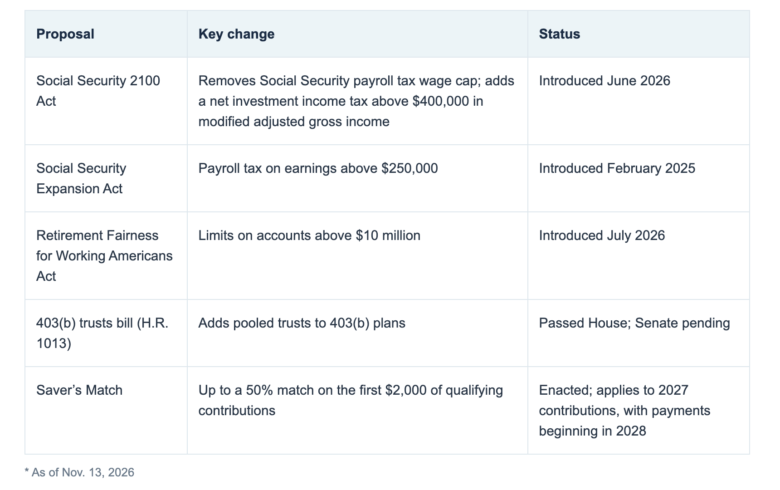
Two proposals backed by Democrats would raise revenue from higher earners while increasing benefits. The Social Security 2100 Act (H.R. 9519) would remove the Social Security payroll tax wage cap after 2026 and impose an additional tax on net investment income for taxpayers with modified adjusted gross income above $400,000. The Social Security Expansion Act (S. 770) would apply payroll tax to earnings above $250,000.
Lifting the cap draws bipartisan interest, as Senators Bernie Moreno, a Republican, and Elizabeth Warren, a Democrat, said in June that they are working on joint legislation. Still, most contested legislation faces a 60-vote threshold to end debate in the Senate. Any proposal must clear both chambers and complete the constitutional process to become law.
Could tax rules for retirement accounts change?
The election itself does not change 401(k) contribution rules, Roth conversion rules, capital gains treatment, or required minimum distributions (RMDs). Changes already scheduled under current law, including applicable inflation adjustments, still apply.
Could accounts above $10 million face new rules?
Senator Ron Wyden and Representative Richard Neal, the senior Democrats on the Senate Finance Committee and the House tax-writing committee, introduced the Retirement Fairness for Working Americans Act. The proposal would restrict new traditional and Roth IRA contributions when prior-year combined IRA and vested defined-contribution plan balances exceed $10 million, and would require affected account holders to take additional distributions.
The sponsors say it leaves rules unchanged for most savers. A separate Neal proposal from 2021 would also have restricted Roth conversions for high-income taxpayers.
Which temporary tax provisions already have end dates?
The additional deduction of up to $6,000 per eligible person age 65 or older applies for tax years 2025 through 2028. It begins phasing out above $75,000 of modified adjusted gross income, or $150,000 for joint filers. A married couple can qualify for up to $12,000 if both spouses are eligible.
The general state and local tax (SALT) deduction cap rose to $40,000 in 2025 and $40,400 in 2026, and is scheduled to return to $10,000 in 2030. These limits are halved for married taxpayers filing separately, and income-based reductions can apply.
Which proposals could expand retirement plan access?
Plan access has drawn votes from both parties.
403(b) investment options: The Retirement Fairness for Charities and Educational Institutions Act (H.R. 1013), led by Republican Representative Frank Lucas, passed the House 295–128 on November 11, 2026. If passed by the Senate and signed into law by President Donald Trump, it would allow 403(b) plans to invest in collective investment trusts and insurance-company separate accounts, options already available through 401(k) plans.
Saver’s Match: Eligible lower- and moderate-income savers can qualify for a federal match of up to 50% on the first $2,000 of qualifying contributions made for tax year 2027, a maximum of $1,000. Match payments begin in 2028.
Automatic IRAs and caregivers: Representative Neal reintroduced an Automatic IRA Act in December 2025 that would cover many employees and independent contractors. Separate bipartisan proposals would ease Roth IRA contribution restrictions for qualifying caregivers and allow qualifying caregivers returning to work to make enhanced workplace-plan catch-up contributions regardless of age for a limited period.
Where do the retirement proposals stand?*
Want a plan that can adapt to changing rules? A free first consultation can help you review your retirement priorities while proposals are still being debated.
How can retirement savers respond to political uncertainty?
Election anxiety tempts people to move to cash, pause contributions, or claim Social Security early. A former director of the SEC’s Office of Investor Education and Assistance has urged people to avoid rash decisions in volatile markets. Claiming at 62 generally means a permanently lower monthly retirement benefit than waiting until full retirement age.
For someone born in 1960 or later, claiming their own retirement benefit at 62 pays 70% of their full retirement age benefit.
Some major retirement changes have been phased in over time. For example, the full retirement age increased in two-month steps for people born from 1955 through 1960, reaching 67 for those born in 1960 or later. Focus on what you control, including asset allocation, emergency reserves, and tax diversification across pre-tax, Roth, and taxable accounts.
How a financial advisor can help
A financial advisor can separate proposed bills from enacted law, so you do not rebuild a decades-long strategy around a bill that may never pass. An advisor can also stress-test your plan against scenarios such as adjusted Social Security benefits in the 2030s or shifting tax brackets, and can build tax diversification across Traditional, Roth, and taxable accounts.
Explore SteadyRetire’s Find a Financial Advisor tool or read Understanding the different types of advisors: Which is right for you to connect with an advisor who can stress-test your plan.
FAQs
Does the election change my retirement account rules right away?
No. The election itself does not change 401(k) contribution rules, Roth conversion rules, or required minimum distributions. Current law continues to apply, including inflation adjustments and other changes already scheduled. A proposal does not change your account’s tax treatment simply because lawmakers introduce it or one chamber passes it.
Will Social Security stop paying benefits if its trust fund reserves run out?
No. Exhausting trust fund reserves is not the same as losing all program income. The 2026 Trustees Report projects that the Old-Age and Survivors Insurance trust fund will exhaust its reserves in late 2032, when continuing income would cover about 78% of scheduled retirement and survivor benefits. That would represent a significant funding shortfall, not the end of Social Security payments. Congress could change the program’s financing or benefits before then.
Would the proposal targeting retirement balances above $10 million affect all savers?
No. The Retirement Fairness for Working Americans Act targets very large combined retirement balances. It would restrict new IRA contributions when prior-year combined IRA and vested defined-contribution plan balances exceed $10 million and require affected account holders to take additional distributions. It remains a proposal, not a current requirement.
When does Saver’s Match begin, and how much could I receive?
Saver’s Match applies to qualifying contributions made for tax year 2027, with federal match payments beginning in 2028. Eligible savers may qualify for a match of up to 50% on the first $2,000 contributed, for a maximum of $1,000. The amount depends on income and other eligibility requirements; not every saver will receive the maximum.
Sources
- 401(k) Specialist, Neal’s “Automatic IRA Act” Is Back
- CNBC, Retirement savings for caregivers a focus of new bipartisan bills in Congress
- CNBC, The SALT deduction limit is $40,400 for 2026
- CNBC, Why some Washington lawmakers want to tax high earners
- Congress.gov, H.R. 9519, Social Security 2100 Act
- Congress.gov, S. 770, Social Security Expansion Act
- Investor.gov, Don’t Panic, Plan It!
- IRS, Check your eligibility for the new enhanced deduction for seniors
- IRS, Treasury, IRS begin implementing Executive Order 14403 (Saver’s Match)
- IRS, Topic no. 503, Deductible taxes
- NBC News, 2026 House Results
- NBC News, 2026 Senate Results
- PSCA, New Bill Would Require Withdrawals from Mega-IRAs
- Senate Finance Committee, Wyden, Neal Introduce Bill to Crack Down on Mega Retirement Account
- SSA, Benefits Planner: Retirement (born in 1960 or later)
- SSA, Retirement Benefits
- SSA, 2026 OASDI Trustees Report
- U.S. House Committee on Financial Services, House Passes Financial Services Committee’s Bipartisan Retirement Fairness Bill
Important information
SteadyRetire is a provider of educational content and information. This article is intended for informational and illustrative purposes only and does not constitute financial, legal, tax, or investment advice. The information provided does not create a professional-client relationship and should not be used as a substitute for consultation with a qualified financial advisor, tax professional, or attorney.
While we strive to provide accurate and up-to-date information, rules and regulations regarding retirement are subject to change. Always consult with a certified professional regarding your specific financial situation.
Ask us! What questions do you have about content, strategy, pop culture, lifestyle, wellness, history or more? We may use your question in an upcoming article!
Like MediaFeed’s content? Be sure to follow us.
This article originally appeared on SteadyRetire and was syndicated by MediaFeed.co.