After a quarter century that brought us a crisis in journalism, there are lessons learned by local journalists about serving their communities.
NEW YORK — Crossing the Brooklyn Bridge yesterday, the skyline of lower Manhattan emerged in the rearview mirror, and it seemed the perfect view to look back on last week’s remembrance of 9-11.
With all the public discussion and the stages set here and in Washington for the 25th anniversary, America was pondering the void where the Twin Towers once stood in a new and deeper way.
This year, there seemed to be a particularly poignant and shared recognition that the solidarity we felt as a country back then, when we stood together to confront a mortal enemy, has vanished into the void. That loss of unity in America felt uniquely stark on this anniversary. What made it worse was knowing that it was not foreign terrorists who had taken that away, but our own collective failing to bridge sharp political divisions. Going forward, we are going to have to find a bridge to cross over our differences, to be in dialogue and to work together again.
Fully one-third of Americans today were not alive when the World Trade Center attacks occurred, and so there is a need to keep the importance of those events alive for a new generation.
On September 10th and 11th this year, I saw firsthand just how many people were answering a call to serve. As I wrote last week, Boston is both my hometown and the place from which two of those doomed planes departed. I decided to work along with thousands of volunteers in the hope of transforming the anniversary into a day of doing good. More than 50,000 volunteers across 50 major U.S. cities came together to pack more than 20 million meals through the nonprofit 9-11 Day of Service.
Inside the New Balance TRACK in Brighton, MA, there were more than two dozen 10-foot tables where over a thousand volunteers were packing a breakfast of oatmeal and apples. More than 400,000 of those meals were delivered to food pantries across Massachusetts, serving a growing community of families who are food insecure — due in no small measure to federal budget cuts.
Join the GroundTruth Community.
We journalists often think of our work as public service, but we don’t always roll up our sleeves and do this sort of hands-on volunteerism. But even through just one four-hour shift packing food for families, it was easy to see the practical benefits of service to others.
One of them is working together as a community.
It’s a simple truth that my neighbor and friend Kenneth Feinberg knows very well.
On this anniversary, Feinberg was at Ground Zero and for the last 25 years, he’s been at the center of the effort to take care of the families and loved ones of the 2,977 victims who were killed. As the special master of the U.S. government’s Sept. 11 Victim Compensation Fund (VCF), he is a globally respected attorney who has long been called upon by U.S. presidents, families, and survivors to navigate payouts following mass tragedies. In doing that work, he served families for 33 months pro bono. It was mid-November 2001 when Congress voted unanimously to establish the fund to compensate the thousands of people who lost a loved one or suffered a physical injury. Feinberg distributed more than $7 billion to victims’ families.
Last week, Feinberg launched a new edition of his book, “What is Life Worth?” This edition includes a commemoration of the 25th anniversary of 9-11 and a foreword that reflects on how America understands the tragedy today.
“I want to remind our country and keep reminding them, so we never forget the outpouring of support for the victims and the sincere bipartisan spirit that brought everyone together. We all knew it required all Americans to circle the wagons and protect each other and help each other. Back then was a divided time too, but there was at least civility and dialogue,” Feinberg told me.
“Today, it can feel like we live in an altogether different place. I doubt very much in this world today that is so polarized that we could forge that unity, and on this anniversary, I hope we will all reflect on that and think about how we find our way back to working together as a country,” he added.
Feinberg applauded the day of service and all the volunteers he has seen through the years who have sought to help with the response to 9-11, from first responders at 9-11 to those who were packing up meals last week to alleviate food insecurity.
“The truth is every individual can make a difference, and service is the way to honor those who died on 9-11… There are communities like this all over America who are quietly working together, and there are lots of different forms of service.”
Those words reminded me of a form of service close to my heart: the public service of journalism — the kind that is community based and community supported.
It is worth remembering that there are lots of dedicated and decent souls who seek to serve their communities by telling the stories important to those communities, or by pushing forward to the frontlines where stories are unfolding.
And these acts of service are occurring at a time of crisis in journalism.
Last week, I touched on the public service offered by colleagues who risked a great deal to serve as journalists overseas, telling the story of the fires of the Middle East and Central Asia that fueled the kind of apocalyptic terrorism we saw on 9-11. I also referenced some journalists who are still out there reporting on the ground to help us make sense of this complex corner of the world that is roiling anew with conflict. But I also want to reflect on the public service of local journalists, who are serving their communities in ways that are just as important — indeed, perhaps more important than the distant posts of foreign correspondents.
These local heroes work every day in local communities across the country, and they are on the front lines of the new struggle we face as a nation that is dangerously divided. When they are doing their jobs right, local reporting is a kind of “binding agent,” as I have often described it, for local communities who can come together around a shared set of facts — and around the local stories of the heroes who should be applauded and sometimes the officials who need to be held accountable. Amid the crisis in local news, it is more important than ever to keep remembering that the work of local journalists has the power to pull us back together.
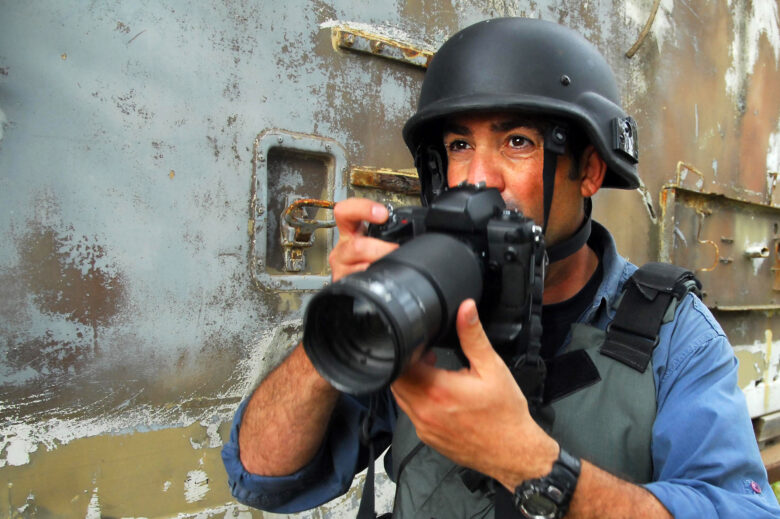
Every day at Report for America, local journalists are being supported to serve their local communities. This movement is gaining momentum, thanks to the hard work and dedication of the leadership and the staff there who are bringing it forward long after I stepped aside from my role as a co-founder.
I still keep in touch with some of the Report for America corps members and I am in awe of their commitment to the public service component of the initiative, which was at the core of what my co-founder Steve Waldman hoped to achieve when it launched nearly 10 years ago.
The idea was to have the reporters actually roll up their sleeves and do service. This typically meant working with students on their high school newspapers or helping with programs that offer media literacy to the areas where they serve.
There are so many great examples of those corps members who have done memorable public service work in their community. One who stands out among them is Amelia Ferrell Knisely.
Amelia first joined RFA in June 2019, covering poverty in West Virginia for the Charleston Gazette-Mail. She arrived as a mother with a baby in tow and also a profound commitment to return to her home in the Mountain State. In a series of essays GroundTruth used to publish called “On The Ground,” Amelia wrote in February 2020 about the rural poverty that was deeply rooted in her corner of Appalachia:
“Think black and white images of Lyndon B. Johnson’s ‘War on Poverty’ — and today, West Virginia remains one of the poorest states in the country, where 1 in 5 children struggle to access food. The history and policy failures here — our vulnerable children, cyclically disadvantaged — are particularly complex in a place where despair is often found lingering in the damp air between its rolling hills, in people who can’t ‘just pick up and leave,’ as outsiders advise, or who simply object to doing so.”
I caught up with her this week in a phone call to talk about what the service component means in local journalism.
Despite being offered jobs at larger news organizations in bigger cities, including Nashville, Amelia has stayed on in Charleston.
“What drives me is: I am from here. I am choosing to raise my family here,” she said, sharing a snapshot of her growing family as she and her husband now have three young girls they are raising.
Not far from where she came of age, she has navigated several different local newsrooms and the challenges facing local news. While working at West Virginia Public Media, she saw the ups and downs in an era of budget cuts and intense pressure on the business model for community coverage.
But she persevered and landed at West Virginia Watch, which is part of States Newsroom, the nation’s largest state-focused, non-profit newsroom with reporting from every capital in the country. She is a watchdog reporter on poverty, social services and child welfare in West Virginia and has proven to be a fierce advocate for her community, particularly for vulnerable children who are caught in the gears of a grinding machinery that seeks — and too often fails — to serve them.
“I am driven by the families who I report for, by advocating for them. Reporting through that lens is what motivates me,” she said.
While local journalism often proves its value in deep investigations that lay bare corruption in the county sheriff’s office or miscarriages of justice in a state’s courtrooms, the public service meaning of journalism can often seem abstract. It’s often hard to quantify the value and translate it into metrics to share with donors who could help fund the reporting.
When asked about impact and if she ever loses her passion, she replied:
“You have to be patient. It’s about showing up every day. And part of being a reporter who shows up is reminding state officials you are there watching them. I struggle sometimes with the burden of the need to document impact, but the truth is if a child feels heard, that is what I would call impact.”
The week after the 25th anniversary of those attacks on September 11th, she has been reflecting on what service her reporting can offer on a local level.
She was only 13 on that day in 2001, but she vividly remembers that, while watching the attacks on television, she wanted to contribute to the body of journalism that recorded history that day and the many drafts of history since.
Whether it is in Afghanistan or Appalachia, as she put it, “This work takes bravery; it takes a commitment to resisting intense pressure from public officials, and it comes with an amazing camaraderie in the field with other reporters who still understand how important this work is.”
If you haven’t yet taken our GroundTruth Survey, we would love to hear from you!
Ask us! What questions do you have about content, strategy, pop culture, lifestyle, wellness, history or more? We may use your question in an upcoming article!
Like MediaFeed’s content? Be sure to follow us.
This article originally appeared on GroundTruth and was syndicated by MediaFeed.co.