
Subjective vs. objective measurement in autism care: Why the field is shifting
Autism assessment has always relied on two trusted sources: what a trained clinician observes and what a caregiver reports. Both are rigorous, both are clinically valuable, and both are subjective by design — they depend on a human observer or respondent. The shift now underway in the field isn’t away from clinical judgment. It’s the addition of a third source: objective, biomarker-based measurement that doesn’t depend on who’s doing the looking.
This is a category explainer for clinicians weighing where objective data fits. The short version: subjective and objective methods answer different questions, and the strongest assessments increasingly use both.
Two Paradigms, Defined
Start with the words, because the distinction is precise and often blurred in conversation.
Subjective measurement depends on a human judgment. That can be a clinician administering a structured observation and scoring what they see, or a caregiver answering questions about what their child does at home. The data is filtered through a person — their training, their attention, their memory, their interpretation. This is the foundation of autism assessment, and it works: expert clinical judgment, supported by standardized instruments, remains the standard of care.
Objective measurement is produced by an instrument and does not depend on who administers it. The classic examples in medicine are a lab value or an imaging result — the number is the number regardless of which technician ran the test. In autism care, the emerging objective measure is social visual engagement: where and how long a child looks during structured video scenes, captured by eye-tracking sensors many times per second.
Neither paradigm is “better.” They measure different things in different ways. Understanding the trade-offs is what lets you use each one well.
What Subjective Methods Do Well — and Where They Reach Their Limits
Observation-based and report-based tools are the standard of care for good reasons. A skilled clinician integrates dozens of signals at once — eye contact, joint attention, language, play, the texture of an interaction — into a clinical picture no single number captures. Caregiver-report instruments add something a clinic visit can’t: how a child functions across many days and settings, reported by the person who knows them best. These are not weaknesses to be fixed. They are the strengths of the method.
They also carry well-documented limits, and naming them isn’t a criticism — it’s the nature of any method that runs through a human.
Observation depends on the observer. Structured observation tools show excellent reliability under optimal conditions with highly trained, research-reliable examiners. In everyday clinical settings, agreement is lower. One multi-site analysis of the most widely used observation instrument found percent agreement for diagnostic classification ranging from 64% to 82%, with kappa values from .19 to .55, and noted that objectivity was lowest for borderline and non-spectrum presentations. The instrument is sound; the variability comes from the human applying it, which is why continuous rater training matters.
Report depends on recall. Caregiver-report measures ask a parent to reconstruct behavior from memory across time. Research on parental recall in autism documents effects like forward telescoping — reporting events as more recent than they were — and shows that recall accuracy varies with the child’s age, the developmental domain, and the parent’s awareness of an eventual diagnosis. Retrospective reports can be accurate, but their consistency is conditional and should be used with care.
There’s no confirmatory biological test. Autism remains a clinical diagnosis. There is no blood test or routine scan that confirms or rules it out, and its diagnostic features overlap with other neurodevelopmental and communication conditions. That places the full weight of the assessment on subjective judgment.
None of this argues for abandoning subjective tools. It argues for adding a second, independent stream that doesn’t share those particular limits.
What Objective Measurement Adds
Objective measurement doesn’t try to replicate what a clinician does. It captures something a person can’t observe directly and quantifies it the same way every time.
The evidence base is substantial. The technology reflects more than 20 years of research at Yale University and the Marcus Autism Center at Emory University, led by founders Ami Klin, PhD, and Warren Jones, PhD. In two large prospective, double-blind studies published in JAMA and JAMA Network Open in 2023, covering 1,089 children, the EarliPoint Severity Indices predicted 74.1% of the variance in social disability, 88.8% of verbal ability, and 77.9% of nonverbal cognitive ability against gold-standard reference measures. Its diagnostic classifier proxied expert clinician diagnosis with 81.9% sensitivity and 89.9% specificity in the discovery study and 80.6% and 82.3% in replication.
Subjective vs. Objective Measurement at a Glance
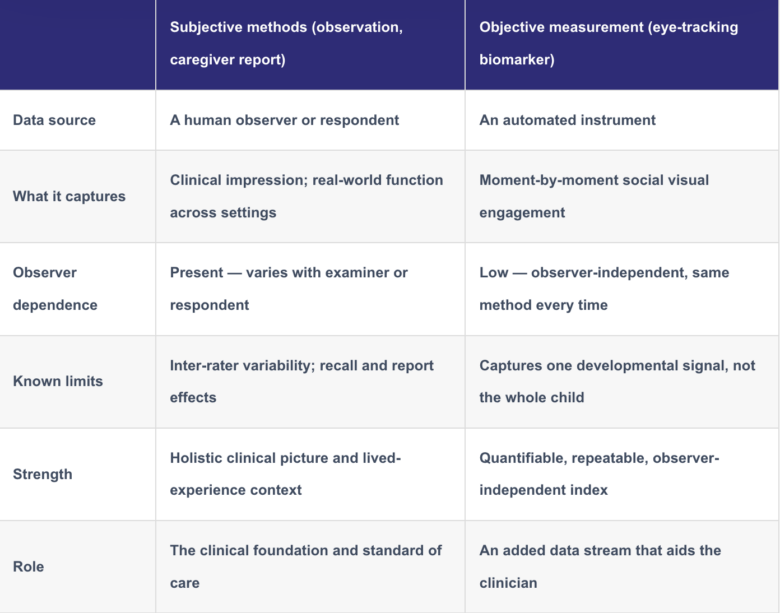
Read across the bottom row: these are not competitors. One provides the clinical picture, the other adds a measurement that doesn’t move when the observer changes. The point of an objective layer is to give clinicians more to work with — not to take the judgment out of their hands.
Why the Field Is Adding Objective Data Now
Three pressures are converging.
First, the limits above are now well characterized in the literature, so the field can name exactly what an objective stream addresses — observer variability in the clinic and recall effects in report — rather than treating subjectivity as an abstract concern.
Second, the tools have matured. Objective social-visual-engagement measurement is no longer a research concept. It’s FDA-cleared, published in JAMA, and in clinical use, which clears the credibility bar that earlier objective approaches couldn’t.
Third, the work increasingly extends beyond a one-time diagnosis into progress monitoring over years of treatment. Tracking change is exactly where an observer-independent measure earns its place: when you re-measure the same child every six months, you want as much of the difference as possible to be real development rather than variation in who reported it. That’s a structural advantage of objective data, and it’s a large part of why clinicians are adding it alongside the subjective tools they already trust.
What This Means in Practice
You don’t replace anything. You add a stream.
Keep expert observation and caregiver report for what they do best — the clinical picture and the real-world, lived-experience context no instrument captures. Add an objective developmental measure for children in the cleared age range, at intake and on a periodic cadence, so you have a quantifiable index that travels consistently across time and across clinicians. When two independent streams point the same direction, the case is stronger and harder to question than either one alone.
That’s the shift. Not subjective or objective — subjective and objective, each doing the job it’s built for.
Frequently Asked Questions
Is autism diagnosis subjective or objective?
Autism diagnosis is primarily a clinical judgment built on expert observation and developmental history, which makes it subjective by design. There is no single biological test that confirms autism in routine practice. Objective, biomarker-based measures such as FDA-cleared eye-tracking are now being added alongside clinical judgment to provide an observer-independent data stream — they aid clinicians, they don’t replace them.
What is the difference between subjective and objective measurement in autism care?
Subjective measurement depends on a human observer or respondent — a clinician scoring behavior or a caregiver reporting on a child. Objective measurement is produced by an instrument and doesn’t depend on who administers it. In autism care, observation tools and rating scales are subjective by method; eye-tracking that quantifies a child’s social visual engagement is objective.
Why is the field adding objective measurement now?
Subjective tools are valuable but carry known reliability limits — inter-rater variability in observation and recall effects in caregiver report. An objective, observer-independent stream addresses those specific limits and supports more consistent measurement over time, especially for progress monitoring.
Related:
- ABA reauthorization documentation for autism: How objective measurement strengthens medical necessity
- Your guide to the Verbal Behavior Milestones Assessment and Placement Program for autism
Ask us! What questions do you have about content, strategy, pop culture, lifestyle, wellness, history or more? We may use your question in an upcoming article!
Like MediaFeed’s content? Be sure to follow us.
This article originally appeared on EarliPoint Health and was syndicated by MediaFeed.co.