

Key takeaways
- Tax credits can lower business owners’ tax liability, meaning they lower the final amount owed to the government.
- Currently, 37 states have research and development incentive programs to help business owners find and use these credits, alongside the federally owned Section 41 credits.
- Updated federal legislation enables companies to deduct domestic research expenditures immediately instead of amortizing them across five years.
- Many jurisdictions offer additional credits for expanding payrolls or purchasing capital assets, with select options providing cash payouts or transfer rights.

How can small businesses find state tax credits?
Many business owners miss valid state-level tax incentives because standard tax preparation focuses strictly on annual compliance rather than proactive strategy. Use this five-step audit, discussed in greater detail later, to uncover and claim high-value savings:
- Map operating footprints and economic nexus: Identify all states with employees, physical assets, or remote sales to pinpoint tax obligations and regional credit opportunities.
- Match operations to research and capital credits: Compare payroll, R&D activities, and equipment purchases against state incentives, including R&D, payroll expansion, and capital investment credits.
- Calculate annual Pass-Through Entity Tax (PTET) elections: Evaluate state-level PTET elections annually to convert state income taxes into fully deductible business expenses that bypass individual SALT caps.
- Audit credit structures for refunds or transfer rights: Determine if earned credits offer direct cash refunds when tax liability equals zero or allow transfer rights to sell unused incentives to third parties.
- File amended returns and track carryforward windows: Recover missed credits from open tax years (typically three to four past periods) on amended returns and log multi-year carryforward limits for future savings.
Thinking about taxes in retirement? Explore professionals who can help you evaluate withdrawals, conversions and required distributions.

Why do state tax incentives vary by location?
Every business across the United States files a federal return using standard Internal Revenue Code guidelines, such as standard Section 179 limits, bonus depreciation schedules, and Section 41 research calculations. State tax codes operate independently and present structural differences across regions.
State governments create unique codes, determine local tax rates, and decide which federal updates to accept. A business owner operating in Texas faces no general state income tax on corporate earnings. If that same owner operates in California, net profits face corporate tax rates up to 8.84% or pass-through individual rates reaching 13.3%.

Why are credits more valuable than deductions?
Simple deductions can lower a business owner’s total taxable income. In contrast, a tax credit can lower that same tax bill on a dollar-for-dollar basis. To see why that difference matters practically, take the following example:
Go Further: Check out our guide to small business owner-friendly retirement options.
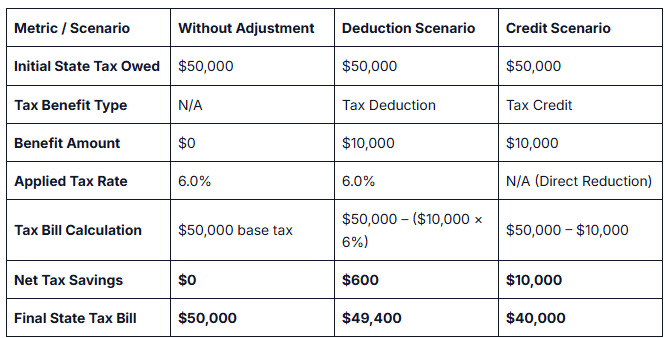
Which state tax credits matter most for small businesses?
State tax credits can help directly lower a business owner’s tax liability. Because of this, they provide a structural benefit over deductions, which only lower taxable revenue. There are a three basic state tax credit categories for small businesses:
- Research & development
- Workforce expansion
- Capital investments

1. How do state R&D credits work?
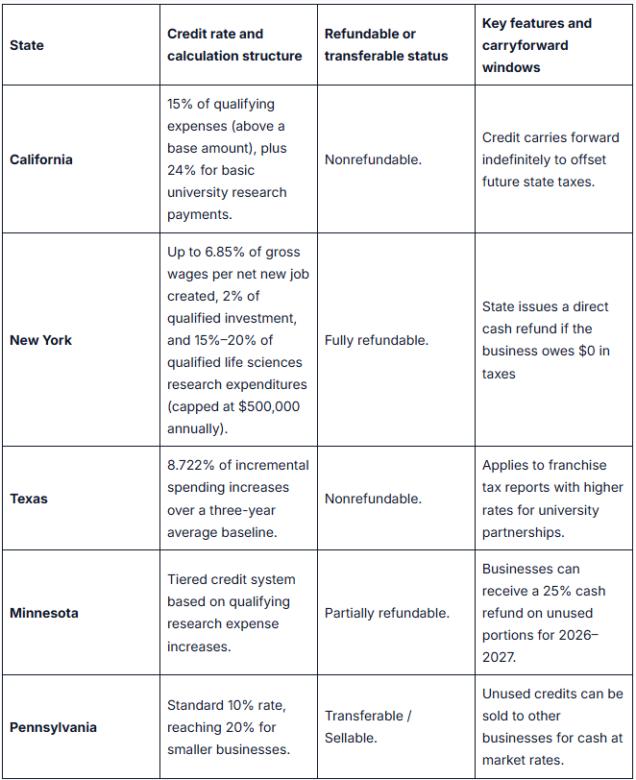
37 states offer regional research and development credits that build on federal Section 41 credits using identical expense records. State credit rates vary from 5% to 27% of qualified research expenditures.
Take a look at the chart below to see a list of some of these credits by state. It also breaks down whether they:
- Are a refundable tax credit: Offers a dollar-for-dollar reduction of tax liability that allows taxpayers to receive the remaining amount as a cash refund if the credit exceeds the total tax owed.
- Are a transferable tax credit: Can be sold or transferred to an unrelated third party for cash, allowing tax benefits to be monetized even if the seller lacks sufficient tax liability to use them directly.
- Have a carryforward window: A designated period of time during which unused tax benefits, such as capital losses or credits, can be applied to future tax years to offset taxable income or liability.
What are baseline calculation rules?
Calculating credits based on qualified research expenses above a “base amount” means the credit applies only to spending that exceeds a calculated historical benchmark. A company spending $2,000,000 on research with a $1,200,000 “base amount” earns a credit on the $800,000 difference. Under California rules, a 15% rate on that $800,000 increase generates a $120,000 tax credit.
In Texas, the credit calculation compares current spending against the average of the prior three years. A business increasing its research budget relative to its recent average receives a credit on that new expenditure spike.

How did Section 174A change research expense deductions?
The One Big Beautiful Bill Act established Section 174A, restoring immediate expensing for domestic research costs starting in tax year 2025 at the federal level. This update ended the previous requirement to amortize domestic research costs over five years. Note that foreign research expenses are not eligible for immediate expensing under Section 174A and must still be capitalized and amortized over 15 years.
If a business spends $1,000,000 on qualifying domestic research in 2026, it can deduct the full $1,000,000 against income that year. States do not automatically adopt federal rules. For instance, California updated its tax conformity date to align with federal standards, but business owners should verify local rules with an advisor before calculating combined savings.

2. Which hiring credits and workforce incentives are available?
State programs frequently offer credits for adding jobs, hiring from targeted groups, or building facilities in specific economic zones. These incentives historically stacked alongside the federal Work Opportunity Tax Credit. The federal program expired on December 31, 2025, and remains in legislative hiatus throughout 2026.
While WOTC is in hiatus, employers must still file IRS Form 8850 within 28 days of hiring to preserve their rights for retroactive credits upon reauthorization. The IRS provides information regarding current federal reauthorization updates.
Comparing different states’ hiring credits
- New York: The Excelsior Jobs Program provides fully refundable credits up to 6.85% of qualifying wages for net new job creation in designated growth sectors.
- Georgia: The Job Tax Credit provides up to $4,000 annually per new job created in qualifying counties, with higher benefits in rural areas.
- Tennessee: The Job Tax Credit grants up to $4,500 per new full-time employee above baseline thresholds, with bonus credits for rural investments.
- North Carolina: The William S. Lee Quality Jobs Act offers structured credits for businesses expanding employment within economic development zones.
- Additional states: Other states offer their own hiring credits, usually available through the state’s Department of Revenue or State Workforce Agency websites.

3. How do capital investment credits work?
Capital investment credits encourage purchases of equipment, operational machinery, or real estate facilities. Georgia offers an Investment Tax Credit for manufacturing and telecommunications expansions, while Louisiana maintains the Digital Media Tax Credit for technology infrastructure investments.
These credits cover a percentage of the total purchase price rather than the entire equipment expense. An enterprise spending $2,000,000 on industrial machinery under a 10% state credit generates $200,000 in credit value. That $200,000 credit then offsets $200,000 of state tax liability directly.
Go Further: What is a fiduciary? Why the legal standard matters covers the legal standard that governs advisors who help business owners coordinate tax strategy across federal and state systems, including how to verify their credentials and regulatory registration.

How can pass-through entity taxes reduce federal taxable income?
The federal deduction for state and local taxes (SALT) on individual tax returns is temporarily expanded from $10,000 to $40,000 through the 2029 tax year. This individual itemized deduction applies to personal state income and property taxes, but phases out for taxpayers with an adjusted gross income of $500,000 or more (dropping back to $10,000 for incomes reaching $600,000).
Corporate-level tax deductions remain unaffected by these individual limits. Meanwhile, pass-through businesses (such as LLCs, partnerships, or S-Corporations) often utilize Pass-Through Entity Tax (PTET) elections, a simple choice to pay state income tax at the business level instead of the personal level. This converts state tax payments into fully deductible corporate expenses, bypassing individual SALT caps entirely.
What is a pass-through entity tax election?
More than 35 states permit pass-through entities to pay state income taxes at the business level rather than passing liability to individual owner returns. Bypassing personal Schedule A deduction caps lets high-earning business owners classify state tax payments as standard business operating expenses.
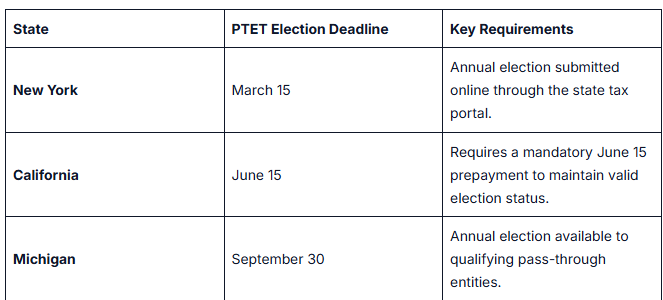
How does a PTET election work?
A qualifying partnership, S-corporation, or LLC makes a formal election with state authorities. The business pays state tax directly, deducting that payment from federal income calculations. Owners report reduced net earnings on Form K-1 while receiving a state tax credit offsetting individual state tax obligations.
Owners earning $2,000,000 in annual pass-through profit often find that entity-level elections lower federal liability far more than personal itemized deductions. This strategy avoids deduction phase-outs that affect individual high earners.
Go Further: 9 states with no state income tax for retirees covers how state income tax structures affect retirement income, which is directly relevant to business owners planning the transition from business income to retirement distributions.

What state tax differences should small business owners model?
State business tax requirements fall into three primary categories that function independently across jurisdictions.
1. How do corporate and pass-through income taxes differ by state?
Nine states impose no individual income tax on pass-through earnings, which are business profits that flow directly onto owners’ personal tax returns:
- Alaska
- Florida
- Nevada
- New Hampshire
- South Dakota
- Tennessee
- Texas
- Washington
- Wyoming
Washington does not tax personal income, but it imposes a Business and Occupation tax on gross revenue regardless of profit margins. The service sector tax rates are structured as follows:
- 1.5% on gross revenue under $1,000,000
- 1.75% on gross revenue between $1,000,000 and $5,000,000
- 2.1% on gross revenue exceeding $5,000,000
A service company generating $4,000,000 in gross revenue with $500,000 in actual net profit owes $70,000 in Business and Occupation tax. Gross receipts taxes apply even during unprofitable operating years.
Practical implications
Operating in an income-tax-free state creates immediate cash flow savings for owners, but gross receipts models change financial risk dramatically. Because taxes like Washington’s B&O are assessed on top-line revenue rather than net income, low-margin or temporarily unprofitable businesses must pay tax regardless of losses. Multi-state business owners must carefully model cash flow based on gross revenue versus net profit depending on where they operate.

2. How do franchise taxes work?
A franchise tax is a state-level tax or fee levied on businesses for the right to form, register, or conduct business within that state’s jurisdiction. Unlike income taxes based on net profit, a franchise tax is charged regardless of whether the business turns a profit or operates at a loss.
States use various tax bases to calculate these fees:
- Revenue-based structures: Tax payments are calculated from a business’s total gross sales or receipts generated within that specific state, rather than net profits (e.g., Texas and Washington).
- Capital and equity-based structures: Tax payments are calculated from the overall economic size or capital value of the business, such as its total net worth, total assets, or invested capital (e.g., Louisiana and Georgia).
- Share-count structures: Tax payments are calculated using the total number of authorized corporate stock shares (the maximum number of shares the company is legally allowed to issue, as stated in its charter), regardless of how many shares are currently sold or circulating (e.g., Delaware).
Practical implications
Franchise taxes function as an overhead cost for maintaining corporate status, irrespective of business profitability or operational activity. Companies holding high share counts or large asset bases in states like Delaware or Texas can face thousands of dollars in mandatory annual fees. Businesses must audit entity structures and authorized shares regularly to avoid unnecessary, non-revenue-based tax overhead.

3. How does economic nexus create sales tax obligations?
Sales tax is a consumption tax levied by state or local governments on the sale of goods and services. In contrast, economic nexus is a legal standard that requires out-of-state businesses to collect and remit that tax based on their economic activity within a jurisdiction.
Under the Supreme Court ruling in South Dakota v. Wayfair, states can enforce sales tax collection on remote sellers once those sellers cross specific state-defined thresholds for annual sales revenue or transaction volume.
In most states, those limits are triggered at $100,000 in remote sales or 200 annual transactions. However, local sales taxes may also apply, such as in the case for out-of-state businesses selling to California, Tennessee, and Washington customers.
Practical implications
Crossing an economic nexus threshold instantly introduces major administrative burdens and compliance software costs. Sellers must track multi-state sales volumes in real time, register with state revenue departments, and integrate automated sales tax collection tools into online checkout systems. Failing to monitor these limits creates severe liability for back taxes, interest, and penalties if an audit reveals unregistered remote sales.
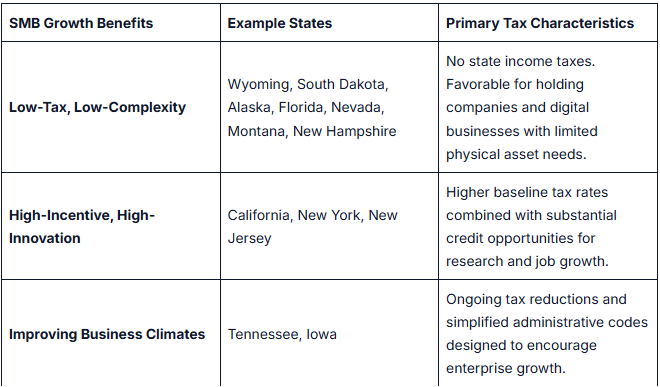
Which states offer different business tax advantages?
How can small businesses audit for unclaimed state tax savings?
Many owners miss valid state tax credits because standard filing procedures focus strictly on annual compliance. A comprehensive review helps uncover unclaimed savings options.
Step 1: How should operating states and nexus footprints be mapped?
Identify every state where your company maintains employees, physical assets, or customer sales. Multi-state operations often qualify for credits across several locations.
Step 2: How should business activities be matched to credit definitions?
Gather documentation covering research activities, new employee payroll records, and major equipment purchases. Comparing operational records against state guidelines reveals credits missed during regular tax preparation.
Step 3: How should PTET benefits be reviewed each year?
Evaluate pass-through entity tax options across every active state each tax year. Fluctuating profit levels, shifting state laws, and federal deduction limits alter election benefits annually.
Step 4: When can amended returns recover missed credits?
States often allow retroactive credit claims on amended returns for open tax years. Unclaimed research credits can frequently be recovered for three to four past filing years.
Step 5: How should credit carryforwards be tracked?
Unused nonrefundable credits usually carry forward to reduce tax liabilities in future years. California allows research credits to carry forward indefinitely, while Massachusetts caps carryforwards at 15 years.

How a financial advisor can help
State tax credits and entity elections alter personal financial outcomes. Pass-through tax choices change personal adjusted gross income, impacting Medicare premium calculations, capital gains tax brackets, and retirement contribution thresholds. A fiduciary advisor coordinates business tax planning with overall personal wealth management strategies.

How can expansion into new markets change the plan?
Advisors evaluate business entity structures when companies expand into new geographic markets. Selecting between S-corporation status, partnership structures, or limited liability companies affects annual tax costs and long-term retirement savings capacities. Fee-only advisors work with certified public accountants to verify that operational credits are properly documented and claimed.

Why do changing state rules need annual review?
Tax codes, credit thresholds, and state rules change frequently. Building multi-year tax projections aligned with planned business growth and ultimate exit goals provides better outcomes than focusing solely on current filing deadlines.

FAQs
Can a small business claim both federal and state R&D credits on the same expenses?
Yes. State research credits stack directly on top of federal Section 41 credits using the same underlying expenditure documentation. The federal credit reduces federal tax obligations, while state credits lower state tax balances. Certain states require calculation adjustments or mandate reducing state credit amounts by a portion of federal claims.
What is a Pass-Through Entity Tax and who can use it?
A pass-through tax is an elective state tax paid at the company level by partnerships, S-corporations, or eligible limited liability companies. The entity deducts state tax payments as business operating expenses, lowering net taxable income distributed to owners. Owners receive matching state credits to offset personal tax obligations. Over 35 states permit this election, though deadlines and entity rules vary by state.
Does the PTET election still make sense after the SALT cap increase?
Yes. Increasing personal deduction limits to $40,000 assists taxpayers itemizing deductions at those levels. Business owners facing state tax liabilities above $40,000 reduce federal taxable income more efficiently using entity elections. Entity deductions occur before income reaches personal tax returns, bypassing income-based deduction phase-outs.
How does a business find out which state hiring credits it qualifies for?
State revenue departments publish specific criteria for hiring credit programs. Eligibility rules require creating net new jobs, meeting wage thresholds, or hiring within targeted areas. A tax professional can evaluate past payroll records against available state workforce incentives.
Are state tax credits refundable?
Refundability depends entirely on state laws and credit classifications. Refundable credits pay out cash balances when state tax obligations drop to zero. New York offers fully refundable research credits, while Minnesota permits partial refunds. Other states, including California, restrict credits to nonrefundable carryforwards, whereas Pennsylvania allows businesses to sell unused research credits to third parties for cash.

Glossary
- Business and Occupation (B&O) tax: A Washington state gross receipts tax levied on total sales revenue regardless of company profits.
- Economic nexus: Tax compliance standards established by South Dakota v. Wayfair requiring remote sellers to collect sales taxes based on transaction volumes or sales totals.
- Franchise tax: A state fee imposed on companies for the right to operate within a jurisdiction, calculated from revenues, net worth, or asset bases.
- Pass-through earnings: Business profits that bypass taxation at the corporate level and flow directly onto the personal tax returns of the business owners, where they are taxed at individual income tax rates.
- Pass-Through Entity Tax (PTET): An elective state tax paid by S-corporations, partnerships, or LLCs. Tax payments reduce federal business income, providing matching personal state tax credits to owners.
- Pass-through entities: A pass-through entity is a legal business structure (such as an LLC, partnership, or S-Corporation) where business profits and losses bypass the entity level and flow directly onto the owners’ personal tax returns.
- Qualified research expenses (QREs): Operational expenses qualifying for research credits, including research wages, specialized supplies, and qualified contractor expenses.
- SALT cap: The federal limit on personal state and local tax itemized deductions. Federal legislation temporarily set the limit at $40,000 through 2029.
- Section 41 credit: The federal research and development tax credit calculated from qualified spending above baseline thresholds.
- Section 174A: The federal tax rule enabling immediate expensing of domestic research costs starting in tax year 2025.
- State Tax Competitiveness Index: An annual ranking by the Tax Foundation analyzing state corporate, individual, sales, property, and unemployment tax codes.
- Tax credit carryforward: Rules allowing unused tax credits to offset future state tax liabilities across defined multi-year windows.
- Work Opportunity Tax Credit (WOTC): A federal hiring credit worth up to $9,600 per eligible employee. Federal authorization expired on December 31, 2025. While WOTC is in hiatus, employers must still file IRS Form 8850 within 28 days of hiring to preserve their rights for retroactive credits upon reauthorization.

Important Information
SteadyRetire is a retirement education platform offering practical financial resources and access to a financial advisor matching service. This article is intended for informational and illustrative purposes only and does not constitute financial, legal, tax, or investment advice. The information provided does not create a professional-client relationship and should not be used as a substitute for consultation with a qualified financial advisor, tax professional, or attorney. While we strive to provide accurate and up-to-date information, rules and regulations regarding retirement are subject to change. Always consult with a certified professional regarding your specific financial situation.
Ask us! What questions do you have about content, strategy, pop culture, lifestyle, wellness, history or more? We may use your question in an upcoming article!
Like MediaFeed’s content? Be sure to follow us.
This article originally appeared on SteadyRetire and was syndicated by MediaFeed.co.