
As autism prevalence reaches 1 in 31 children and diagnostic wait times for autism evaluations often extend four months or longer at the majority of evaluation centers, the demand for clinicians capable of conducting formal autism assessments has never been higher. For ABA practices, speech-language pathologists, and multidisciplinary clinics, building ADOS-2 competency is one of the most common paths to expanding diagnostic capability—but the timeline and investment required can be a surprise.
This guide covers everything you need to know about ADOS-2 training: what “certification” actually means (and doesn’t mean), the clinical and research training pathways, the full cost breakdown, and realistic timelines from first workshop to confident clinical use. We also explore alternatives that can help your practice build diagnostic capacity faster.
ADOS-2 Training Requirements Overview
One of the most common misconceptions about ADOS-2 is that there is a formal “certification” process. In reality, there is no official ADOS-2 certification credential. The instrument’s publisher, Western Psychological Services (WPS), offers clinical training workshops that prepare clinicians to use the tool, but completing a workshop does not confer a license, certificate, or formal credential in the traditional sense.
What clinicians receive after completing an ADOS-2 workshop is a certificate of completion—documentation that they attended the training and earned continuing education contact hours. Clinical competency, however, is developed through ongoing supervised practice after the workshop, not through the workshop alone.
Prerequisites
ADOS-2 training is designed for experienced professionals with a prior background in autism spectrum disorder and formal clinical assessment. The typical prerequisites include a bachelor’s degree or higher in a relevant field (psychology, speech-language pathology, occupational therapy, medicine, or special education) along with current clinical experience working with individuals with ASD. The tool is intended to be administered and interpreted by clinicians working within their professional scope of practice.
The Clinical Training Path
ADOS-2 clinical training is generally open to professionals with experience in autism assessment, developmental psychology, or clinical diagnostics, such as clinical psychologists, developmental pediatricians, child and adolescent psychiatrists, SLPs, occupational therapists, or other licensed behavioral or developmental health providers who have formal training in child development, psychopathology, or related clinical assessment.
Workshop Format and Providers
The standard ADOS-2 introductory clinical workshop is typically a two-day, in-person or virtual training that covers Modules 1 through 4. Additional time is sometimes offered for providers who want to be trained in the toddler module as well. Several leading institutions offer these workshops throughout the year, such as:
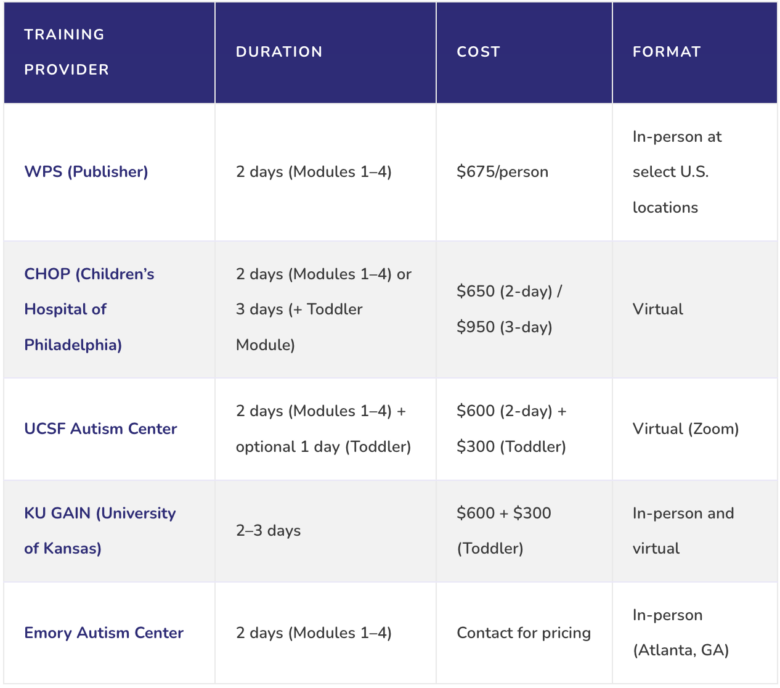
Note: Costs and availability are subject to change. The ADOS-2 Manual must be purchased separately and is not included in workshop fees.
Workshops typically include lecture instruction, video demonstrations of each module being administered, and supervised practice scoring. Upon completion, attendees receive a certificate of completion equivalent to approximately 12–16 continuing education (CE) contact hours, depending on the provider.
What the Workshop Covers
During a standard two-day clinical workshop, participants learn the principles of administering and scoring Modules 1 through 4 of the ADOS-2. The training covers module selection criteria, administration protocols, behavioral coding procedures, and algorithm scoring. Participants practice coding behaviors by watching recorded ADOS-2 administrations and comparing their scores with those of certified trainers. The Toddler Module is typically covered through post-course self-study materials or as an additional third day of training. Join our newsletter
The Research Reliability Path
For clinicians and researchers who need to use ADOS-2 in published research or multi-site studies, the bar is significantly higher. Research reliability requires demonstrating that you can administer and score the instrument consistently enough to meet inter-rater agreement standards.
What Research Reliability Requires
After completing the introductory clinical workshop (a mandatory prerequisite), individuals pursuing research reliability attend an advanced research training workshop, typically for an additional two to three days. Following this workshop, candidates must submit video recordings of their own ADOS-2 administrations and achieve an inter-rater agreement threshold of 80% or higher with an established, reliable coder. This process involves multiple rounds of feedback and resubmission for many trainees.
Research reliability training is offered by select institutions, including CHOP, the University of Michigan, and programs affiliated with the ADOS-2 authors. The timeline from the introductory workshop to confirmed research reliability typically ranges from six to twelve months, depending on access to suitable clinical populations for practice and the speed of the video review process.
There is no official ADOS-2 “certification.” Clinicians complete training workshops and develop competency through supervised practice. Research reliability requires additional advanced training and demonstrated inter-rater agreement of 80% or higher.
Full Cost Breakdown: ADOS-2 Training and Materials
Understanding the total investment required for ADOS-2 capability is essential for practice owners and clinical directors planning their diagnostic expansion. The costs extend well beyond the workshop registration fee.
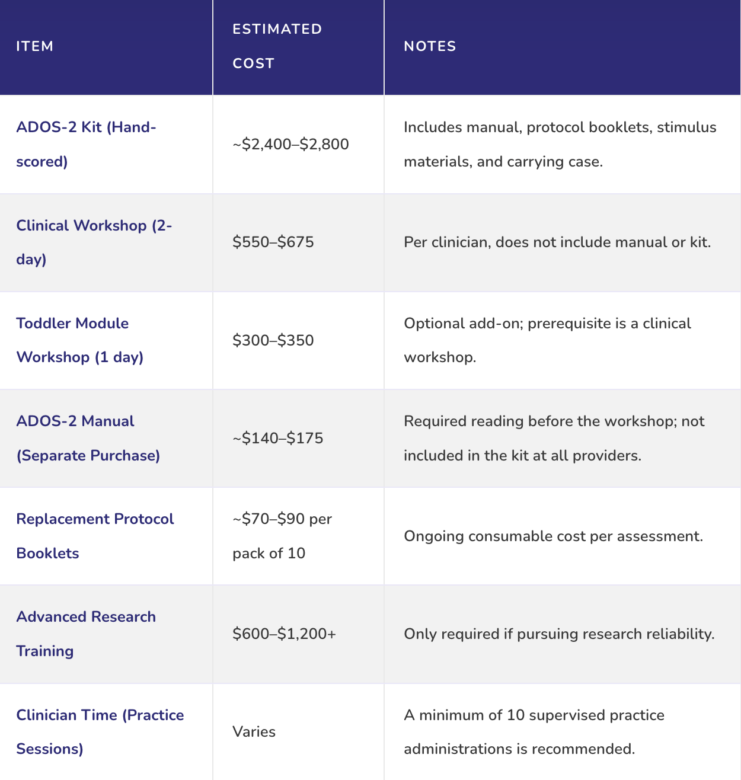
Total estimated investment per clinician for clinical use: $3,500–$4,200+ (including kit, workshop, manual, and initial protocol supplies). This figure does not account for the clinician’s time away from billable activities during training and the three-to-six-month practice period, which represents a significant opportunity cost for most practices.
Realistic Timeline: From Workshop to Clinical Competency
One of the most important questions for practice leaders is not just how long the workshop takes, but how long it takes before a clinician can reliably use ADOS-2 in a clinical setting. The answer is longer than many expect.
The Practical Timeline
Workshop: 2–3 days. The introductory clinical workshop provides foundational knowledge, but it is explicitly described by WPS and all training providers as an “essential step toward competence”—not competence itself.
Supervised practice: 10+ administrations per module. After the workshop, clinicians need to administer ADOS-2 at least ten times for each module used under supervision or with scoring review before they can be considered clinically competent. For clinicians who do not see a high volume of ASD referrals, accumulating these practice sessions can take weeks to months.
Self-study and post-course materials: 10–20+ hours. Workshop providers supply post-course video materials and a Toddler Module guidebook that clinicians are expected to complete independently. This additional self-study solidifies skills but adds to the overall timeline.
Total realistic timeline: 3–6 months from initial workshop attendance to confident, independent clinical use. For research reliability, the timeline extends to 6–12 months or longer.
Alternatives for Building Diagnostic Capability Faster
For ABA practices that want to expand diagnostic services without a six-month onboarding timeline per clinician, there are complementary paths worth considering. These are not replacements for clinical expertise, but they offer different tradeoffs in terms of speed, accessibility, and the type of data they provide.
CARS-2 (Childhood Autism Rating Scale, Second Edition)
CARS-2 is a clinician-completed rating scale that typically takes 20–30 minutes, including both observation and scoring, and requires a significantly shorter training period than the ADOS-2. While it lacks the structured observational depth of ADOS-2, it provides a quicker screening and severity rating and is often used as part of a broader assessment battery. Many practices use the CARS-2 as a more accessible entry point into diagnostic assessment.
Choosing the Right Path for Your Practice
The best approach to building diagnostic capability depends on your practice’s current staffing, patient population, and strategic goals. Many leading practices are adopting a multi-tool approach—combining the clinical depth of traditional assessments with the speed and objectivity of FDA-cleared technology. This allows them to serve a broader range of patients, reduce wait times, and produce diagnostic reports backed by both clinical observation and quantitative biomarker data.
Frequently Asked Questions
Q: Is there an official ADOS-2 certification?
A: No. There is no formal ADOS-2 certification credential. WPS and other training providers offer clinical workshops that result in a certificate of completion and continuing education hours. Clinical competency is developed through supervised practice after the workshop, and research reliability requires additional advanced training and demonstrated inter-rater agreement.
Q: What prerequisites do I need for ADOS-2 training?
A: You generally need a bachelor’s degree or higher in a relevant clinical field (psychology, speech-language pathology, occupational therapy, medicine, or special education) along with experience working with individuals with ASD. The training is intended for professionals who already have a background in autism assessment and will use the tool within their scope of practice.
Q: How much does ADOS-2 training cost in total?
A: The total investment per clinician is approximately $3,500–$4,200 or more, including the ADOS-2 kit (~$2,400–$2,800), clinical workshop ($550–$675), manual (~$140–$175), and initial protocol supplies. This does not include the clinician’s time away from billable work during training and the three-to-six-month supervised practice period.
Q: Can a behavior technician (RBT) administer ADOS-2?
A: No. ADOS-2 requires administration by a trained clinician with graduate-level education and supervised experience in autism assessment. Behavior technicians cannot administer ADOS-2 independently.
Q: What’s the fastest way for an ABA practice to start offering diagnostic services?
A: The fastest path is to incorporate FDA-cleared technology-assisted tools, which can be administered by a trained behavior technician. While this does not replace the need for qualified diagnosticians to confirm the diagnosis, it does save time and money by improving the efficiency of your diagnostic service.
Related:
- Screeners vs. diagnostic tools for autism: What do they really do?
- Insurance coverage for autism testing: What parents need to know
Like MediaFeed’s content? Be sure to follow us.
This article originally appeared on Earlipointhealth.com and was syndicated by MediaFeed.co