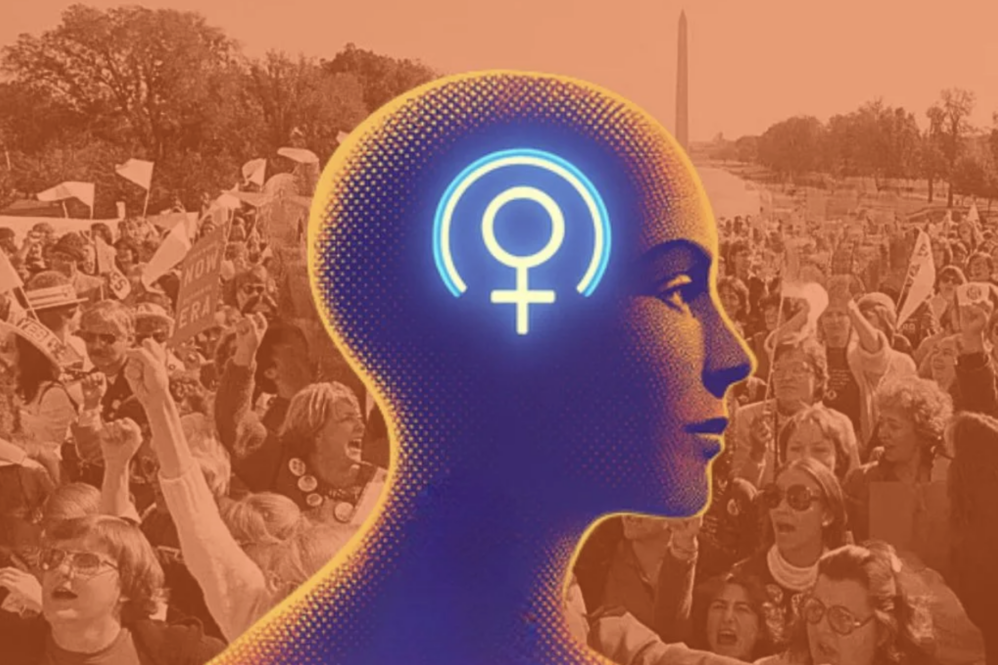
When women fought for the vote in the early 20th century, they weren’t simply demanding a ballot. They were demanding to count—in public, in law, and in the future of their own country. That fight, like every feminist wave since, was never only about rights on paper—it was about autonomy, dignity, and visibility in the face of structures that profited from women’s silence.
A century later, politicians and the patriarchy are still very much on the guest list. But now there’s another player at the table: artificial intelligence, a sprawling tangle of algorithms and agents that promises to make life easier while quietly learning the shape of our lives. The men building these systems have very little understanding of women’s lives, and that blind spot continues. But now the threat runs deeper.
AI is moving from answering our questions to organizing our calendars, filtering our information, helping make decisions, and learning what we buy, fear, say, and need. If women aren’t in the room when those systems are built, we don’t just get ignored. We get engineered around.
The Mirage of “Frictionless”
We’re told AI butlers will soon run our calendars, shop for our groceries, manage our health records, even draft our love notes. It’s Rosie the Robot from The Jetsons—except this Rosie doesn’t just dust the furniture. The tech industry insists this future is inevitable, frictionless, and benevolent.
But frictionless for whom? And benevolent on whose terms?
Margaret Atwood in The Handmaid’s Tale reminded us, “When we think of the past, it’s the beautiful things we pick out. We want to believe it was all like that.” The same nostalgia is now being peddled about the future: a fantasy of ease that glosses over the darker bargains.
The Price of Magic
Meredith Whittaker, president of the Signal Foundation, has already warned that so-called “AI agents” demand near-total access to our lives. Not just your email or shopping list but your bank accounts, location data, private texts—the nervous system of your digital existence. “This isn’t an optional app,” she cautioned. “It’s being fused into the operating systems of our devices, all but mandatory.” In other words: The magic comes with a price tag we can’t afford to ignore.
The danger isn’t abstract. Apple’s “Apple Intelligence” has already been accused of routing encrypted WhatsApp transcripts through its servers, effectively breaking the promise that only sender and receiver can read a message. Researchers have demonstrated how malicious prompts can trick AI agents into taking actions they were never meant to take: leaking sensitive information, following hostile instructions, or turning a helpful assistant into an uninvited accomplice. If this sounds like the plot of Black Mirror, that’s because it practically is.
Want more? Get PROVOKED’s free Thursday newsletter. Sign up at PROVOKEDMagazine.com.
Who Gets to Set the Rules?
Timnit Gebru, founder of the Distributed AI Research Institute, asked the question bluntly: “Who gets to set the rules for AI? Is it built for speed, profit, and the status quo—or for justice, transparency, and actual user needs?”
And for women over 50—the people buying, caregiving, organizing, researching, remembering, and often keeping multigenerational households from falling apart—the stakes are particularly high. We’re not niche users.
We’re the market.
Unless we act, the future being built may exclude us, just as past systems once did.
Lessons From the First Three Waves
History is rhyming in dangerous ways. Each feminist wave confronted a system that declared women’s lives unimportant. AI is simply the newest iteration.
First Wave: Visibility. Women fought for recognition: votes, legal status, the right to be counted, to exist in civic life. Its lesson was blunt—invisibility is the oldest and most effective form of oppression. Tech platforms today operate on that same erasure—optimizing for the “average user,” who is rarely an older woman. Unless we demand representation in data sets and design labs, we risk vanishing again, not from history books this time, but from the code that will govern our daily lives. Ada Lovelace wasn’t invited to shape computing. She insisted. So must we.
Second Wave: Autonomy. From reproductive rights to financial independence, women rejected proxy decision-makers. Autonomy today means refusing to hand over wholesale control to a machine that promises efficiency while mining our lives for profit. As UNESCO recently argued in its call for feminist AI governance: “Privacy must be the default, not an option buried in settings.” Seamless is not the same as safe.
Third Wave: Intersectionality. No woman’s story is complete without her race, age, class, disability, culture, and the other forces that shape how she moves through the world. Yet most AI systems are trained on biased data, often excluding the very people they claim to serve. The danger isn’t theoretical. Joy Buolamwini, founder of the Algorithmic Justice League, has shown how technology literally sees some women less clearly, if at all.
The Cost of Convenience
Whittaker put it starkly: Agentic AI (meaning having agency; they don’t need your help because they already have all your information) requires access not just to our apps, but to the nervous system of our devices. And once your private messages, financial accounts, and health data are absorbed into a corporate “data slurry,” you don’t control them anymore.(Related: I Trained the AI That’s Coming for My Job. Then I Became It.)
The pattern is familiar. Companies racing to monetize “the next big thing” cut corners on privacy, transparency, and safety. Whittaker warned that, unless challenged, we’re heading toward “an elimination of privacy and security at the application layer.”
Translation: The very foundation of private communication could collapse in the name of convenience.
The future they’re building is less Rosie the Robot and more Gilead—the theocratic dictatorship in The Handmaid’s Tale—a closed system where convenience trumps autonomy. The cost is your sovereignty.
Now: The Feminist Blueprint for AI
So what do we do? We return to the feminist playbook the women that came before us left us.
- Resist erasure. Visibility must be demanded, not assumed. Women over 50 should be in the test groups, the data sets, the focus panels. If Ada Lovelace hadn’t insisted on her place in early computing, we wouldn’t have her algorithms. Insist.
- Guard autonomy. Don’t confuse ease with agency. Set limits on what tools can access. Refuse AI that overrides your choices in the name of efficiency. Opt out where you can.
- Demand intersectionality. Ask hard questions: Whose needs is this tool serving? Whose pain points count? Whose life is it making easier—and whose more precarious? As feminist scholar Sophie Toupin wrote, “True tech justice means co-designing systems with seldom-heard people, shaping tools around real lives—not optimizing for the majority.”
- Choose friction. A life without wrinkles, interruptions, or rough edges isn’t life—it’s performance. A fully automated life risks being no life at all.
Enjoyed this story? Read more from PROVOKED at provokedmagazine.com.
Why It Matters for Women Over 50
This isn’t a distant problem. This is a now problem.
We aren’t a generation fading out—we’re living another 20, 30, 40+ years. We have more resources, influence, and longevity than any cohort of women before us. If we abdicate control now, we risk consigning the rest of our lives to systems built without us.
Fourth Wave feminism has to include digital sovereignty: the right to know what systems are doing with our data, to question who built them, to limit what they access, and to refuse technologies that treat our privacy like an inconvenience. We have to take the fight seriously.
AI won’t replace us unless we hand over our agency.
And the most important lesson feminism has delivered across every wave is this: No one gives you power.
You take it.
Related:
- How to Live Artfully in the Age of Digital Slop
- AI in Therapy: Concerning or Comforting?
- It’s Not Them. It’s You. Why You’re Failing at Online Dating.
Ask us! What questions do you have about content, strategy, pop culture, lifestyle, wellness, history or more? We may use your question in an upcoming article!
Like MediaFeed’s content? Be sure to follow us.
This article originally appeared on PROVOKED and was syndicated by MediaFeed.co.