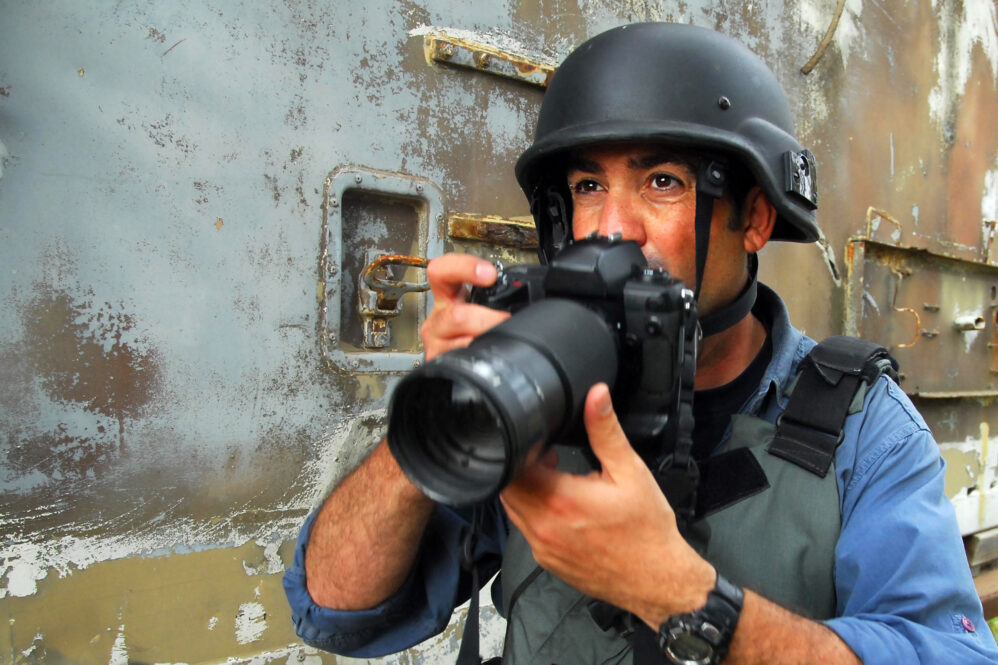
For more than two months, GroundTruth has been on a virtual road trip through the crisis in local news across America. We’ve been from Pittsfield, Massachusetts to Chicago and Montana down to Austin, Texas. But this week I am looking at how this issue is playing in other countries. These two paths — local and global — run parallel to each other and are headed in the same distressing direction that traverses the rising peril for journalists and the steep decline in press freedom.
According to the World Press Freedom Index, 4.25 billion people in 42 countries live in places where being a journalist means risking your life or your liberty. As the death toll continues to soar for journalists killed trying to do their job, the persistent fact is that 90 percent of the attacks on journalists take place with impunity. The culprits almost always get away with murder.
That is why World Press Freedom Day is so important. It is a day to remember that everyone, and particularly our leaders, need to recommit to press freedom. It is also a day of reflection among media professionals, an opportunity to celebrate the fundamental principles of our profession; defend the media from attacks on their independence; and pay tribute to journalists who have lost their lives in the line of duty.
It is hard to know where to begin on this global exploration of the decline of press freedom, but it makes sense to head toward places where gathering facts and telling the truth can be a death sentence.
Among the 20 countries with the worst safety scores for journalists, several particularly worrying situations stand out, according to research by the World Press Freedom Index. I realized in writing this that I have touchstones in each of these regions through my 40 years as a journalist. I have seen the hope for press freedom in some of these corners in dramatic and inspiring ways. And in more recent years I’ve witnessed the dispiriting collapse of a free press and the steady erosion of democracy that comes along with it.
Middle East
Simmering conflicts from Lebanon to Yemen have long presented peril for local journalists as well as Western journalists who have been kidnapped, tortured and killed in these countries for decades now. But the war on Gaza has escalated into one of the most dramatic conflicts for the muder of journalists in recorded history. Palestine is now regarded as the single most dangerous place in the world for journalists. With more than 200 reporters, photographers, and media workers killed in Gaza by the Israeli army since October 2023, including at least 44 of whom were slain while doing their job.
According to the Committee to Protect Journalists (CPJ) Israel’s killing of journalists marks the deadliest and most deliberate effort to kill and silence journalists that the organization has documented in its 45 years of existence. Palestinian journalists are being threatened, directly targeted, and murdered by Israeli forces, and are arbitrarily detained and tortured in retaliation for their work, CPJ reports.
Israel has systematically destroyed media infrastructure in Gaza, and tightened censorship throughout the West Bank and Israel. International media have been barred from independent reporting in Gaza where a consensus has been building among international experts on humanitarian crises that a genocide is taking place against the Palestinian people. It is important to note that inside Gaza, journalists have also long reported harassment and intimidation by Hamas, the Islamic Resistance Group which has a military force and a political wing that has governed Gaza since 2007.
I began reporting in Gaza in the late 1990s and witnessed the hopeful return of a free press under the Palestinian Authority. Truthfully the PA was never too kind to those who sought to expose corruption, but it was still going through the motions of allowing for a free press. Then I watched the pretensions of support for the role of independent journalism smashed by Hamas as it rose to power. And now too many of us have to watch from afar as Israel targets those Palestinian journalists who seek to cover the war on Gaza and ban all of us from entering and documenting the destruction, the human rights violations and the killing unfolding every day.
Asia
China and Myanmar top the list of Asian countries with the most detained journalists. There are currently 123 journalists wrongfully detained in China, including 10 in Hong Kong. And 59 media professionals are behind bars in the country of Myanmar, where a military coup in 2021 paved the way for the return to a police state. That military junta has extinguished hopes for a democracy where press freedom is respected.
Just 12 years ago, I reported in Myanmar, or Burma with a team of young journalists, 10 locals and 10 Americans, and it was a very different place back then. With support from The Open Hands Initiative, we carried out a reporting fellowship titled “Burma Telling Its Own Story,” during which we sought to build upon the heroic independent journalism that established itself in exile over the years. Now many of those talented, young journalists who worked with us, live in fear and have returned to exile, have been detained or find themselves watching their dreams of working in journalism deferred.
My colleague Gary Knight, the co-founder of VII Photo and co-founder of GroundTruth, worked with me to lead the reporting initiative in Myanmar, recently returned to the region, heading to Chiang Mai, Thailand where Burmese journalists have set up newsrooms in exile or worked as freelancers from there. Gary shared:
“The situation for journalists in Myanmar is terrible, and they are considered ‘enemies of the state’. Burmese journalists living in Chiang Mai told me that approximately 1500 of them are in exile, either internally, or in neighbouring countries. I do not know of a larger diaspora of journalists anywhere. I was told that those that stayed behind in Yangon have largely quit journalism because it’s unsafe, and are doing other things to make a living, like working in real estate. The diaspora suffers not only because it is vulnerable from an immigration perspective, but also from economics because USAID pulled the plug on media that they could work for. The Burmese Press has been eviscerated and they have few places to publish. From a combined publishing, safety and sustainability perspective I can think of few worse places.”
Africa
This is a region where candidly I do not have extensive experience, but I have reported on the perils of truth telling in Nigeria amid violence that is often ignited by misinformation by one side or the other and often fueled from afar by extremists who are both Muslim and Christian. The violent divide we covered featured in a short documentary titled “A Bridge in Kaduna,” which is set in what is known as the “Middle Belt” between herders in the predominantly Muslim North and farmers in the predominantly Christian South. The plight of Nigeria’s Christian communities in Kaduna and elsewhere has been an obsession for American Christian evangelical groups and has received the very recent attention of President Trump’s White House in a way that seems to overlook the great work being done by a free press to expose how outside forces fan the flames of hatred.
There are many other countries in the continent where journalism is at risk, but any thermal mapping of the perils faced by a free press would include a burning red indicator across the Great Lakes region, particularly in the Democratic Republic of Congo. In a recent report by Reporters Without Borders (RSF), “The epicentre of the region’s deteriorating security situation lies in the conflict-ridden eastern Democratic Republic of the Congo (DRC).”
As the report reveals, the Great Lakes are a region struggling with the geopolitical tensions around natural resources, and journalists in the area are constantly on the move. The new RSF report takes readers inside the day-to-day lives of media professionals who continue to report the news despite grave risks. It states, “Independent reporting in the east of the DRC has become virtually impossible. Reporters are caught between the anvil of the armed group M23 and the hammer of the Armed Forces of the Democratic Republic of Congo (FARDC).”
Too often, this means arrests, attacks, threats, enforced disappearances, executions and the closure, looting and ransacking of newsrooms.
Europe
The war in Ukraine rages on the gates of Europe in a brutal stalemate with sputtering talks about a ceasefire that seem to go nowhere. It is a war of attrition where heroic work is being done by journalists who are risking their lives every day trying to cover it. But long before the war started, Russia began systematically crushing an independent press just as it was starting to emerge following the collapse of the Soviet Union. Russia’s effort to undermine a free press was intended to create news deserts in the border regions where misinformation and disinformation could seep into the barren media landscape, particularly in the Donbas region.
This calculated policy by Russia led up to the first Russian assault on Ukraine with the invasion and occupation of Ukraine’s Crimean Peninsula in 2014. Seven years later, Russia’s full-scale invasion of Ukraine began in 2021 as Russian forces attacked Kyiv. Since then journalists have been under attack repeatedly and many have lost their lives covering the conflict.
Over the last five years, I have taken several reporting trips into Ukraine and each time have been drawn to the city of Bucha, the dateline where the world first saw the brutality of the unprovoked Russian assault on Ukraine. I have twice attended what has become known as the Bucha conference, which focuses on the important role of a local media in Ukraine. The conference brings together local media from every corner of the country. There, I learned a fairly hidden history of Russia undercutting the independent media. Today these newsrooms are often shuttered or struggling mightily to survive and stay on the story as Russia seeks to destroy the country’s infrastructure and bulldoze any hopes of a free press under the rubble of relentless drone attacks. But funding for such efforts to establish a free press is just one of the many casualties of Putin’s war in Ukraine.
I have gotten to know the committed and talented and courageous team of reporters at Ukrainska Pravda, a leading, independent digital news organization in Ukraine. I am proud to serve on the advisory board, and to support them any way I can as I’ve gotten to see up front the heroic work they do. I am thinking of the whole team on this day, and praying for their safety and hoping that the country will get back on the road to building their democracy and that Americans will wake up to how important it is that we support a strong, independent press in places like Ukraine.
Latin America
Long a place of great peril for journalists, Mexico today still holds the record for the highest number of missing journalists, with 28 unsolved cases to date. Mexico’s shameful record is often attributed to the drug cartels, but the police and security forces in the country are also culpable, particularly in doing virtually nothing to bring those who murder journalists to justice.
In this vacuum, other journalists have taken upon themselves to find the truth. I’ve been drawn to the work of Katherine Corcoran, former AP Mexico Bureau Chief, who investigated the murder of Regina Martinez, a legendary Mexican journalist who was killed on the verge of exposing high-level government corruption. Corcoran was tired of seeing the killing of journalists going unsolved, or cases fabricated to make it look as if they were killed by drug cartels when in fact the government had done this kind of extrajudicial killing and covered up their crimes almost always by making it look like a drug hit.
Martinez, an investigative reporter out of Veracruz where she worked with a controversial, independent news organization known as Proceso, was just about to break a big story on corruption linking the government to the cartels and she was found bludgeoned to death in her bathroom. Questions began to emerge immediately as Martinez had no connections with cartels and the crime scene was suspicious as the only thing of value that was taken was a television. With the assistance of four reporter proteges who worked with Martinez, Corcoran dug in on the story and together they doggedly pursued several different theories of who was responsible for the killing. But they arrived at the conclusion the killing of Martnez was likely a hit ordered by the Attorney General. In her book “In the Mouth of the Wolf” she convincingly shines a light that breaks through the fog the government often created by blaming the murder of journalists on the cartel.
“It turns out that was a pattern in many of these cases and an attempt to undercut journalism as not trustworthy, and this is why it was important to go back,” Corcoran told me in an interview in January last year.
She added that during her research she was drawing parallels in the way President Trump sought to tarnish journalism and defame journalists as the “enemy of the people.” “This is all the same stuff we heard in Mexico through its history and sometimes they were even using the same language and same narrative. Referring to her home country of the United States, she said, “We are going down that path, and this is where that path leads you. The point is it is not about the press, it is about controlling the population. My book is a cautionary tale, and I hope it is one that might be heard in America.”
The backdrop for the killing of Martinez, she said, was that the threats posed by narcos as well as the government silenced the media in Mexico. There, she said, they do not have news deserts; they have patterns of self-censorship and fear that end with news organizations shutting down. They are called “Zonas de Silencio,” or “zones of silence.”
“Too often with these attacks, the newspapers shut down and self-sensorship is huge. Then people no longer know what is going on in their communities.” This, she said, is what ties together the threads of the crisis in local news around the world and in the United States. We have to be vigilant and we have to be sure that the forces trying to silence the media are called out. If we don’t we are looking at a bleak future.
It can be a tall order to try to encourage Americans to see these connections between the erosion of press freedom around the world and the ways in which American news deserts and the collapse of local news is producing a different, but pervasive threat to American democracy.
Related:
Like MediaFeed’s content? Be sure to follow us.
This article originally appeared on Charlessennott.substack.com and was syndicated by MediaFeed.co