Driving under the influence of alcohol or drugs is a mistake you don’t want to make. Even if the police arrest you before you get in a crash, getting a DUI can derail your life. You may have your license suspended, spend time in jail — up to a year for a first DUI in some states — and pay thousands of dollars in fines and legal costs. You’ll also see your car insurance rates skyrocket, with the higher premium costing tens of thousands of dollars over time. Here’s why and how to prevent DUIs — and what to do if you find yourself charged with one.
Key takeaways:
- Approximately 10,500 people killed in drunk driving accidents in the U.S. in 2018
- 290,000 people maimed and injured in alcohol-related crashes in the U.S. annually
- $44 billion is the cost of alcohol-related crashes to the U.S. annually
- Insurance doubles after a DUI: your car insurance premiums could easily double overnight
- $5,000 to $50,000 is the cost of a DUI, not including medical expenses
- $40,000 is the cost of an auto insurance increase related to a DUI over 13 years
Sources: Centers for Disease Control and Prevention and Insurance Institute for Highway Safety
A DUI: What It Is, What It Means for You
Despite the overwhelming risks, the FBI estimates that in 2018 there were more than 1 million people arrested for driving under the influence. That’s 9.7% of all arrests annually. This usually means the drivers had a blood alcohol level (BAC) of at least 0.08 — the federal cutoff for driving under the influence (DUI). This often means they had five drinks or more.
Can you be arrested for a lower BAC? Yes. Some DUIs go to commercial drivers for a BAC of 0.04, and under “zero tolerance” laws, teens can be arrested for 0.02 or less in many states. People may also be arrested if they have less than a 0.08 blood alcohol but are weaving, drifting across traffic lanes, or showing other signs of impairment. In many states, you can also get a DUI for driving under the influence of drugs, including marijuana or cocaine.
Most DUI defendants have not been in an accident, but their decision to drink and drive can turn their lives upside down. A DUI is one of the worst things you can have on your driving record, and it’s guaranteed to drive up your car insurance premiums, according to the Insurance Information Institute.
Drunk driving is a major concern to the insurance industry, according to Michael Barry, vice president of media relations at the Insurance Information Institute. “Many of these accidents — even when there’s no fatality — involve significant property damage and bodily injury,” he says. Bodily injury costs are especially concerning, says Barry, because “it costs a lot more to repair a person than it does to repair a car.”
The good news is that drunk driving fatalities fell by 7% between 2008 and 2017, thanks to public awareness, increased enforcement and the use of safety belts, according to the National Highway Traffic Safety Administration (NHTSA). Mothers Against Drunk Driving and other safety groups hope to drive that percentage close to zero.
What a DUI Will Cost You
A DUI exacts a high financial toll. “Even when there’s no accident involved, the financial implications are very serious for someone convicted of driving under the influence — no matter what state you’re in,” warns Michael Barry of the Insurance Information Institute.
According to Josh Dale, a California attorney and executive director of the California DUI Attorneys Association, “In California, the high-end of punishment for a first offense includes five years of probation, DUI classes, a 30-day license suspension followed by five months of restricted driving, and usually a jail term or community service. There isn’t room in the jails, so people usually do the sheriff’s work program instead.”
Besides having your license suspended for 30 days or more and possible jail time or community service, you’ll pay out of pocket for many other DUI fines and charges (see below).
The True Cost of a DUI
Here’s what the California Department of Alcohol and Drug Programs estimated a first-time DUI conviction could cost (the cost may be higher in some other states):
- Fines, court and attorneys’ fees: $4,000
You will certainly have to pay fines following a DUI conviction, along with various court costs. A conviction may carry other fines up to three times higher. Often you’ll need a DUI attorney to help you post bail or to fight a charge you deem unfair. - Towing/impound fee: $685
Since you can’t drive if you’re arrested, the police will have your car towed and impounded. - Drug education and treatment: $650
Most DUI convictions carry some sort of required alcohol or drug education program. This could range from an eight-hour online class to months of classroom and group counseling. For example, in California, you will have to complete either a 30-hour, 44-hour or 60-hour program after your first offense, depending on how high your BAC was. - DMV reinstatement fee: $100
- Estimated increase in car insurance premiums over 13 years: $40,000
Each insurance company calculates premiums differently, but no matter which company you use, you are bound to see a significant increase in your premium following a DUI. Estimates range from a few hundred dollars (Esurance) to $2,700 a year (the state of California). - Total estimated minimum cost to you of a DUI: $45,435
The penalties and fines are much higher for a repeat DUI. And as the California program points out, this doesn’t count the possible medical costs to you or to victims, which could run into millions of dollars.
How to Avoid Getting a DUI
The best way to prevent a DUI: don’t drink and drive, period. But if you are one of the tens of millions of Americans who drink socially, you are probably wondering how much is too much — and there isn’t an easy answer. The happy hour after work, the Sunday football party at a friend’s house, or your cousin’s wedding can all end with a DUI if you are not careful. That’s why experts recommend that you don’t drive after drinking, even one beer or glass of wine.
All states allow a DUI arrest if you have a BAC of 0.08, but people may experience very different levels of impairment at this blood alcohol level. A large man who drinks regularly may show no signs of impairment, while a smaller woman who rarely drinks may be significantly impaired. According to NHTSA, the typical effects of a 0.08 BAC level of impairment include:
- Poor muscle coordination (balance, speech vision, reaction time, hearing)
- Difficulty detecting danger
- Impaired judgment, self-control, reasoning and memory
This might inhibit your ability to drive by affecting:
- Concentration
- Short-term memory loss
- Speed control
- Reduced capability of processing information
- Impaired perception
TO BE SAFE, EXPERTS RECOMMEND THAT YOU:
- Agree on a designated driver before the drinking begins
- Have a backup plan: taxis, Uber, Lyft, having a friend come to get you, or a sleepover
- Speed control
- Don’t ever mix alcohol with prescription drugs, as this could lead to greater impairment, even if you’ve just had a small amount of alcohol
- Always wear your seatbelt — it’s your best defense against impaired drivers
Keeping Intoxicated Friends and Family Off the Road
Let’s face it — it’s hard to reason with a person who is drunk and wants to drive home. The best strategy is to have a plan for a designated driver before it becomes a life or death situation. But if you do find yourself trying to stop a friend or loved one from driving, try these strategies from Mothers Against Drunk Driving:
- Stay calm, talk slowly and clearly, and don’t be confrontational
- Try to get others to help you — it will be harder for the person to ignore the advice of several friends
- Explain you care about them and don’t want them to hurt themselves or others
- Suggest alternatives — a sober friend, Uber/Lyft, a cab or public transportation
- Invite them to sleep over at your house
- Try to get their car keys
- If all else fails, call the police. As MADD points out, “It’s better to have a friend arrested than injured or killed.”
Colleen Sheehey-Church is the president of Mothers Against Drunk Driving (MADD)
This article originally appeared on MoneyGeek.com and was syndicated by MediaFeed.org.
More from MediaFeed:
This is how much Americans spend drunk shopping

According to Finder’s latest Drunk Shopping survey conducted in September 2020, more than a fifth (21.4%) of Americans admit to shopping under the influence.
The percentage of Americans that admitted to buying under the influence has slowly decreased each year from 26.4% in 2019 to 21.4% in our most recent survey. The average drunk shopper is spending an average of $423.73 on drunk purchases this year, compared to $768.58 last year.
Collectively, Americans spent $21.6 billion on drunk purchases in the past 12 months, down 51.80% from last year’s $44.9 billion.
DepositPhotos.com

Finder’s data is based on an online survey of 1,800 U.S. adults born between 1928 and 2002 commissioned by Finder and conducted by Pureprofile in September 2020. Participants were paid volunteers.
We assume the participants in our survey represent the US population of 254.7 million Americans who are at least 18 years old according to the July 2019 U.S. Census Bureau estimate. This assumption is made at the 95% confidence level with a 2.32% margin of error.
The survey asked people whether they made a purchase while under the influence of alcohol in the last 12 months and asked them to select the categories they purchased in and the amount they spent.
Purchase categories were Shoes, clothes, or accessories; Gambling; Cigarettes; DVD, movies, or streaming service; Tech products; Narcotics or other drugs; Music; Artwork, Vacation; Pet; Furniture; Car; Motorbike; Food; and Other. Unlike previous years, we did not include “More alcohol” as a purchase category this year.
Average calculations of the amount spent on drunken purchase were based on only the participants who reported spending in a category — for example, to calculate the average amount spent on food while drunk, respondents who indicated that they have not made any drunk purchases in the past 12 months, and those who responded “0” (meaning they did not make a drunk purchase on food but did make a drunk purchase in another category) were not included.
Our calculations were weighted for age and gender.
To avoid skewing the data, we did not include extreme outliers in our calculations.
We define generations by birth year according to the Pew Research Center’s generational guidelines:
- Gen Z — 1997-2002
- Millennials — 1981-1996
- Gen X — 1965-1980
- Baby boomers — 1946-1964
- Silent generation — 1928-1945
We define geographical regions according to the divisions of the U.S. Census Bureau.
CentralITAlliance / istockphoto

- According to a 2020 survey by Finder, 69.7% of Americans drink at least one alcoholic beverage per week.
- 69.7% of Americans drink at least one alcoholic beverage per week.
- On average, American drinkers consume 8 alcoholic drinks per week.
- The most commonly consumed alcoholic beverage by men is beer, with 63.7% of men drinking at least one beer a week, compared to women who tend to favor wine, with 46.2% of women having at least one glass per week.
- Millennials and Gen X are consuming the largest amount of alcoholic beverages weekly, both consuming an average of 8.85 drinks per week
- Americans on average spend the most per glass of wine ($11.86) and the least on a can of beer ($7.57).
Finder.com

Over a quarter (28.6%) of men admit to drunk shopping, with male drunk shoppers spending an average of $489.54. The top purchase for men under the influence is food (86.3%), followed by cigarettes (69.1%) and gambling (63.9%).
Significantly less women (15.0%) admitted to drunk shopping than men, with female drunk shoppers spending an average of $303.00 on their purchases during the past year. The top drunk purchase among women was food (70.1%), with shoes, clothes or accessories coming in second (55.9%), and cigarettes in a close third (39.4%).
DepositPhotos.com

The West showed the highest percentage of people admitting to drunk shoppers with 25.1% of adults in the West saying they had drunk shopped in the past year, spending and average of $486.52. This was followed by the 22.0% of the people drunk shopping in Northeast, 19.9% in the South and the 19.8% in the Midwest.
Finder.com

% of respondents who admitted to drunk shopping: 19.8%
DepositPhotos.com

% of respondents who admitted to drunk shopping: 19.9%
Poike / istockphoto

% of respondents who admitted to drunk shopping: 22.0%
DepositPhotos.com

% of respondents who admitted to drunk shopping: 25.1%
Choreograph / istockphoto
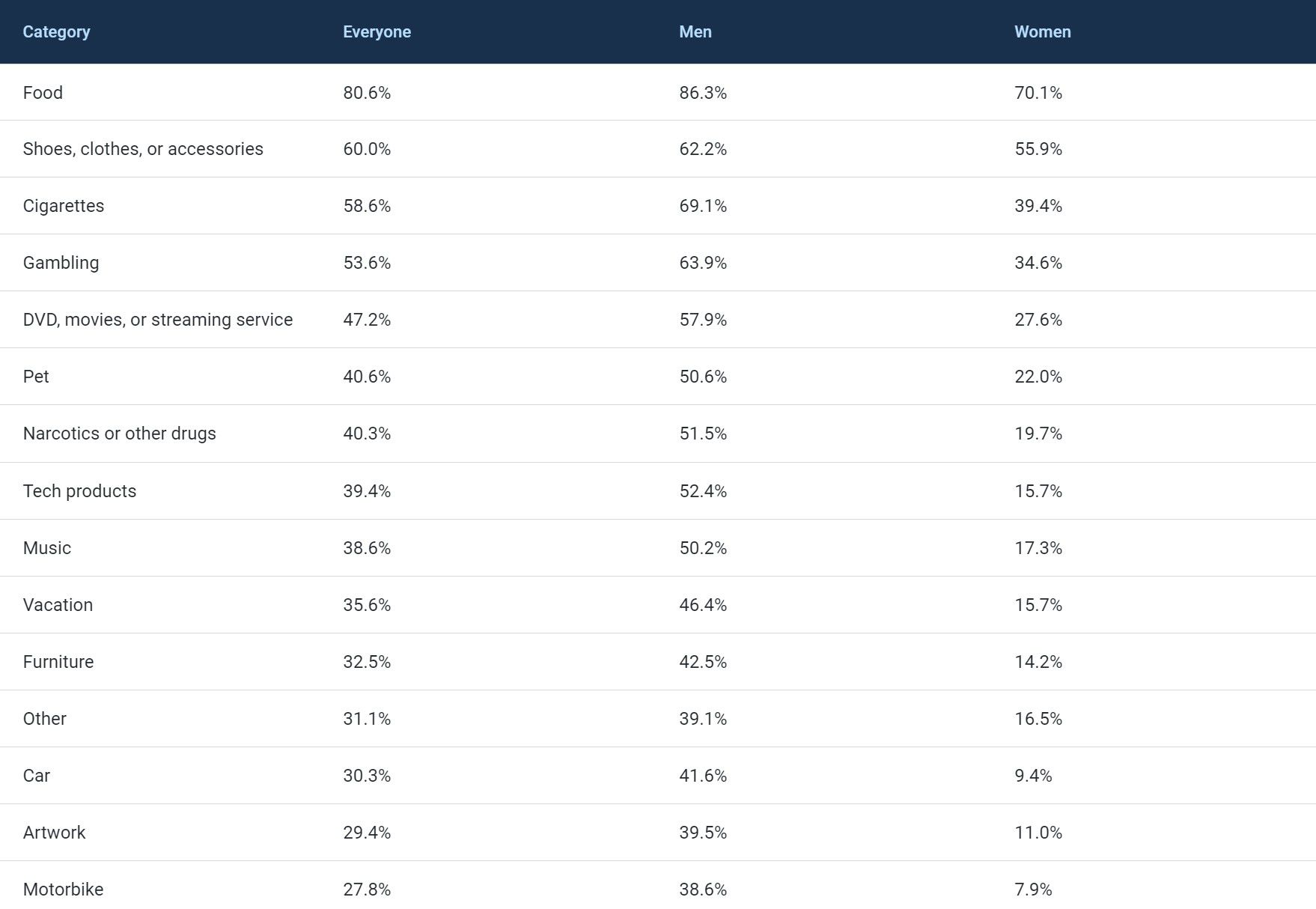
For those of you who have ever made a late night call to Domino’s after cracking open a few brewskis, it will come as no surprise that food is our most common drunk purchase. More than 80% (80.6%) of drunk shoppers admit to purchasing food while drunk, followed by apparel including shoes, clothes and accessories at 60.0%, and cigarettes at 58.6%.
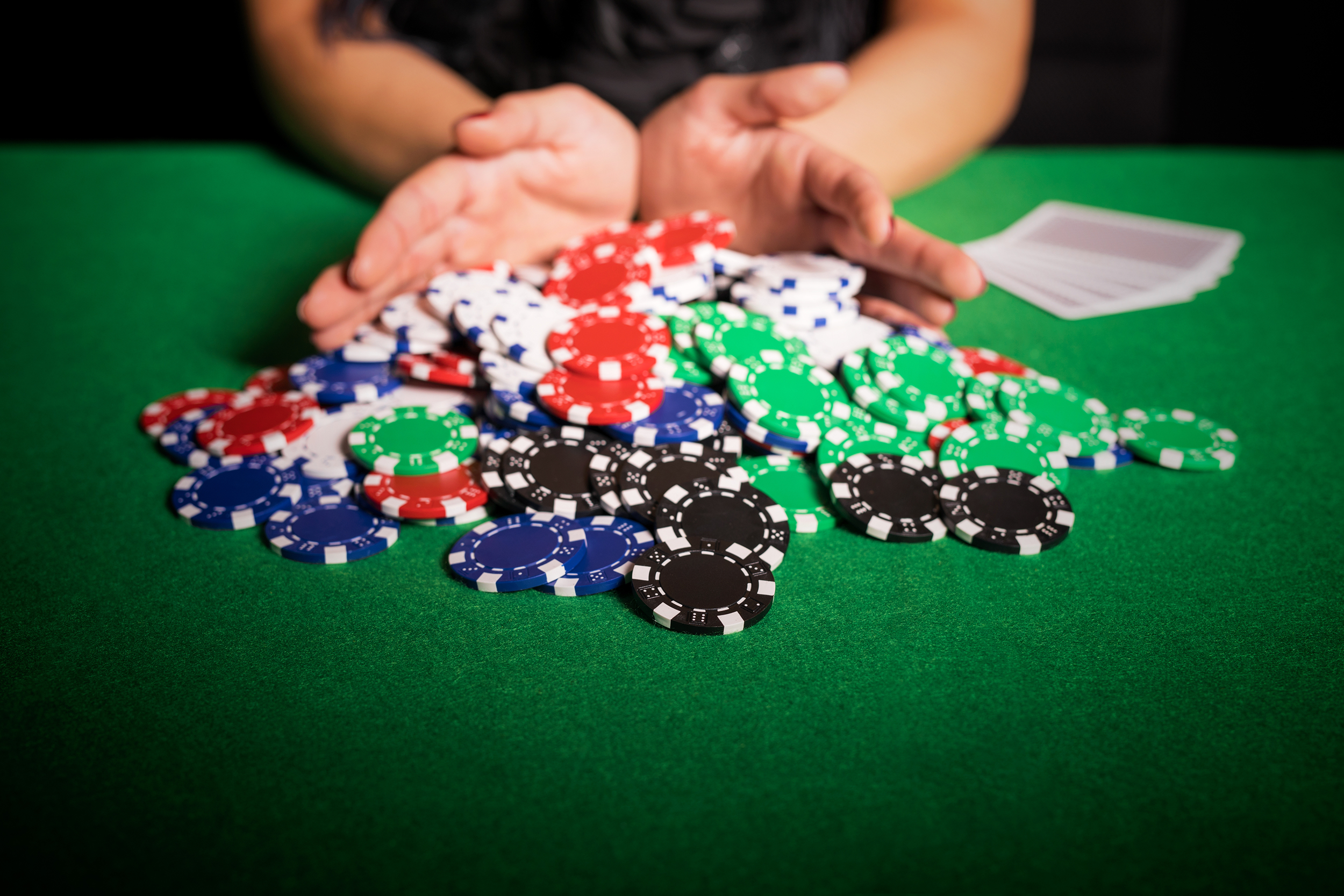
When looking at average dollar amount spent, Americans spent the most on gambling ($121.07), followed by car-related purchases ($89.64) and vacations ($84.52). The most popular category, food, had drunk shoppers spending an average of $82.32.
Finder.com
- Everyone: $121.07
- Men: $108.07
- Women: $165.09
grinvalds/istockphoto

- Everyone: $89.64
- Men: $88.16
- Women: $101.64
SrdjanPav

- Everyone: $84.52
- Men: $85.14
- Women: $81.16
DepositPhotos.com

- Everyone: $82.32
- Men: $79.73
- Women: $88.15
Adobe

- Everyone: $72.13
- Men: $62.07
- Women: $92.68
DepositPhotos.com

- Everyone: $69.52
- Men: $65.82
- Women: $87.30
Julia Paszkiewicz/istockphoto

- Everyone: $68.66
- Men: $66.02
- Women: $83.15
fizkes/istockphoto

- Everyone: $60.61
- Men: $53.97
- Women: $89.35
DepositPhotos.com

- Everyone: $59.17
- Men: $61.77
- Women: $35.80
ClassicCars.com

- Everyone: $58.88
- Men: $59.04
- Women: $57.87
depositphotos.com

- Everyone: $50.89
- Men: $44.29
- Women: $78.71
Chewy

- Everyone: $38.77
- Men: $39.27
- Women: $37.15
Mac99/istockphoto
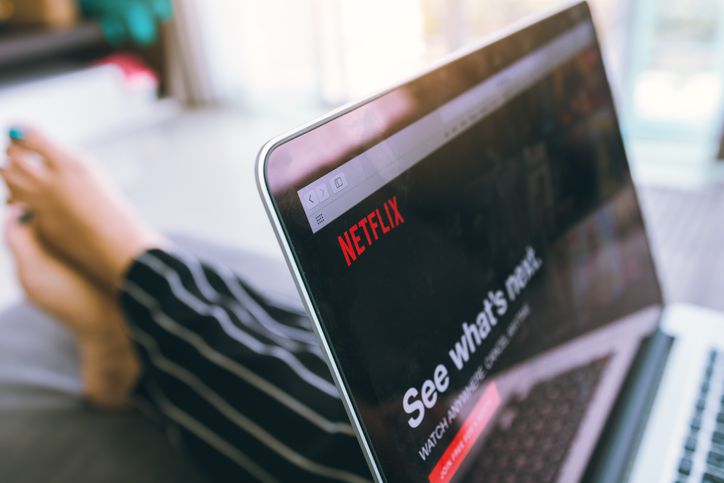
- Everyone: $34.89
- Men: $35.57
- Women: $32.27
wutwhanfoto / istockphoto

- Everyone: $34.67
- Men: $33.69
- Women: $41.10
KatarzynaBialasiewicz/istockphoto

- Everyone: $34.10
- Men: $31.01
- Women: $50.53
Rohapp
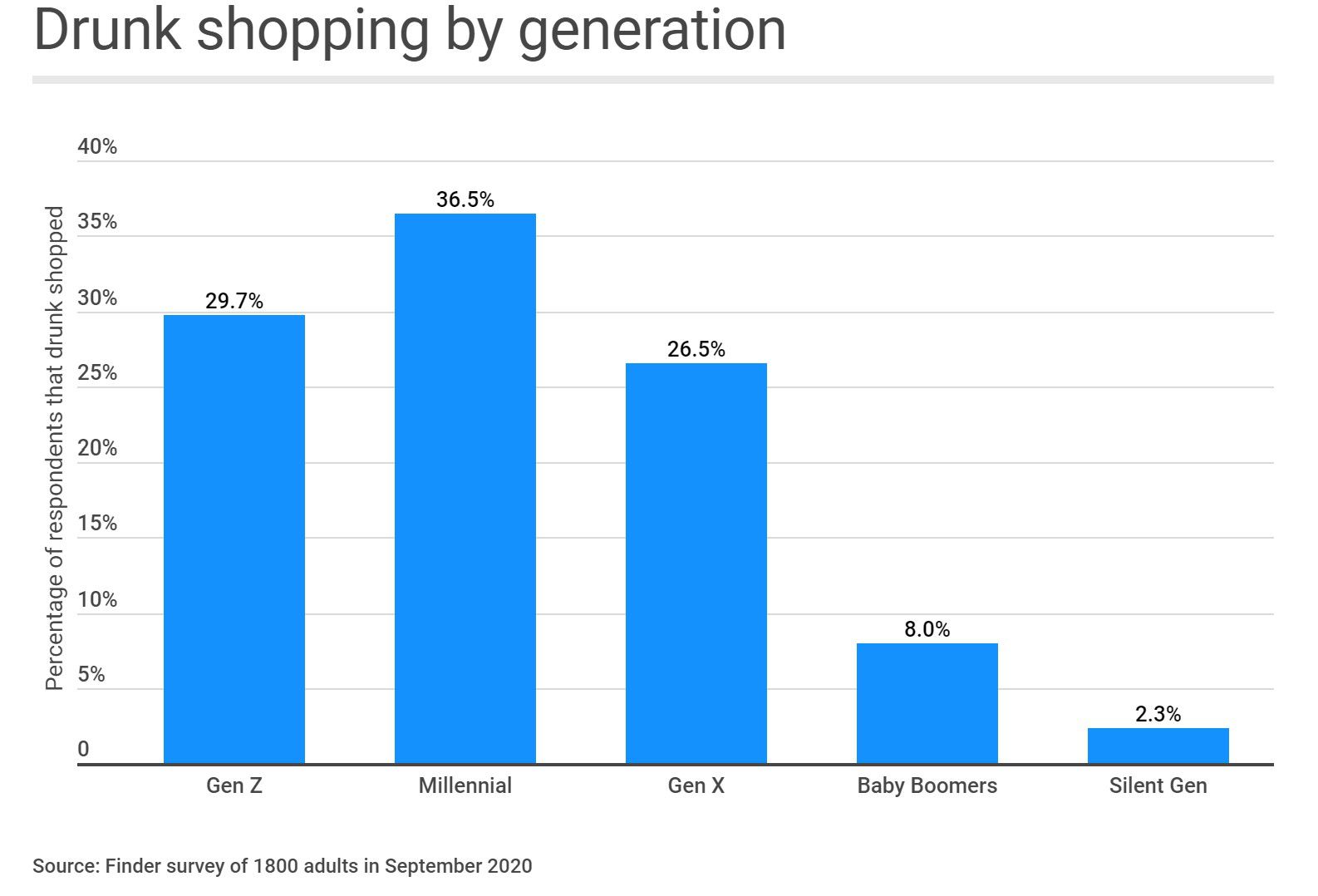
On par with last year’s trend, millennials were the generation most prone to drunk shopping (36.5%). Following millennials was Gen Z (29.7%), Gen X (26.5%) and baby boomers (8.0%).
Finder.com

Although drunk shopping was the most prevalent among millennials, Gen X was the generation that actually spent the most on average among drunk shoppers. However, all generations spent less drunk shopping this year compared to last year. Gen X drunk shoppers spent an average of $521.57 compared to last year’s average of $797.49. Following Gen X are millennials ($475.75) and baby boomers ($274.62).
This article
originally appeared on Finder.comand was
syndicated by MediaFeed.org.
Finder.com
Featured Image Credit: dusanpetkovic / istockphoto.