
Several large lenders shaved their posted mortgage rates Wednesday morning, but the more consequential number for anyone shopping a loan wasn’t the cut. It was the distance between lenders.
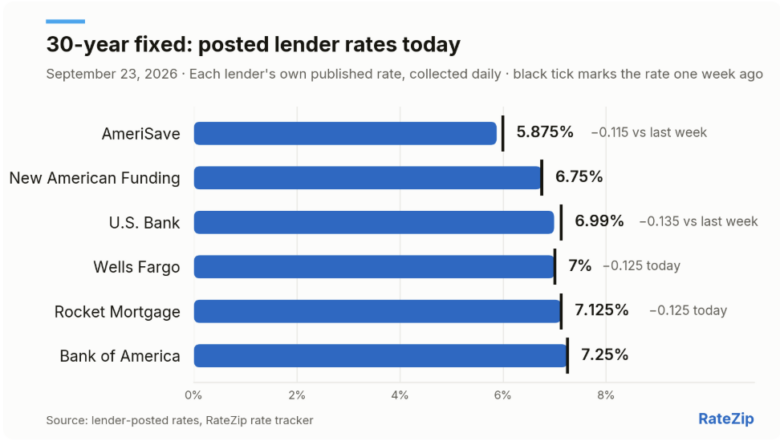
As of 9:50 a.m. ET, the cheapest posted 30-year fixed rate in RateZip’s tracked set was AmeriSave’s 5.875%. The most expensive was Bank of America’s 7.25%. That is a spread of 1.375 points — worth roughly $363 a month on a $400,000 loan, or many times the 0.125-point trims that Rocket Mortgage (to 7.125%), Wells Fargo (to 7%) and Bank of America’s 20-year fixed (to 7%) each posted the same morning.
What that means in practice is that the lender you call matters more on any given morning than the day the market hands you. APR is the cleaner cross-lender comparison, since each posted rate carries its own assumptions about credit, points and loan size: Wells Fargo’s 30-year carries a 7.174% APR, U.S. Bank’s 6.99% rate a 7.152% APR.
The backdrop borrowers are shopping into
Nationally the direction has been up, not down. The average 30-year fixed rate was 6.95% in the week ending September 17, according to Freddie Mac’s weekly survey — no, per Freddie Mac’s Primary Mortgage Market Survey, up from 6.76% a week earlier. The 10-year Treasury yield, which long-term mortgage pricing most closely tracks, closed Monday at 4.96%, down 5 basis points from the prior close and down 1 basis point on the week.
Buyers have not entirely stepped back. Pending home sales rose 0.3% in August from July, though they were down 4.7% from a year earlier and fell in all four regions annually, according to the National Association of Realtors. Its chief economist, Lawrence Yun, put it this way in the association’s statement: “Buyers steadily entered into contracts in August even though mortgage rates increased”.
Sellers, meanwhile, are giving ground. HousingWire reported that 42.1% of active listings carried a price cut in the week ending Sept. 18 — a third straight week above the comparable 2025 level — with 86 single-family homes going under contract per 100 new listings, down from 96 a week earlier, and active inventory at 890,303.
Where the demand has gone
The clearest signal of how households are responding is what they are shopping for. Home-equity products — HELOCs plus reverse mortgages — drew 76% of inquiries over the three months through August 2026, up from 43% in the same months a year earlier, according to RateZip’s Mortgage Demand Index. Refinance inquiries went from 39% of the mix to 2%.
Total inquiry volume is not shrinking, either: August ran 11% above July and 157% above August 2025. The one home-equity rate in the tracked set, FourLeaf Federal Credit Union’s variable HELOC at 7%, was also the biggest weekly mover, up 0.25 points — a reminder that the product borrowers are crowding into is repricing too.
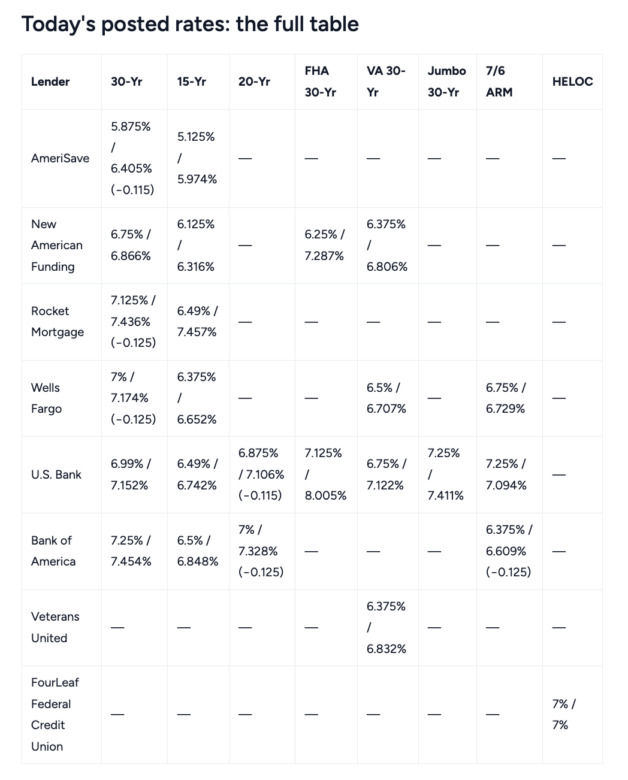
Rates are each lender’s own published rate as of 9:50 a.m. ET, collected from their public rate pages and feeds. The APR is the better cross-lender comparison; a figure in parentheses is today’s change; a ‘—’ means the lender doesn’t post that product. How we collect and publish this: our rate methodology.
Read more
RateZip is operated by Peklava LLC, DBA RateZip, a licensed mortgage broker (NMLS ID 1592292). We are compensated by some of the partners shown on this page, which may affect which offers appear and where. It does not affect our reporting or our recommendations. Rates shown were last updated September 23, 2026 at 9:50 a.m. ET. See our editorial standards and how we use AI.
How we track rates: methodology. Found an error? Tell us.
Ask us! What questions do you have about content, strategy, pop culture, lifestyle, wellness, history or more? We may use your question in an upcoming article!
Like MediaFeed’s content? Be sure to follow us.
This article originally appeared on RateZip and was syndicated by MediaFeed.co.