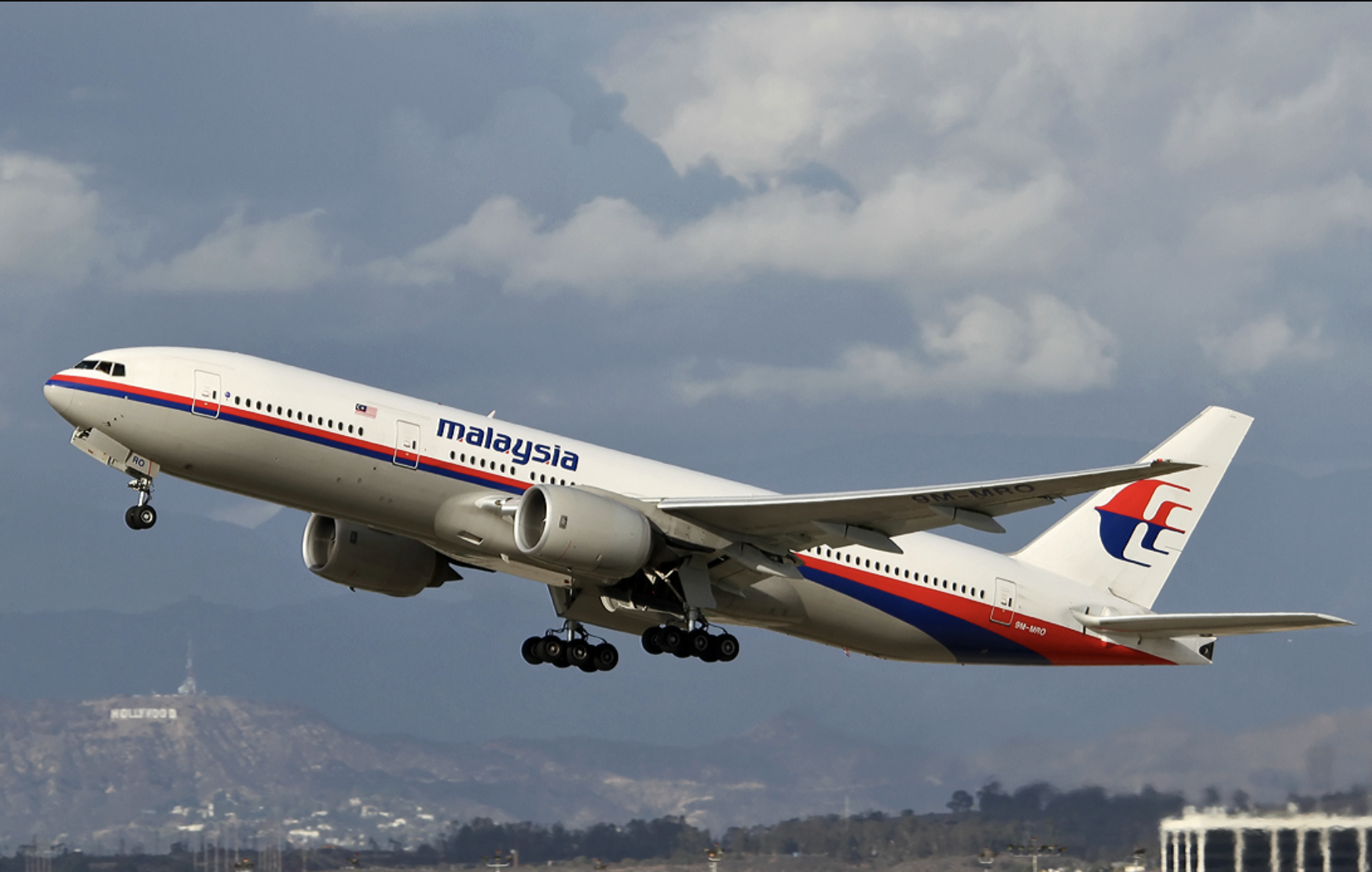
On March 8, 2014, Malaysia Airlines Flight 370 took off from Kuala Lumpur, Malaysia, headed for Beijing, China. On board were 227 passengers and 12 crew members, making a total of 239 people. However, less than an hour after departure, the plane vanished, and despite an extensive international search covering millions of square kilometers across the Indian Ocean, the main wreckage of the plane has never been found.
Shortly after takeoff, the aircraft lost contact with air traffic control. At the time it disappeared from radar, the plane was over the South China Sea. Investigations later revealed that the Boeing 777 did not simply stop working, instead, it veered sharply off its planned course. Instead of continuing north toward China, the plane turned back across the Malay Peninsula and then headed south toward the Indian Ocean. Because the plane’s transponder, the device that communicates with radar, had been turned off, tracking the flight became nearly impossible for authorities.
Ask us! What questions do you have about content, strategy, pop culture, lifestyle, wellness, history or more? We may use your question in an upcoming article!
The Flight took off at 12:41 am local time and reached a cruising altitude of 10,700 meters, 35,000 feet, at 1:01 am. The Aircraft Communication Addressing and Reporting System (ACARS), sent its last transmission data about the aircraft’s performance at 1:07 am and was subsequently switched off. Twelve minutes later, at 1:19 am, the crew made their final voice communication with air traffic control.
At 1:21 am, just as the plane was about to enter Vietnamese airspace over the South China Sea, the plane’s transponder, which communicated with air-traffic control, was switched off. Without the transponder, the plane could no longer communicate its position to civilian air traffic controllers, effectively making it invisible to standard tracking systems.
Despite the loss of communication, military and civilian radar in Malaysia continued to track the aircraft’s physical movements. At 1:30 am, radar showed the plane making a significant turn. Instead of continuing toward Beijing, it flew southwest over the Malay Peninsula and then turned northwest over the Strait of Malacca.
The last bit of radar evidence came at 2:22 am, when Malaysian military radar lost contact with the flight over the Andaman Sea. At this point, the plane had traveled far from its intended path, heading into remote regions where traditional tracking was unavailable.
Although the plane had vanished from radar, it continued to send automated pings to a satellite. An Inmarsat satellite, positioned in geostationary orbit over the Indian Ocean, received hourly signals from Flight 370. These signals provided a haunting trail for investigators to follow.
The very last signal from the aircraft was detected at 8:11 am, more than seven hours after it had first taken off. This data suggested the plane had continued to fly for several hours over the Indian Ocean before finally disappearing.
Following the disappearance, an international search effort was launched. It eventually became the most expensive search in aviation history. For years, teams from several countries used advanced technology to scan the floor of the southern Indian Ocean, covering thousands of square miles.
Despite these massive efforts, the main body of the plane was never found. While a few small pieces of debris confirmed to be from Flight 370 eventually washed up on beaches in Africa and on islands in the Indian Ocean, the black box flight recorders and the bulk of the fuselage remained missing.
The disappearance of Flight 370 was a tragedy for the families of the 239 people on board, and the disappearance led to significant changes in how global flights are tracked, ensuring that planes are monitored more frequently while over the ocean.
Like MediaFeed’s content? Be sure to follow us.
This article was syndicated by MediaFeed.org.