What we see (and don’t see) in the Middle East
The U.S.-Iran conflict continues to escalate, and it is hard for me not to feel a centrifugal force pulling me toward the Middle East.
For most of the last 40 years, when the region heated up, I packed my bags and got visas that would allow me to head into the latest hot spot. I served as a long-time Middle East correspondent for The Boston Globe for nearly a decade following September 11 and also did a stint for PBS Frontline during the so-called Arab Spring when we thought the uprising against authoritarian regimes in Egypt, Libya, Syria and elsewhere might actually transform the region. Those hopes for real change were dashed long ago.
Those of you who read this Substack know that I have stepped back from the frontlines of the Middle East and the kind of international reporting that I used to do in Ukraine, Afghanistan and elsewhere. These days, I am focused much more intently on local news in America where we are seeing our democracy fray, a story of civilizational decline and a gathering storm of public discontent that I still believe is the biggest story in the world. Most immediately, I am focused on the difficult challenge of serving as a local publisher and trying to make the newspaper in my community sustainable.
Still, it is hard not to feel surrounded by the drumbeat of war banging away on CNN and NPR and in the New York Times. Every day, new headlines indicate a wider regional war is set in motion. New fronts are opening across the Middle East as diplomatic efforts consistently sputter and fail. According to the Associated Press, Iran launched a surprise ballistic missile attack targeting U.S. forces in Jordan. The missiles were reportedly intercepted, but in retaliation the U.S. and Saudi Arabia launched joint strikes against Iranian-backed militias in Iraq.
But as the world plunges into the black hole of the Middle East what seems most striking is that international journalists as well as local media organizations have been effectively thwarted across the region, particularly in Israel and Iran. The two countries are mortal enemies but they are bound together by a determination to constrain a free press and prevent independent reporting from their respective countries.
These constraints placed on journalism are explained away as security concerns and carried out by governments that are consistently refusing to grant unfettered access to cover the conflicts. As a result, their citizenry and the whole world is left flying blind straight into the dark abyss of war. All of us are left without the benefit of ground truth, the belief that we can all best calibrate the complexity of the world around us by basing our observations on the discernible facts gathered by reporters who are there on the ground.
In Iran, which has long been opaque to the outside world and always a uniquely perilous place for Western media organizations, WIRED magazine reports that journalists are relying on satellite links, encrypted apps and smuggled video footage to try to tell the story. The attempt is noble, but so far, they are largely failing to provide any coherent picture as to what is happening inside the country. The stakes are of course incredibly high as any journalist found, for example, with a mobile Starlink would be immediately suspected as a spy for Israel and/or the U.S. and then detained and put in prison.
In Israel, the restrictions are imposed through a tight cordon of security that prevents journalists from operating independently inside Gaza, and therefore a full assessment of the extent of the devastation of Israel’s bombing campaign is difficult to achieve. In a piece titled “Subversion of Reality,” Gerry Shih, an international correspondent for the Washington Post focusing on the Middle East, offers a glimpse of the daily struggle of reporters on the ground, including some of the prominent correspondents in the world such as the BBC’s Jeremy Bowen, NPR’s Daniel Estrin and others.
The Israel Defense Forces are providing tightly controlled tours of Gaza for these journalists which then makes the news organization obliged to submit to censorship rules which Israel says is based on security concerns, but Shih unpacks how these guided tours can end up skewing coverage.
He writes, “While the Israeli military readily facilitates visits to sites that allegedly implicate Hamas—tunnels running under hospitals, the purported weapons workshop Bowen (of the BBC) saw—its ban on journalists’ entering Gaza means that investigations into other subjects, including possible Israeli war crimes, become far more challenging to execute.”
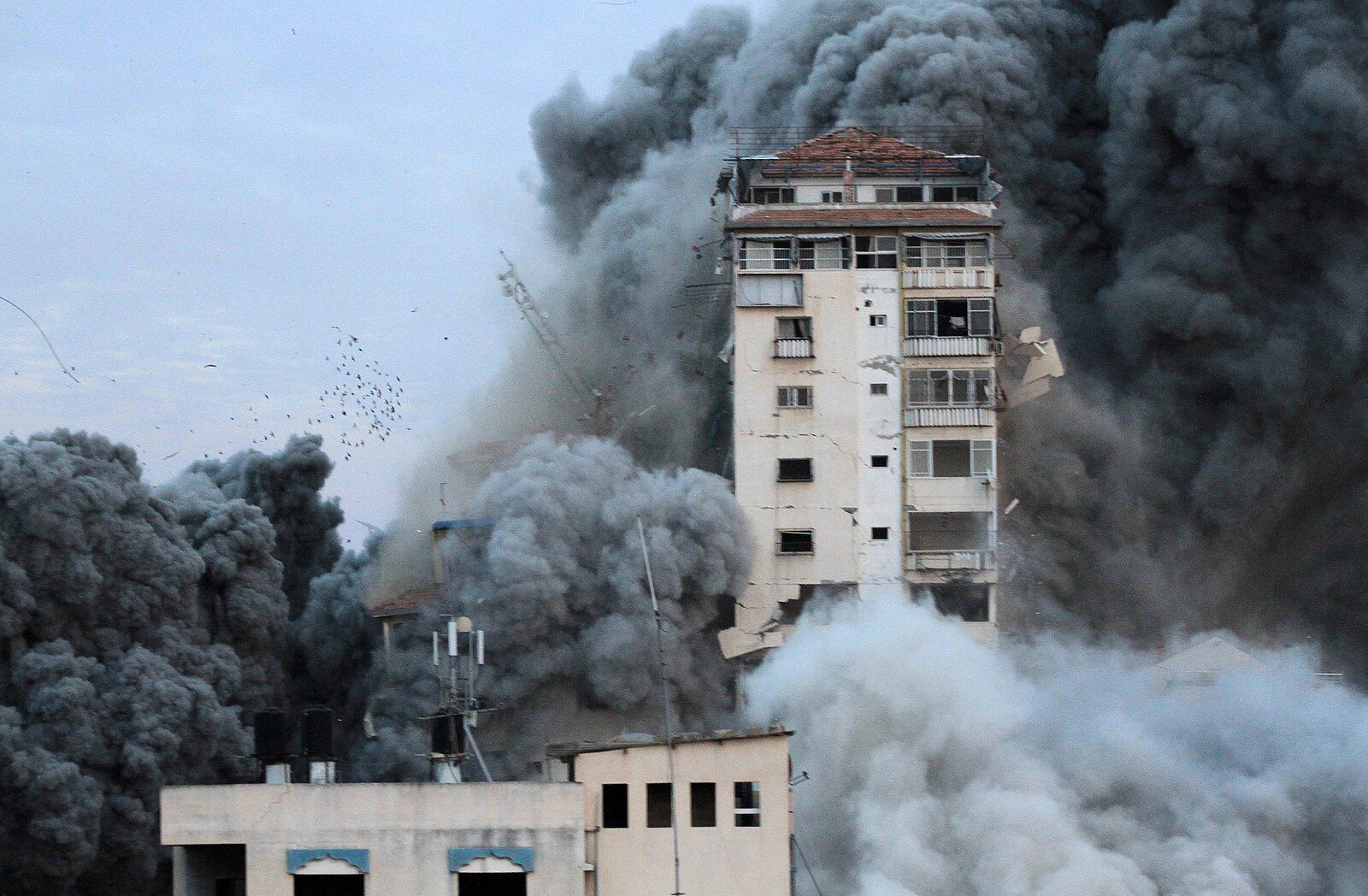
While journalists are frustrated by the lack of news that is actually coming out of these tours, there was often information that would serve as part of a larger story and photographs that emerged were useful in furthering an understanding of what is going on. As Shih explained, the Washington Post has done its level best to make the most of the dog-and-pony shows that the IDF is offering. He cited an old friend and longtime colleague, Heidi Levine, a Post photographer who I worked with for many years who took a memorable image of Gaza City reduced to ruins which landed on the Washington Post homepage.
Shih wrote, “During the mid-2025 hunger crisis, Levine joined the Royal Jordanian Air Force on a humanitarian airdrop. Despite Israeli pressure on Jordanian officials to block aerial photos, she captured a striking shot of Gaza that went viral around the world.”
I worked with Levine in Gaza over the years, and have seen how dedicated she is to telling the story and how many risks she has taken. But in Gaza, it has long been the case that Palestinian reporters and photographers who work with international news agencies are the most consistent avenue for information on what is happening. There are more than 1,000 local Palestinian journalists and stringers affiliated with agencies such as Al Jazeera, Reuters and the Associated Press who fill a void as international reporters are barred by Israel from independently entering and doing their work.
As a result, Palestinian journalists have been in the line of fire as never before, according to the Committee to Protect Journalists. As of June 25, 2026, the current total of individuals documented by CPJ as journalists or media workers killed by Israel in Gaza and in Israeli detention centers since October 7, 2023, stands at 209. Recently, Israeli government officials and pro-Israel media watchdogs have scrutinized the CPJ numbers and methodology, and offered photographs of some Palestinians named as journalists who were killed in military fatigues and as combatants connected to Hamas. CPJ follows a strict protocol for verifying who is a journalist and, consistent with this approach, has removed eight names from its database because they were later established to have been Hamas or PIJ combatants. Those corrections to the database would not change the current number of journalists killed in Gaza at 209, according to CPJ.
“It is the deadliest place in the world to be a journalist,” said Jodi Ginsberg, the CEO of CPJ.
In an interview with Al Jazeera in April after a Palestinian journalist who worked for the network, Mohammed Wishah, was killed when an Israeli drone struck the vehicle in which he was driving while on assignment.
“We’ve seen the systematic targeting and killing of journalists … a pattern in which Israel is seeking to control information about what we are seeing out of Gaza,” said Ginsberg, adding that the pattern of killing and the complete impunity with which it is happening “constitutes a war crime.”
In a story earlier this month by Ha’aretz, a correspondent criticized the attempt by pro-Israel press watchdog groups to undercut the distressing findings of CPJ that show an unprecedented level of killing of journalists by Israel. Pointing out inconsistencies and holding CPJ to account is all well and good, and very much the work of media watchdogs. But when relatively small numbers of cases are highlighted as a way to undercut CPJ’s work and suggest that they are inflating numbers, the result, as the headline claims, is actually “an attack on journalism.”
This is crucial, not just because it tries to move the attention away from the fact that dozens of journalists have been killed by state forces, when just one would be one too many, but also because it makes it harder for us to see the complexities of Iran and Gaza and the U.S. role in the region. It serves to push us farther away from the truth, always one of the first casualties of war.
Join the GroundTruth community
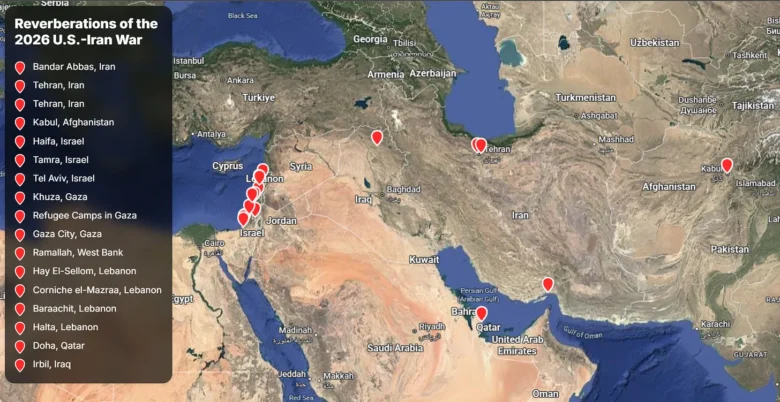
Storymap: Reverberations of the 2026 U.S.-Iran War
Amid the numerous restrictions on reporting across the Middle East, on-the-ground reporting has been made difficult, but several organizations, from global outlets like the Associated Press and The New Yorker to smaller regional magazines like Public Source and 972 Magazine, have produced thorough human-centered reporting that highlights the myriad ways this war has impacted people in Israel, Iran, and everywhere in between. My GroundTruth colleague, Alana Campbell, has mapped these stories here.
Iran
- Southern Iran Is Being Destroyed | Fateme Karimkhan, New Lines Magazine
- Iran’s Care for Orphans Has Been Transformed by War | Fateme Karimkhan, New Lines Magazine
- What the War Has Done to Iranians | Cora Engelbrecht, The New Yorker
- Afghans in Iran are fleeing bombs, and Iranian crackdowns | Ali M. Latifi & Farzad Rahim, The New Humanitarian
Israel
- A Collapsing Society: Israel Suffers a National Mental Crisis Due to the War | Tom Levinson, Haaretz
- Exposed from above, silenced from within: Palestinians in wartime Israel | Samah Watad & Baker Zoubi, 972 Magazine
- Israel antiwar protests spur intensifying government crackdown | Rachel Fink, The Forward
Gaza
- Israel’s campaign of erasure: The demolition of eastern Gaza | Riley Sparks & Ghada Abdulfattah, The New Humanitarian
- How War Has Redefined Marriage in Gaza | Athar Abu Samra, New Lines Magazine
- ‘The war is between Israel and Iran. Why should people in Gaza pay the price?’ | Ahmed Dremly and Ibtisam Mahdi, 972 Magazine
West Bank
- With West Bank under total Israeli closure, settlers are seizing the moment | Oren Ziv & Basel Adra, 972 Magazine
Lebanon
- “Black Wednesday”: Minutes of Israeli Strikes, Days of Searching for the Missing | Dana Hourany, The Public Source
- Labor Amid Displacement: How Lebanon’s Midwives are Carrying Expecting Mothers Through War | Amelia Hankins & Ghadir Hamadi, The Public Source
- The real ramifications of Israel’s mass evacuation orders in Lebanon | Ranine Awwad, The New Humanitarian
- Inside Israeli-occupied southern Lebanon | Santiago Montag, 972 Magazine
The Gulf & Iraq
- Iran’s Attacks on the Gulf Are Leaving Scars That Won’t Fade | Sinem Cengiz, New Lines Magazine
- Drivers endure overnight gas lines as a war-driven fuel shortage grips Iraq’s Kurdish region | Stella Martany, AP News
Related:
- Journalism labor unions reawakened in the age of AI
- After the Washington Post: The future of D.C. journalism
Ask us! What questions do you have about content, strategy, pop culture, lifestyle, wellness, history or more? We may use your question in an upcoming article!
Like MediaFeed’s content? Be sure to follow us.
This article originally appeared on GroundTruth and was syndicated by MediaFeed.co.