
Every six months or so, your practice has to prove that a child is making progress — or risk a reduced authorization, a denial, or an appeal. The hard part isn’t doing good clinical work; it’s documenting change in a way a reviewer can’t easily question. When your progress evidence leans on parent recall and rating scales, normal reporting variation can mute real gains, and a true plateau can read as failure. This guide walks through why the six-month cycle is so unforgiving and how a repeatable, objective developmental measure — run on the same cadence — gives you a second, independent data stream that makes progress harder to argue with.
The Reauthorization Rhythm — Why Six Months Is the Make-or-Break Cycle
For most plans, the reauthorization clock runs on roughly a six-month interval, with a fuller reassessment often expected annually. The exact timing, forms, and required assessments differ by payer and state — some, for example, want the package submitted weeks before the current authorization expires — so the only safe assumption is that requirements vary by plan and should be confirmed for each.
What doesn’t vary is the underlying question. Payer medical-review teams keep returning to the same point: is there clear, measurable progress that justifies continued services at the authorized intensity? Twice a year, you have to answer that in writing — and a thin answer has real consequences for the child’s continuity of care and for the practice.
What Current Reassessment Workflows Look Like — and Where They Fall Short
A typical six-month package pulls together updated standardized assessment scores, goal mastery and progress summaries, graphed program data, and a medical-necessity rationale. The standardized outcome measures most teams reach for — the Vineland-3, the VB-MAPP, the ABLLS-R — do important work, capturing adaptive function and developmental milestones in formats payers recognize.
The limitation isn’t the tools. It’s that most of these measures are report- or recall-based, which introduces three predictable problems when the job is tracking change over time.
Reporting noise can hide real change. A caregiver answering “does your child do X” is reconstructing across many days and settings. Between two interviews six months apart, some of the difference in scores is genuine development, and some is variation in the reporting itself. When the signal is small, the noise can swallow it.
A plateau looks worse than it is. Skill acquisition isn’t linear. A child can be consolidating gains, or progressing on dimensions a particular instrument doesn’t measure, and still show a flat profile that quarter. On a single report-based stream, “flat” is easy for a reviewer to read as “not working.”
One stream carries all the weight. When adaptive scores and program data both originate from the same observers and the same setting, they aren’t fully independent. A reviewer is being asked to trust one vantage point — and trust is exactly what’s under scrutiny.
None of this argues against your current measures. It argues for adding something next to them.
How the Two Streams Work Together at Reauth
When a reviewer sees adaptive gains on a report-based measure and an objective developmental index moving in the same direction, two independent streams agreeing make a stronger, harder-to-question case than either alone. The streams answer different questions, which is exactly why they corroborate well.
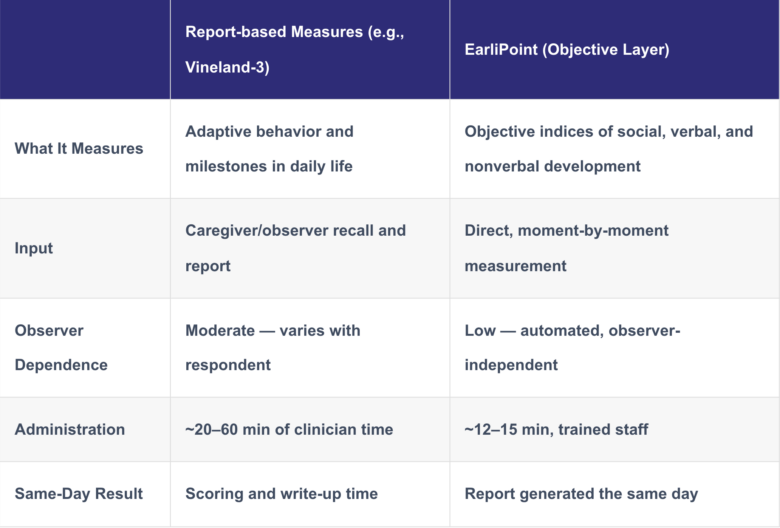
If a child plateaus on the report-based measure but the objective index ticks up, you have evidence the development underneath is still moving — useful context a reviewer rarely gets. If both move together, the progress case largely makes itself.
Building a Longitudinal Developmental Record Across Years of Care
Because the same objective measure can be run at intake and re-run at each six-month cycle, you can build a consistent developmental trajectory across years of treatment — every data point produced the same way, on the same instrument, independent of who administered it. That’s something a series of separate interviews can’t reliably reproduce. Over four or five reauth cycles, a clean trajectory line is one of the more persuasive artifacts you can put in front of a reviewer.
A Six-Month Reassessment Workflow With Objective Data Built In
You don’t have to change your process. You add one repeatable step to it:
- Keep your current measures. Maintain the Vineland-3, VB-MAPP, ABLLS-R, and program data you already report.
- Establish an objective baseline at intake for children in the 16–95 month range.
- Re-measure on the reauthorization cycle so the objective index lands alongside your other reassessment data.
- Report the streams side by side, integrated by your clinical narrative, so the agreement between them is visible to the reviewer.
The objective assessment runs about 12 to 15 minutes and is administered by trained staff, so it adds little to clinician workload while giving you a data point no recall-based tool can.
What Payer Reviewers Actually Look for in a Reauthorization File
Reviewers converge on a few questions: is ABA medically necessary at this intensity right now, does the documentation match what was authorized, and is there clear, measurable progress? Notably, denials tied to “lack of progress” frequently trace back to documentation gaps — missing data, vague goals, thin evidence of functional gains — rather than the absence of real progress.
That’s the gap a second, objective stream is built to close. To be precise: adding objective data doesn’t guarantee approval, and payers don’t require only one specific tool. But an FDA-cleared, observer-independent index strengthens the documentation that progress is real — and gives a reviewer a corroborating reading instead of a single vantage point to question. Always confirm each plan’s specific reassessment and reauthorization requirements, since they vary.
Frequently Asked Questions
How often does ABA reauthorization happen?
Most payers require a progress review and reauthorization roughly every six months, with a more comprehensive reassessment often expected annually. The exact cadence, forms, and assessment requirements vary by plan and state, so confirm each payer’s policy.
What’s required in a six-month ABA reassessment?
Generally: updated standardized assessment scores with pre/post comparisons, goal mastery and progress summaries, graphed program data, and a medical-necessity rationale tying continued treatment to ongoing need. Specific elements vary by payer.
How do you demonstrate progress in ABA therapy?
Through program data, goal mastery, and standardized outcome measures readministered on the reauthorization cycle. Pairing report-based measures with an objective, observer-independent developmental index gives you two streams that can corroborate each other — strengthening the case beyond what a single source carries.
Why do reauthorization requests get denied for lack of progress?
Denials often stem from documentation gaps — missing data, vague goal descriptions, or limited evidence of functional progress — rather than an actual lack of gains. A second, independent measure of development can make the progress case clearer and harder to question.
Related:
- The ABA practice owner’s toolkit for picking the right marketing channels
- How to keep families happy while your ABA practice grows
Like MediaFeed’s content? Be sure to follow us.
This article originally appeared on Earlipointhealth.com and was syndicated by MediaFeed.co