In January, months before the first whistle, a small group gathered to imagine what the World Cup might mean for Montclair, an affluent suburb in northern New Jersey, close to Manhattan, and practically spitting distance from MetLife Stadium, where the games are played.
The meeting, convened by the township’s Economic Development Coordinator, Daniel White, brought together Dave Placek of Lackawanna Plaza, Jason Gleason of the Montclair Center Business Improvement District, local town council member Aminah Toler, and others. Ideas flowed: public watch parties, international food, a downtown celebration worthy of the world’s biggest sporting event.
By this summer, as matches unfolded at MetLife Stadium, many residents and business owners were asking a different question: what happened?
New Jersey had been promised an economic windfall — a state committee projected more than $3 billion in regional economic activity from the eight matches, including the championship, also held at MetLife Stadium. Montclair, with its walkable downtown, international restaurants and reputation as one of the state’s premier dining destinations, looked positioned to cash in.
The Quiet on Bloomfield Avenue
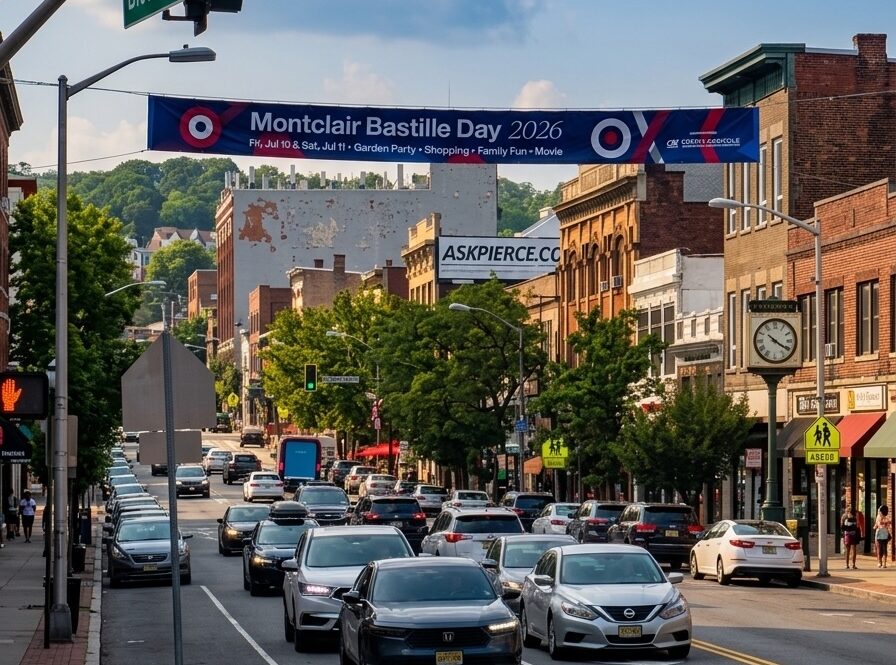
Instead, Bloomfield Avenue during the tournament looked like Bloomfield Avenue on any other week. No coordinated decorations, no town-wide campaign, no visible sign that the world’s largest sporting event was happening down the road. The banner spanning the avenue’s four lanes was promoting Bastille Day.
That absence became the story, even though beneath the surface, plenty was actually happening.
Local restaurants like Faubourg ran viewing parties as France advanced. Noches de Colombia became a gathering spot for Colombian fans. Cuban Pete’s decorated all tournament long. Sam’s Table built a World Cup menu around competing nations. The MC Hotel hosted the German, English and Norwegian national teams and opened its doors for public watch parties. According to Placek, crowds at Lackawanna Plaza sometimes topped 1,500 for free screenings while kids kicked balls around between matches. By most accounts, it’s been the closest thing Montclair had to a real World Cup atmosphere.
But it was happening one business at a time. What never emerged was a shared sense that Montclair itself was celebrating the World Cup.
On the Ground
Employees noticed. A server at Greek Taverna said she expected the tournament to fill more tables: “We thought it was going to be busier.” A two-year employee at The French Dad hoped France’s presence in Jersey would pull in more visitors: “I don’t see that hype. I think they should promote it more.” An employee at Chip City offered the starkest comparison — last summer, she said, their Montclair location was much busier than this one.
An Instagram poll of nearly 100 followers found only 36 percent felt World Cup excitement around town.
A Different Read
Not everyone agreed. “Honestly? It’s been lit,” said Zane Keyes, owner of Keycuts Barbershop on Church Street, pointing to projectors, viewing parties and crowds gathering across town. His complaint was narrower: “The problem is we don’t have a quality sports bar.” It’s a gap several business owners flagged — Montclair has plenty of great restaurants and bars, and few places to hold a few hundred fans around a big screen.
Leo Sawadogo, owner and head brewer of Montclair Brewery on Walnut Street, made his own bet on the tournament: a rotating lineup of small-batch beers, one for many of the competing nations. His hope was bigger than beer sales. He wanted the World Cup to show people “how interconnected the world is.”
“There’s no team you’re gonna see without an African player,” he said. “One single game in Europe can have a lot more viewers than the whole entire Super Bowl. That’s one of the things people didn’t realize.”
What he didn’t expect was how little of that global audience would find its way to Walnut Street. The German national team was staying a mile away from his brewery. The English team was in town, too. He had beers named for both teams. “So where are the people?” he said. “I heard Boston ran out of beer. I wanted personally to deliver beer to Boston — I wanted to save the day.” He’d braced for a rush. “I thought we was gonna get smashed,” he said. “And none is happening.”
The brewery itself wasn’t hurting — if anything, Sawadogo said his beers overall were selling well. His frustration was on behalf of the town around him. He’d pictured tourists wandering Walnut Street the way Lackawanna’s watch parties pulled crowds a half a mile away. Instead: “Most people that come here are the regulars.”
Whose Job Was This, Anyway?
In communications from the town manager, Stephen Marks, to a local business owner that we reviewed, Marks indicated that promoting the World Cup fell in the Montclair Center Business Improvement District’s realm. The BID’s jurisdiction, however, covers a specific downtown corridor — Bloomfield Avenue and adjacent streets like Church Street and Glenridge Avenue. Montclair Brewery, part of the separate Walnut Street commercial district, sits outside that boundary. So do hundreds of other businesses in Frog Hollow, Upper Montclair and the South End — commercial strips with no BID assessments funding them and no BID marketing dollars aimed their way.
Which sharpens the question underneath: was this a marketing failure or an infrastructure one? Whose job was it, town-wide, to make the case for Montclair during the World Cup? The BID was never built to answer for Walnut Street. Some have suggested that if anyone was responsible for that, it was the township itself — the same body that convened the fall planning meeting and then, by most accounts, let the momentum from it dissolve.
“That is the thing that I’m so [upset] about.” said Sawadogo. “The town should do a better job because the World Cup is coming, the whole entire world is coming to New Jersey.”
For Jeremy Pholwattana, founder of Downtown Montclair and a six-year Church Street business owner, the answer was to stop waiting. He sourced and painted a series of soccer-themed public pianos now sitting on street corners around town. Pholwattana, who also helped launch PorchFest, sees the BID’s core job as advocating for and beautifying downtown, and views the World Cup as exactly the moment that mission should have shown up.
Whatever residents make of his broader criticism of the BID, his read on the tournament is simple: Montclair should have done better. “This town looks pathetic right now during the FIFA World Cup,” he said. “We’re supposed to be a destination spot.”
Owning Some of It
The BID doesn’t dispute that.
“I think everybody at the BID, including myself, would certainly say, yeah, sure, there’s probably more that could have been done,” said Gleason, who ran the BID from 2019 to 2024 and has returned as a consultant during its leadership transition.
The BID’s admission could point to something more than indifference. The board discussed the World Cup for months. It held planning conversations. It had marketing resources. It acknowledged afterward that it could have done more. Yet what never materialized was a coordinated, visible campaign that gave downtown its own World Cup identity.
Timing didn’t help. About a month before the township’s planning meeting, the BID’s Executive Director Abhishek Shah ended his employment, and the BID went roughly seven months without a permanent replacement while Gleason filled in, a stretch that also had to cover planning for Juneteenth, Pride month, the Jazz Festival, and the rest of the BID’s annual calendar. The vacancy has since been filled: the BID recently named Cesar J. Claro as its next executive director, effective July 13. Board members say he brings decades of downtown management experience and hope he’ll push the district toward a more event-driven era.
It would be easy to assume a district collecting assessments from hundreds of downtown property owners had money sitting around for something like this. The books tell a different story.
The BID runs on roughly $1.3 million a year, funded mostly through assessments on downtown property owners. About $400,000 of that — nearly a third — goes to cleaning, landscaping and beautification. Another $237,000 comes from a state Destination Marketing Organization grant earmarked for pulling in visitors from outside Montclair, not for local decorations or internal promotion.
The $600,000 Grant That Never Came
The BID did chase something bigger. In April, its board approved applying for a $600,000 World Cup tourism grant through Choose New Jersey to fund a “Summer of Soccer” activation at Lackawanna Plaza. Because the grant required a nonprofit applicant, the BID filed it on Lackawanna’s behalf; Placek, whose company owns Lackawanna Plaza and who sits on the BID board, suggested the application but recused himself from the board’s discussion and vote. The grant also required a match from the recipient. Placek told The Montclair Pod he was prepared to provide it and possibly lean on sponsors to back the match.
Here the accounts start to diverge. In an interview, Gleason said the grant, had it come through, could have been spread across the district, not just Lackawanna. Placek told The Montclair Pod that, to his knowledge, the money was intended for programming at Lackawanna Plaza specifically. The publicly available April 15 board minutes describe it the same way Placek does: a “Summer of Soccer” activation at Lackawanna Plaza, not a district-wide scope.
In a follow-up, Gleason offered an explanation: Placek, he said, simply wasn’t privy to internal discussions about spending the budget elsewhere.
The grant was never awarded. Separately, Lackawanna did secure a $50,000 Choose New Jersey grant for its upcoming International Food and Dance Festival. This grant did not require nonprofit status. A spokesperson for Choose New Jersey would not provide details regarding individual grant awards, including award amounts or applicant-specific information. Instead, they referred The Montclair Pod to their eligibility criteria.
The proposal also raised governance questions, given that a sitting BID board member stood to benefit from a grant application the board itself approved. Both Placek and Gleason say the BID followed its conflict-of-interest procedures, including consultation with legal counsel. Gleason said the BID sent a full disclosure letter to Choose New Jersey, explaining the fact that Placek sat on the BID’s board and that Lackawanna was a for-profit entity. Placek frames it as the BID doing exactly what BIDs exist to do. “BIDs are set up to support economic activity in their districts,” he said.
Capacity, Not Imagination
Placek’s account points to other challenges for the BID. He remembers the fall planning meeting as genuinely energetic. The shortfall wasn’t imagination, he said — it was capacity. “There were a lot of great ideas thrown around the table. Very few individuals or organizations had the manpower and all the resources required to put together anything like that.”
Looking back, this may be less a story about enthusiasm than about ownership. The township convened people. The BID debated. Individual businesses did their own thing. Lackawanna spent real money on public watch parties. Nobody ended up coordinating any of it into one campaign.
Whether that gap actually cost Montclair anything is genuinely unclear. FIFA controls official branding and licensing tightly; the actual street-level experience was always going to depend on local host committees, business districts and individual owners choosing to organize around it, not on FIFA itself. Even at Lackawanna, where the investment was biggest, the return was modest.
“You’d probably give us a failing grade on the return on investment,” Placek joked. He estimates Lackawanna spent tens of thousands of dollars, possibly approaching six figures, on activities related to the World Cup — money spent, he says, to create a free community gathering space, not to turn a profit. Other small business owners, like Sawadogo, looked forward to a big coming-together in town but were really hoping for a boost in business. They invested real money into it. Arguably, New York is absorbing most of the region’s World Cup energy; suburban downtowns everywhere are competing for the leftovers.
Additionally, Montclair’s letdown wasn’t unique to Montclair. Nationally, the tournament has fallen well short of its own hype: a May survey by the American Hotel & Lodging Association found roughly 80 percent of hotels across U.S. host markets surveyed by the group were running below their pre-tournament booking forecasts, with hoteliers in cities like Boston, Philadelphia and Seattle describing the World Cup outright as a “non-event.”
Even organizations that planned aggressively weren’t spared. New Jersey’s own transit agency overestimated World Cup ridership by roughly half, an error officials say could cost the state as much as $16 million by the time the tournament wraps, though the agency cautioned that figure is projected, not final.
Economists who study these events say this kind of shortfall is the rule, not the exception: when New Jersey hosted matches during the 1994 World Cup, host cities underperformed their own economic forecasts by an average of $712 million, according to a study published years later.
The question remains, however, despite the history, did Montclair miss an opportunity, especially with so many players staying in town?
The Bigger Question
For many Montclair small businesses, the disappointment was never really about revenue.
It was about a once-in-a-generation event that unfolded practically in their backyard and a lingering sense that Montclair never quite rose to meet it.
Whether a bigger campaign would have changed that is impossible to know.
Whether the town is ready the next time an opportunity like this lands nearby — under Claro’s leadership or otherwise — may be the more lasting question.
Subscribe to The Montclair Pod wherever you listen to podcasts (maybe even if you don’t live in, or never heard of Montclair, NJ…).
Editors Note: An earlier version of this article stated the township meeting happened in October, 2025. Discussions started around that time but the meeting referenced in the article was in January, 2026.
This article originally appeared on MontclairPod.com and was syndicated by MediaFeed.