In photos: A guide to chimpanzee trekking in Uganda
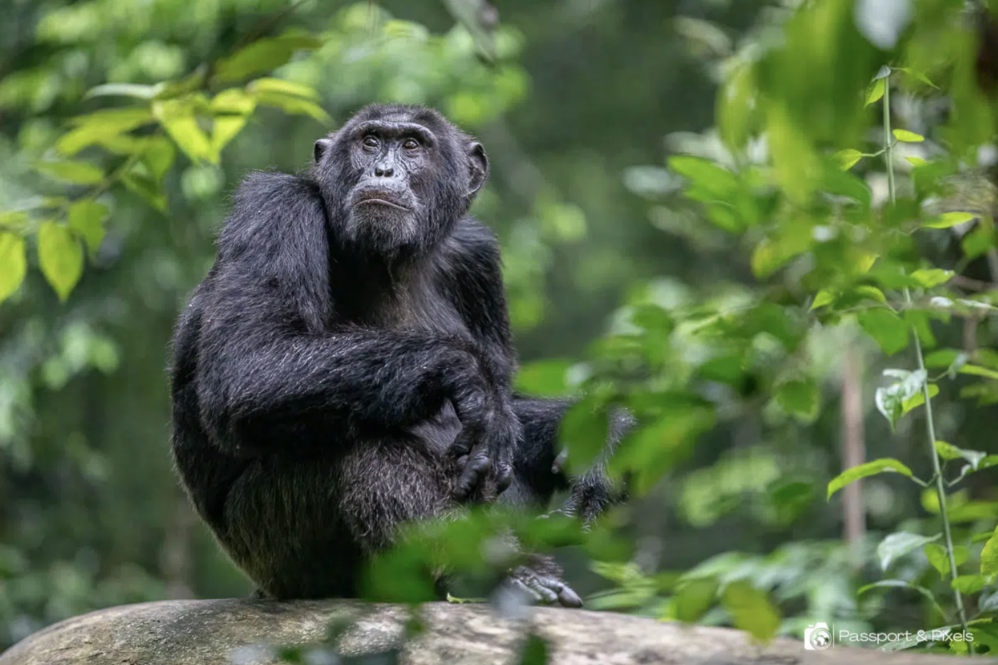
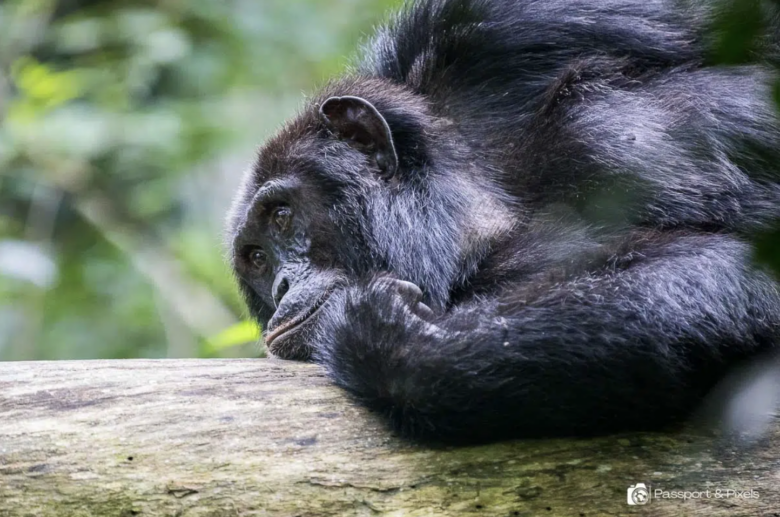
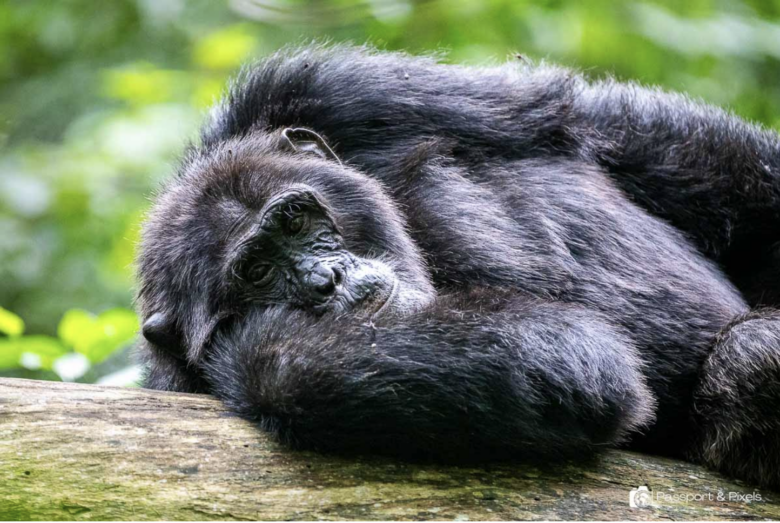
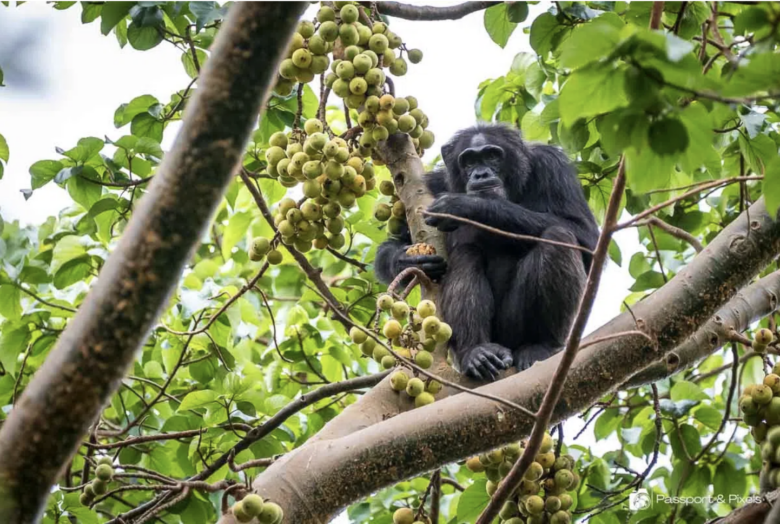
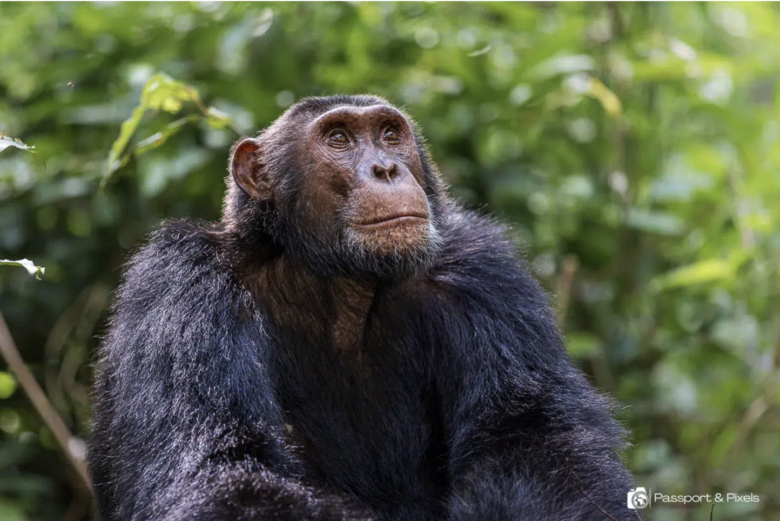
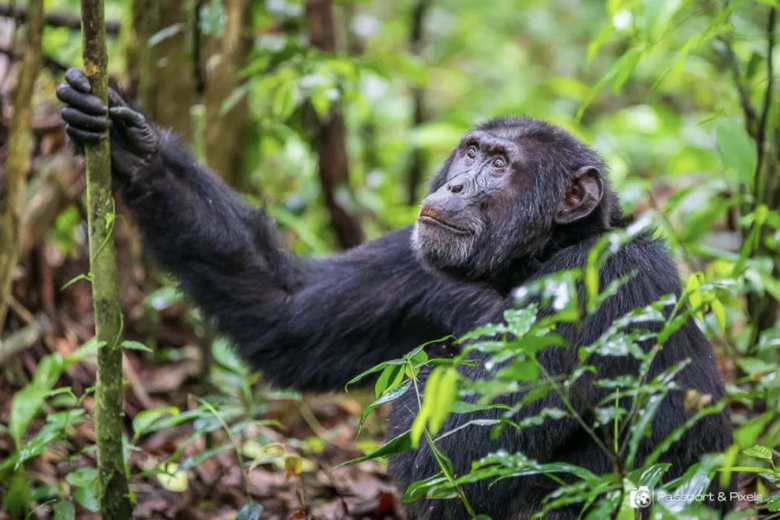
The 42-year-old chimpanzee lounges lazily on the branch, eyeing us congenially.
Far from being bothered by our presence, he seems to be actively enjoying it, striking the sort of poses a catalogue model would be proud of, working the crowd, playing to his audience. This, after all, is almost certainly not his first encounter with the paparazzi.
His name is Ssebo, which means Sir, and he’s one of around 1500 wild chimpanzees living in the Kibale Forest in Western Uganda.
Uganda is famous for its primates. Its best-loved, of course, are the legendary and critically-endangered mountain gorillas, which you can visit by doing a gorilla tracking experience in Bwindi Impenetrable Forest.
No less thrilling, however, is the chance to go chimpanzee trekking in Uganda, and get close to our closest relatives in the animal kingdom.
Interested? Want to know more about the Uganda chimpanzees and how you can meet them?
You’ve come to the right place! Here’s my full account of my own Uganda chimpanzee trekking experiences, plus everything you need to know to plan your adventure.
About my chimp tracking Uganda experiences
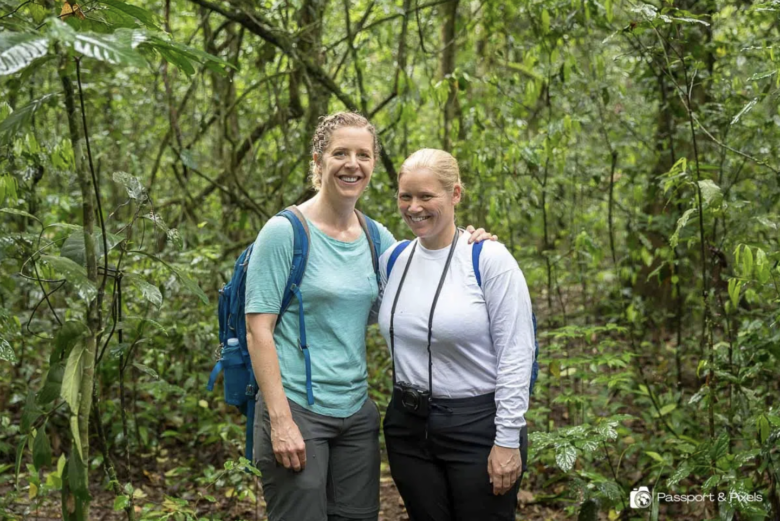
I spent three months living and volunteering in Kampala, Uganda. While I was there, I couldn’t miss the chance to see more of the country and its incredible wildlife.
So, joined by my friend and fellow travel blogger Linn, I organised a two-week tour around Uganda’s highlights with a guide and driver named Hassan.
We visited top Uganda attractions like Queen Elizabeth National Park, Murchison Falls National Park, and of course we went to see the gorillas, but one of the highlights of the trip for me was our visit to Kibale Forest to do a half-day chimpanzee safari tour.
Upon my return, I wrote about chimpanzee trekking for Lonely Planet which you can read here: Why seeing chimpanzees in Uganda is one of the world’s greatest wildlife experiences.
Later, that main photo (the one just above), became my most stolen photo ever.
More recently, I just got back from another trip to Uganda. This time I went chimpanzee trekking in Kyambura Gorge, which is home to a single family of chimpanzees that have been cut off from the rest of the world.
It was quite a different experience, as I’ll explain.
But first, some context…
What is chimpanzee trekking?
Chimpanzee trekking involves hiking into Uganda’s forests to observe wild chimpanzees in their natural habitat. At all times you’re accompanied by experienced guides who are familiar with the chimpanzees’ behaviour and the forest environment.
The guides follow established trails and use their wildlife tracking expertise and local knowledge to find a chimpanzee group.
Once you’ve found them, you get a short period (usually an hour) to observe and photograph the chimpanzees quietly without disturbing them, before heading back to where you started.
If you love wildlife as much as I do, it’s truly breathtaking to see these intelligent and beautiful creatures up close in the wild – an experience as thrilling as any Kenya or Tanzania safari.
If you’re just looking for basic chimpanzee tracking information, you can skip down to the FAQs at the end. Otherwise, read on for the full story (and loads of lovely chimpanzee photos!).
My 5 top chimpanzee facts
Along the way, your guide will tell you lots of interesting facts about chimpanzees. Here are my favourites.
- Chimpanzees are our closest living relatives. We share 98.7% of our DNA with them.
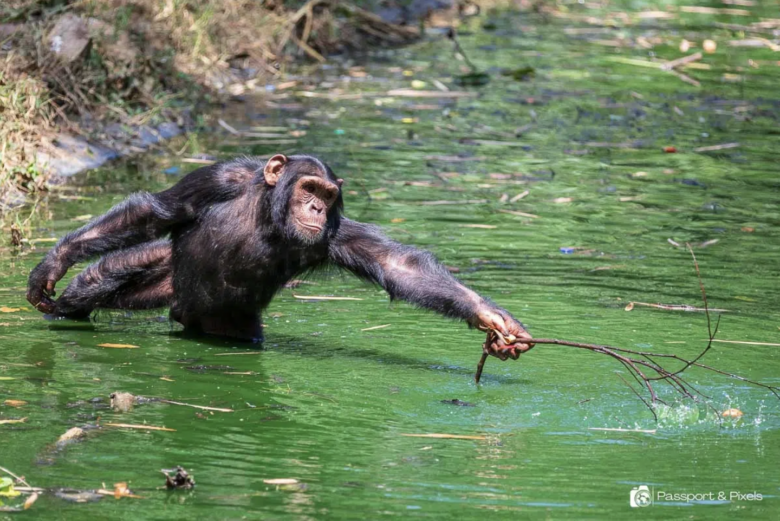
- Chimpanzees know how to use tools. I saw one using a stick to fish a piece of fruit out of a river at Entebbe Wildlife Sanctuary, but they’ve also been observed using sticks and stones to crack open nuts, leaves as sponges to soak up water, and even spears to hunt small prey.
- While chimpanzees don’t have spoken language, they use a sophisticated communication system including hoots and barks to express various emotions and warnings. Like us, they also use facial expressions and body language to communicate.
- Chimpanzees show self-awareness, a trait previously thought to be unique to only a few other animals (and humans of course). They can recognise themselves in mirrors, showing an understanding of their own bodies and individuality.
- Chimpanzees are not just intelligent, but are also emotional creatures. They experience a wide range of emotions, including joy, sadness, fear, anger, and even empathy.
What is chimpanzee habituation?
Chimpanzees are wild animals and normally run away from humans. But in Uganda you’re able to get close to them thanks to something called habituation.
Chimpanzee habituation is a concept that was pioneered by the late, great, Jane Goodall.
It’s the gradual process of getting wild chimpanzees used to the presence of humans in their natural habitat. This allows researchers (and tourists!), to observe them with minimal disruption to their natural behaviour.
For researchers, this means they can study the chimps and learn more about them. For the tourists (and the chimps), this means the parks can run chimpanzee trekking tours and raise money for their conservation.
The habituation process is done slowly over 2-3 years. It involves regular visits by researchers and park guides, who maintain a safe distance and avoid any actions that might upset or frighten the chimpanzees.
Over time, the chimps learn that humans are not a threat, and they become less fearful and more tolerant of human presence, allowing us to visit them.
What happens on a chimpanzee trekking safari tour?
Chimpanzee trekking is usually a half-day experience, though some tours can be longer. Groups are normally small – up to about 12 people – to avoid disturbing the chimps too much and to make sure everyone gets a good view.
You’ll typically meet your guide and group at the park headquarters or trailhead, for a briefing. The guide will explain the safety rules, what to expect during the trek, and the importance of following responsible observation practices.
Then you head out into the forest to look for the chimps. Guides will follow tracks, listen for calls, and use their knowledge of the chimps’ previous location and favourite hangouts to guide you to them.
The hike can range from easy to moderate along jungle paths but sometimes might veer off the path, depending on the location and the group of chimpanzees you’re tracking.
It may take an hour or two of hiking to find them and some trails may be steep or slippery.
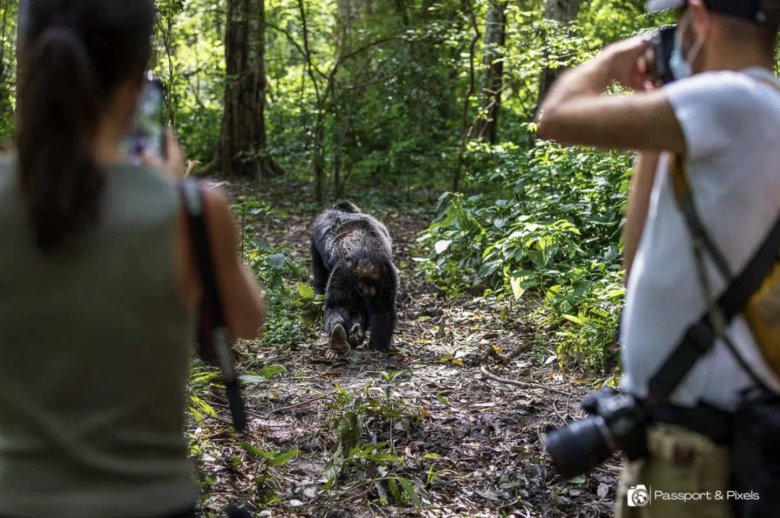
Once the chimpanzees are located, you’ll be allowed to watch them from a safe distance for about an hour.
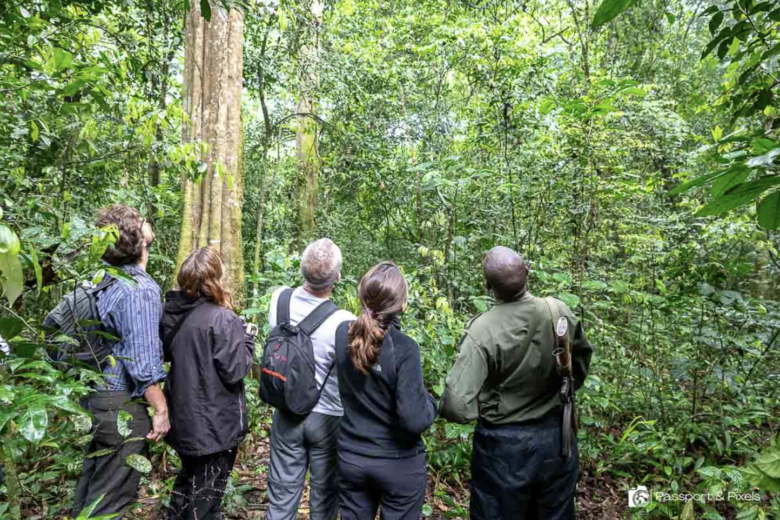
Where to see chimpanzees in Uganda: Kibale National Park
There are a few places in Uganda where you can see chimpanzees, but probably the best (and one of the two I visited) is Kibale National Park.
Kibale National Park (or Kibale Forest National Park) is a protected area in western Uganda established in 1932. It’s teeming with wonderful wildlife and is particularly known for its primate population, which has led the park to be nicknamed the ‘primate capital of the world’.
The park is home to over 13 primate species, including around 1500 chimpanzees living in four communities.
But you may also see various types of colobus monkey, vervet monkeys, mangabeys, elephants, buffaloes, antelopes and over 350 species of birds.
There are no gorillas here though – you’ll need to go to Bwindi National Park if you want to see those.
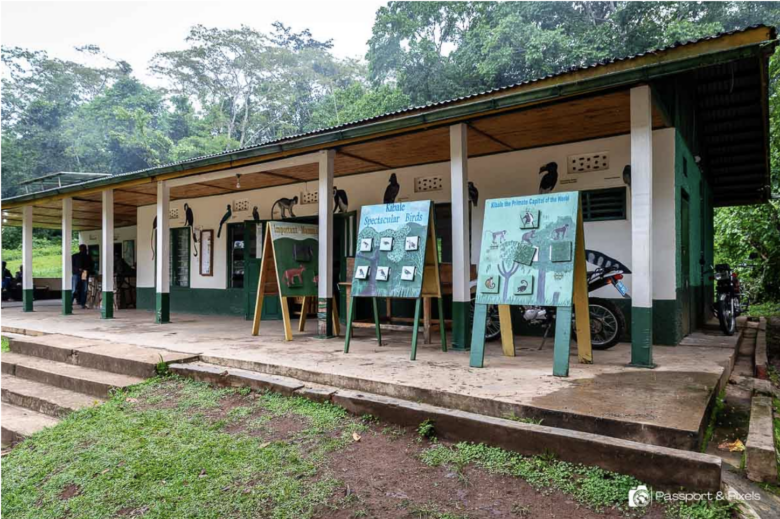
What to expect on a chimpanzee trekking tour
My first chimp tracking briefing started at 8 am at the Kibale Forest Kanyanchu Visitor Center, so we were up bright and early.
Mist hung in the valleys, and I was a bit nervous. It had been raining all night, and it looked like it might be about to start again.
I was fully prepared with everything I needed: sturdy walking boots with socks tucked in (in case of biting ants), a waterproof outer shell (mine is by Rab), my much-loved Canon 5D Mark IV and 70-200 lens (which I have since upgraded), and a banana pinched from breakfast, in case I got hungry on the walk.
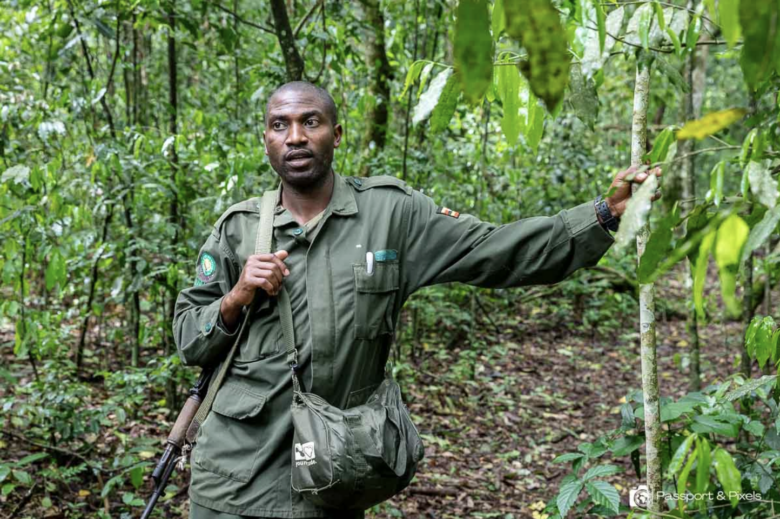
The chimpanzee safety briefing
Our Uganda chimpanzee trekking guide, 33-year-old Africano, gave us the rules for chimpanzee tracking in Uganda:
- Keep at least 8 metres away from the chimps at all times.
- Don’t attempt to imitate their calls in case you accidentally say the wrong thing and upset them.
- Keep quiet, don’t make any loud noises or sudden movements.
- Follow the guides’ instructions at all times.
- Don’t bring food – they may try to steal it (reluctantly, I was forced to sacrifice my breakfast banana).
Then we were divided into four groups of seven, each with a separate armed guide.
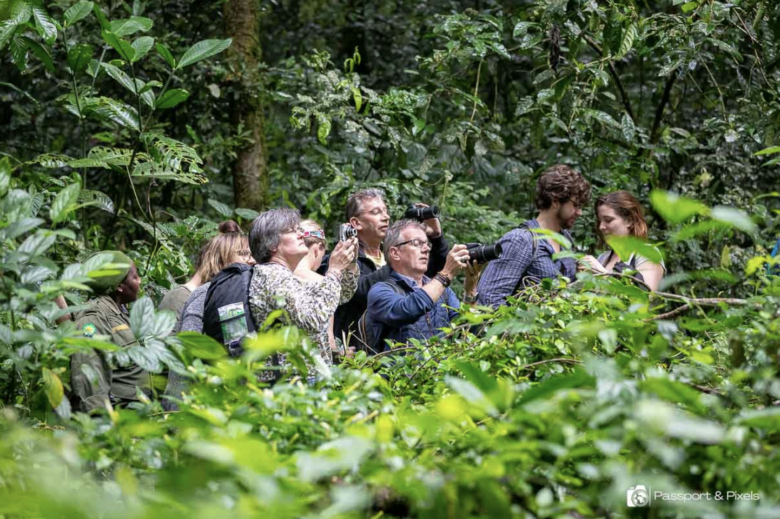
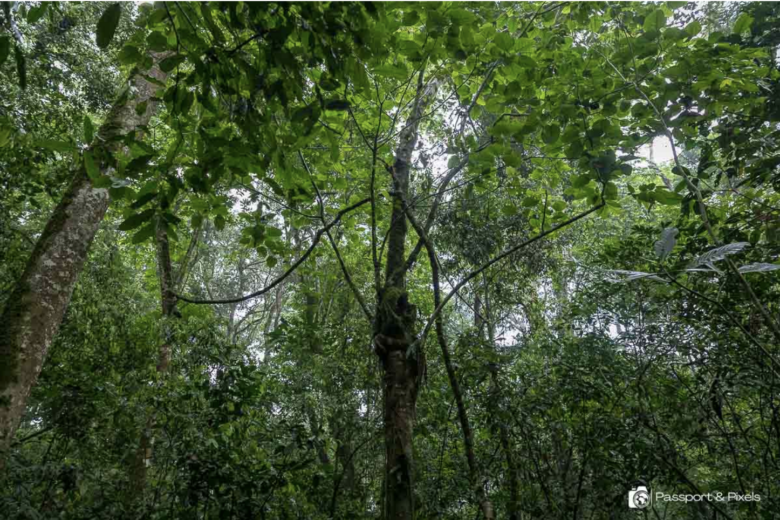
In our groups, we set off, walking into the forest down a muddy path, still soft from last night’s rain, before veering off to the left and pushing on into the tangled undergrowth itself.
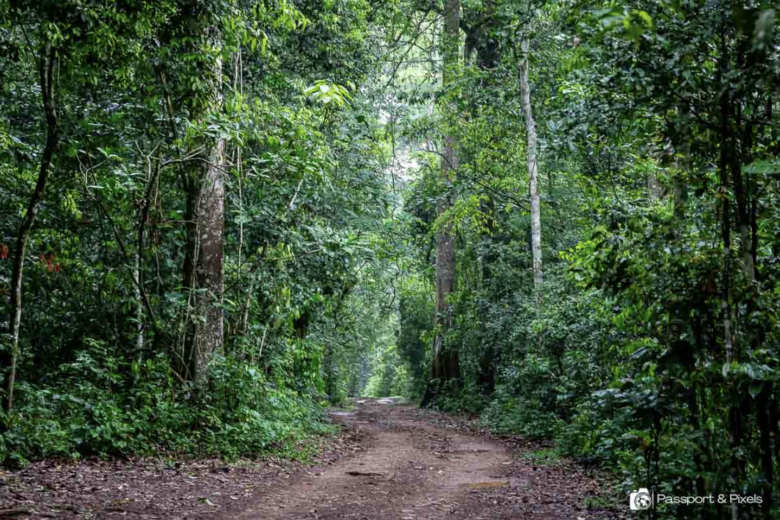
Searching for chimpanzees in Uganda
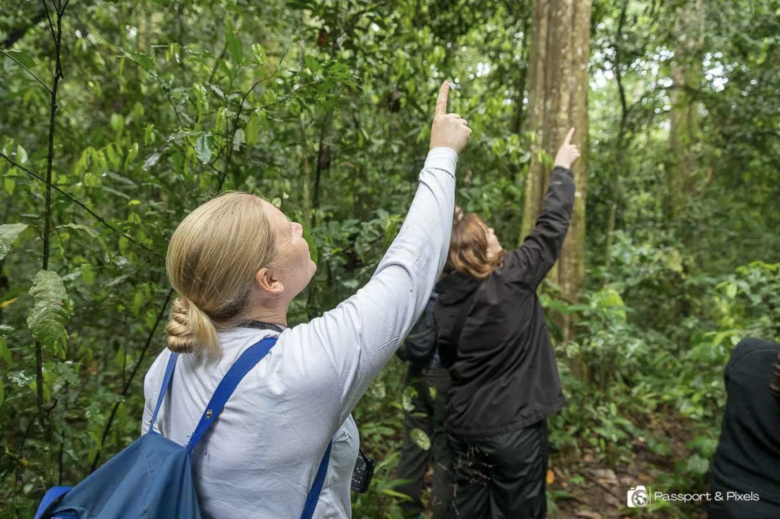
After about 10 minutes walking we stopped, and Africano motioned us all to be quiet.
He was listening for chimpanzee calls. We all craned our heads, though we weren’t sure what we were supposed to be listening for.
Africano explained that the best way to find the chimps is to follow their cries, though the guides usually already have a fair idea of where the group will be based on where they were the day before.
He listened again, and then, from across the forest, we heard them: a distant screeching and yelping echoing through the air.
We made our way towards the sounds, ducking under low branches and picking our way through twisted foliage, stopping every so often so that Africano could listen and check we were still going the right way.
First chimpanzee encounter
It only took us another 12 minutes to reach them.
Africano spotted them first, two males, high up in the tree above our heads. I peered into the green, struggling to see what everyone was looking at, and then, suddenly, one descended, hand over foot down the tree trunk till he reached the ground, before disappearing into the undergrowth.
By the time I realised what was happening and got my camera ready, all I managed to capture was his departing backside.
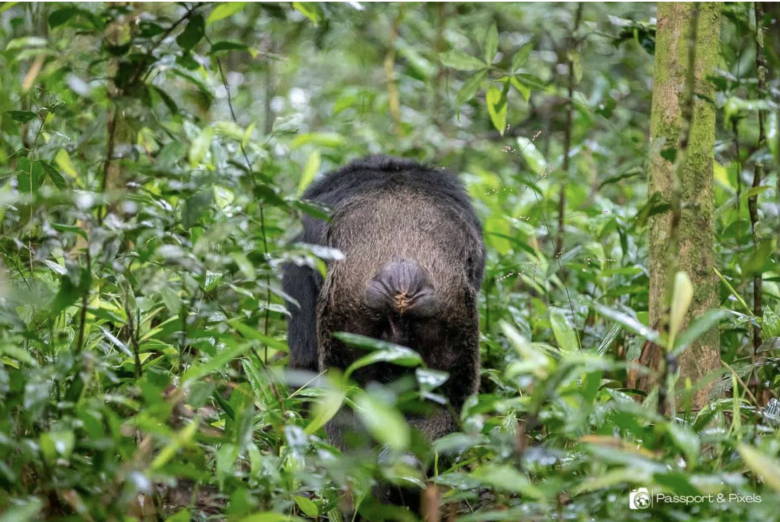
My first encounter with a wild chimpanzee
We set off in hot pursuit, matching his brisk pace as he moved purposefully through the jungle, pausing only once, briefly, to look around – almost as if he was making sure we were still keeping up.
Then he headed off again until he finally reached the place he was looking for: a fallen tree lying across the forest floor, a smooth resting place raised up off the rain-dampened ground. He climbed up, and sat.
We were only about 10 metres away. This was my first encounter with a wild chimpanzee, and I was so shaky with excitement I could barely hold the camera steady.
I fired off shot after shot, and it was perfect: his raised seating position so the undergrowth didn’t get in the way, the clean light coming through the trees, the way he was perfectly still, allowing plenty of time for photographs.
Are chimpanzees friendly?
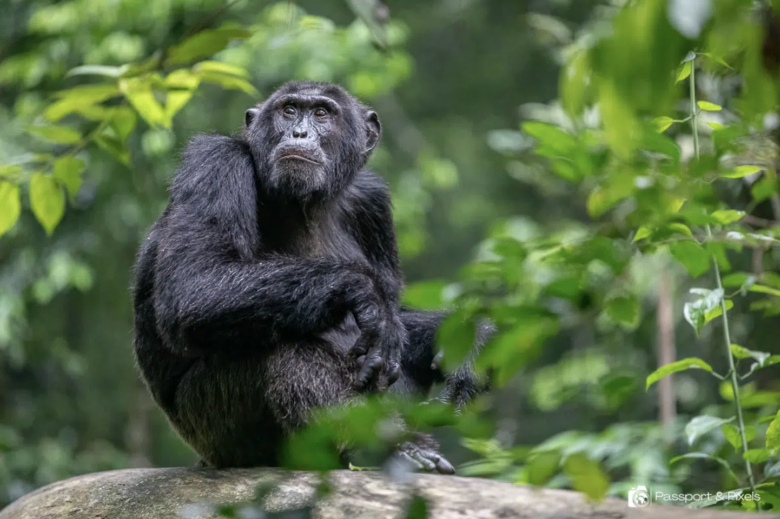
His name, we were told, was Ssebo. Africano explained that he’d come down to the ground after feeding, to rest after a heavy meal – his fruit-stained teeth were a dead giveaway.
Chimpanzees feel more relaxed on the ground, but they don’t like the wet, which is why Ssebo had found this comfy log to sit on, a dry haven away from the chatter of the rest of his group.
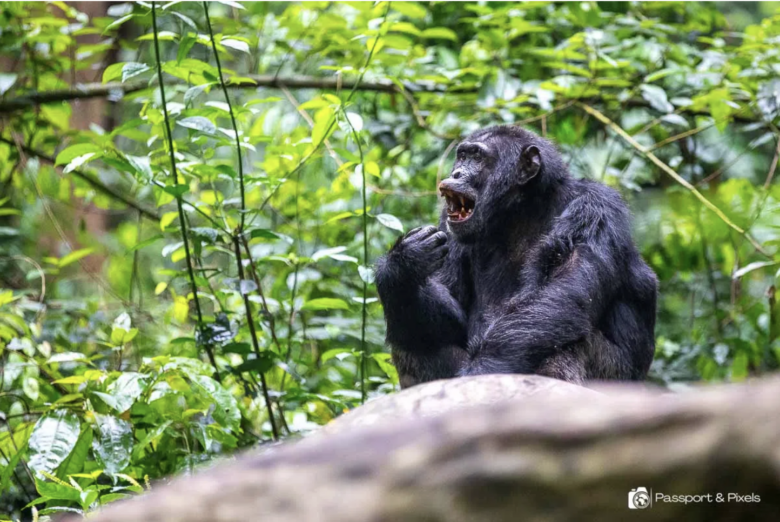
Ssebo is 42, and used to be the beta male, or vice president, of the 120-strong group.
Meeting Magezi
His alpha male, Magezi, was ousted in July 2016 after a 2-year-battle with another male, Totti. When Totti finally won the battle, both Magezi and Ssebo, his second-in-command, were forced to stand down.
Today he’s just a regular group member like everyone else, fallen from grace.
Nevertheless, for us Ssebo was the star of the show, and he knew it.
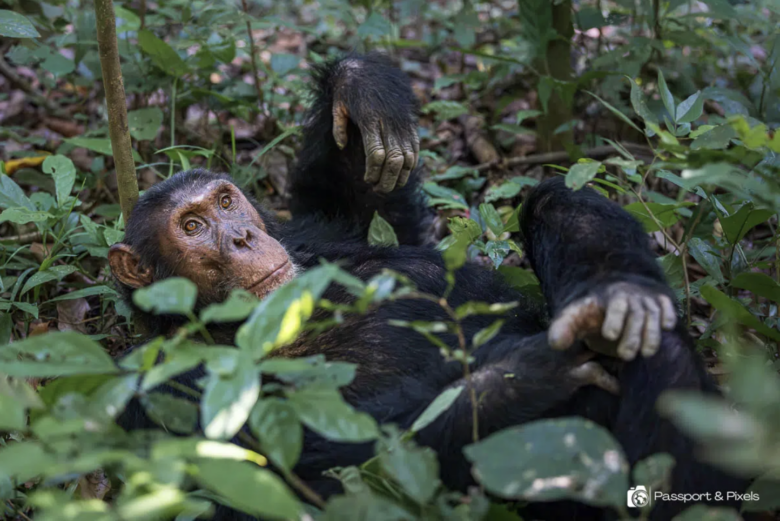
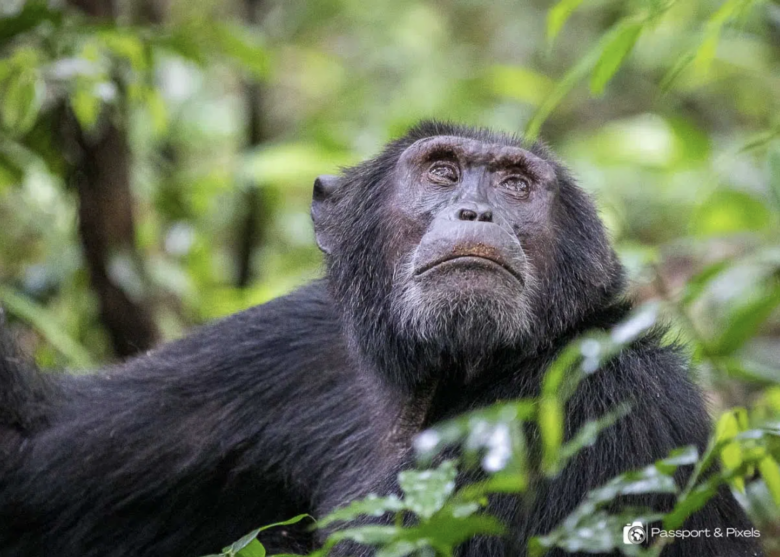
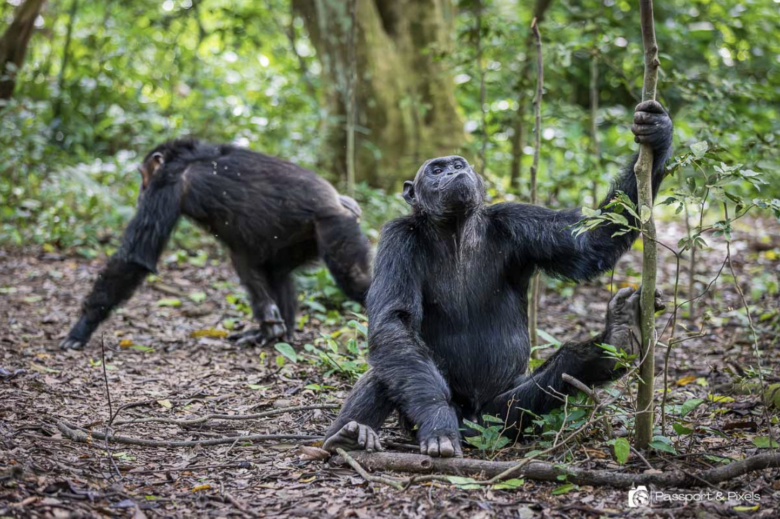
He struck poses like a professional model: a head tilt here, a glance to the right there. He leaned and lounged, sometimes looking straight at the camera, other times shifting his position so that everyone in the group could get a good look at him.
We were all entranced, shutters clicked and clattered like a train. The paparazzi were out in force, and celebrity Ssebo appeared to be loving every second.
While I wouldn’t say he was friendly – he’s still a wild animal after all, and potentially dangerous – he certainly didn’t seem to mind us being there.
Continuing our chimpanzee search
Eventually he lay down to sleep, and, show over, we moved on.
Africano was confident that the rest of Ssebo’s group weren’t far away, and I was keen to see them, and photograph a few more faces.
So we pressed on, stopping occasionally to listen to the hooting and howling that still echoed across the forest. The chimps were definitely nearby.
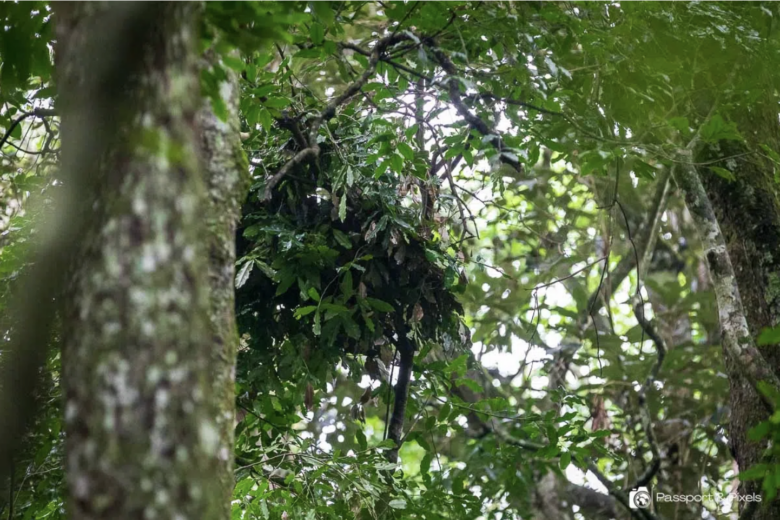
We passed a chimpanzee nest in a nearby tree which surprised me: I had no idea that chimpanzees build nests like birds do – though unlike birds their nests only take about five minutes to build and they make a new one every day.
What do chimpanzees eat?
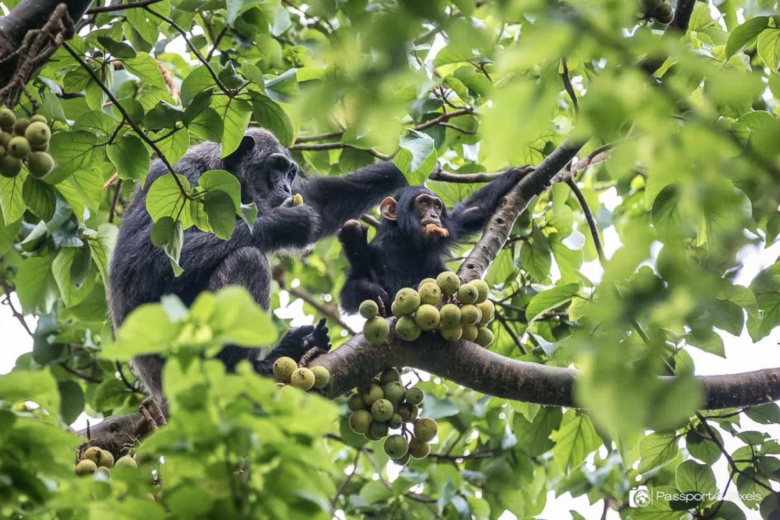
After another few minutes we found the noisy neighbours, about 20 more chimps, high up in a fig tree.
Chimpanzees mostly eat fruit, supplemented by wood for fibre and calcium, and sometimes small monkeys and antelopes which they hunt in packs. Today, though, it was all about the figs.
They spend much of their time feeding and then normally come down to rest, sleep and groom, but if the ground is wet, as it was that day, they just stay up in the trees.
This was obviously disappointing news, but I did my best to capture what I could anyway. It was great to see more chimpanzees, but part of me regretted leaving Ssebo, and of course I cursed the weather gods for making it rain.
We watched the chimps a little while longer, but soon it was time to return to base. I felt a little disappointed – yes we were lucky to get to spend time with Ssebo, but I’d been hoping for more than just one chimp closeup.
Still, these are wild animals, and nothing is guaranteed. And at least we didn’t get rained on.
Take two: chimpanzee trekking in Kyambura Gorge
My second time trekking chimpanzees was quite different.
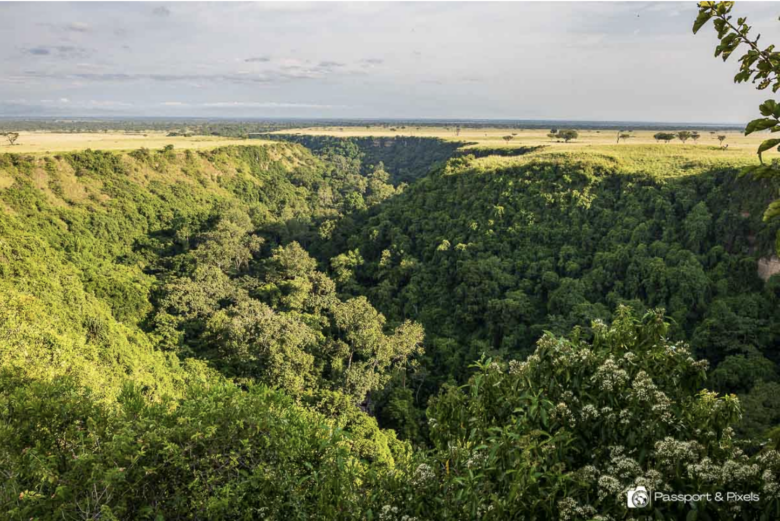
This time, I went to Kyambura Gorge which is on the edge of Queen Elizabeth National Park.
It’s a fascinating place, where a deep gorge splits the flat plain in two, with a river running along the bottom of the gorge and a dense forest cloaking the steep sides.
It’s home to just one group of chimpanzees, which due to farming and habitat destruction all around, are now trapped in the gorge.
Chimpanzees and elephants, oh my!
While these are still wild chimpanzees, this did mean that the experience felt a little ‘canned’. It’s a small area, and the guides knew exactly where to find them.
That said, seeing chimpanzees is still not guaranteed, as there are some areas of the gorge that are inaccessible and if the chimps decide to head over there, you’re out of luck.
And sometimes, they come up out of the gorge to forage out in the open on the plains, where you might also run into elephants – a very different experience!
When I visited, they were in the forest, and they were hunting – which was intense!
Chimpanzees sometimes hunt monkeys, and these guys had spotted some colobus monkeys in the trees. They’d sit for a while observing them – allowing me to get amazing photos! – and then all of a sudden would start running and screaming as they gave chase.
It was fascinating and exciting, though some of my group found it quite scary.
We really got a sense of how powerful and violent chimpanzees can be – a totally different side to their personalities that I didn’t see in Kibale Forest.
You definitely didn’t want to get too close to these guys!
Uganda Chimpanzee Trekking FAQs
So that’s what happened on my two chimpanzee treks.
And now, here are some answers to the most common questions about chimpanzee tracking in Uganda.
Where can you do chimpanzee trekking in Uganda?
Here are the places where you can see chimpanzees in Uganda:
Kibale National Park: This is the most popular place to see chimpanzees in Uganda, so much so that that it’s known as the ‘primate capital of the world’. Kibale is home to over 1,500 chimpanzees, living in four communities.
Kyambura Gorge: This is a beautiful gorge located on the edge of Queen Elizabeth National Park, which has single group of habituated chimpanzees. I went chimpanzee trekking here in 2025 and had an intense up-close experience.
Budongo Forest: This forest reserve is located in western Uganda close to Murchison Falls National Park, and it is home to a small population of chimpanzees. The chimpanzees in Budongo Forest are habituated, and there are a few tour operators that offer chimpanzee trekking in the forest.
Semliki Valley Wildlife Reserve: This reserve is located in western Uganda, and it is home to a small population of chimpanzees. The chances of seeing chimps here are lower than in places like Kibale, but it is still possible to find them.
Is chimpanzee trekking ethical?
When you go chimpanzee trekking in Uganda, the chimps you will see are wild animals. They’re not kept in a zoo and are free to live their lives as normal. So it’s fair to say that as far as wildlife encounters go, chimpanzee tracking is pretty ethical.
There are some who say that we shouldn’t be visiting the chimpanzees at all, and that even habituating them isn’t terribly ethical. But for me the benefits that are gained from research, education and conservation programmes thanks to habituation are worthwhile.
As long as you travel with a responsible tour operator who respects the chimpanzees and follows strict rules to minimise the impact of tourism on these animals, then yes I think you can say that chimpanzee trekking is ethical.
What are the odds of seeing a chimpanzee in Uganda?
Seeing chimps in Uganda is not guaranteed, and your odds depend on where you go. Your best chance is to go to Kibale forest, where the odds of finding chimps are above 90%.
How difficult is chimpanzee trekking in Uganda?
Overall, chimp trekking in Uganda is generally considered moderately difficult and requires a basic level of fitness. You should be comfortable walking on uneven terrain for several hours, potentially in hot and humid conditions.
While the forest trails themselves are generally well-maintained, the terrain can be uneven and muddy, especially during the rainy season.
Additionally, some parks are at a higher altitude (1,100 to 1,600 meters) making hiking a little harder, while others have steeper and more challenging terrain.
We visited in rainy season and although it was a little muddy, in general I found the walk not challenging at all, and much easier than gorilla trekking.
How much does chimp trekking cost?
Chimpanzee trekking permits are issued by Uganda Wildlife Authority. Rates include the park entry fee and guide fee.
Numbers of permits are strictly limited so it best to book as soon as possible.
In Kibale, where I went, a chimp tracking permit costs $250 for a foreign non-resident for a half day. Foreign residents pay $200, and East African citizens pay UGX 180 000.
If you’re extra keen, in Kibale you can also do a full-day chimp habituation experience, during which you get to spend time with the rangers who are in in the process of habituating new families. You have to be fit to do this experience as you’ll spend the whole day following chimps through the forest!
This experience costs $300 for four hours with the chimpanzees.
In Kyambura Gorge, chimpanzee trekking costs $100 for a foreign non-resident.
You can buy chimpanzee tracking permits from the Uganda Wildlife Authority office in Kampala, or through your tour operator. For more information, check the UWA website.
Are chimps friendly to humans?
Chimpanzees are not inherently ‘friendly’ to humans. Remember that they’re wild animals with their own complex social structures and behaviors.
While the habituated chimpanzees you see in Uganda may be comfortable with the presence of humans, it’s important to remember that they are not domesticated and can still display unpredictable behavior.
You definitely can’t pet or even approach the chimpanzees in Uganda, so don’t even try!
Is chimpanzee trekking safe?
As long as you follow the instructions of your guide at all times, then yes, chimpanzee trekking is pretty safe.
The chimpanzees you’ll meet are habituated, meaning they’re comfortable with the presence of humans. As long as you don’t disrupt, stress or antagonise the chimps, they will just ignore you (or even pose for you, as my photos show!).
To ensure your trip is safe, always go with a reputable tour operator and follow the guide’s instructions at all times.
What should you wear for chimp tracking Uganda?
For chimpanzee trekking it’s best to wear lightweight, comfortable clothing suitable for hiking through the forest. Leggings and sportswear are ideal.
Long trousers and sleeves are recommended to protect you from scratches and insect bites. You also need sturdy walking shoes or boots.
Don’t wear shorts or open-toed sandals, and tuck your trousers into your socks to protect from the (very painful) bites of safari ants.
Neutral colours or green are best so you blend in with the surroundings.
Make sure you bring a waterproof if it looks like it might rain, insect repellant and of course your camera!
Where else can you go chimpanzee tracking in Africa?
Chimpanzees can be found mainly in central and west Africa. Outside of Uganda, you can also go chimpanzee tracking in:
Tanzania: Mahale Mountains National Park provides stunning scenery alongside chimpanzee encounters. Another famous place to see chimpanzees is the forest of Gombe, where Jane Goodall did her work.
Republic of Congo: The Goualougo Triangle offers a unique opportunity to observe habituated chimpanzees alongside other primates.
Chimpanzee trekking vs gorilla trekking: which is better?
I did both gorilla trekking and chimpanzee trekking twice in Uganda and I loved them both!
While the gorilla trekking was an incredible privilege – to be able to see these wonderful and rare animals in their natural environment is something not many people get to do – gorilla tracking is much more expensive than chimpanzee tracking. Gorilla permits cost $800 per person while chimpanzee tracking permits cost $250.
I also found the gorilla trek much harder. The mountainous region where the gorillas live is much steeper, the hike is much more challenging, and they don’t call it Bwindi ‘Impenetrable Forest’ for nothing!
Meanwhile the chimp walk was flatter, and it was easier to find the chimps.
So while ‘which is better’ is obviously a subjective opinion, I’d say that if you can’t splash the cash for a gorilla permit, don’t worry. I thought the chimpanzee tracking experience was just as brilliant as seeing the gorillas in Uganda.
How to get to Kibale Forest to go chimpanzee tracking
The best way to get to Kibale Forest is by road from Kampala – a journey of about 6 hours. If you have time, I recommend stopping for lunch at Kyaninga Lodge in beautiful Fort Portal.
Alternative you can fly from Entebbe to Kasese, which takes about an hour and a half. From Kasese to Kibale Forest is about another hour by road.
However, Linn and I travelled to Kibale Forest on a 2-week Uganda road trip. We started our journey in Kampala and headed to Murchison Falls before moving on to Kibale for chimpanzee trekking (and other adventures).
Where to stay for chimpanzee trekking in Kibale
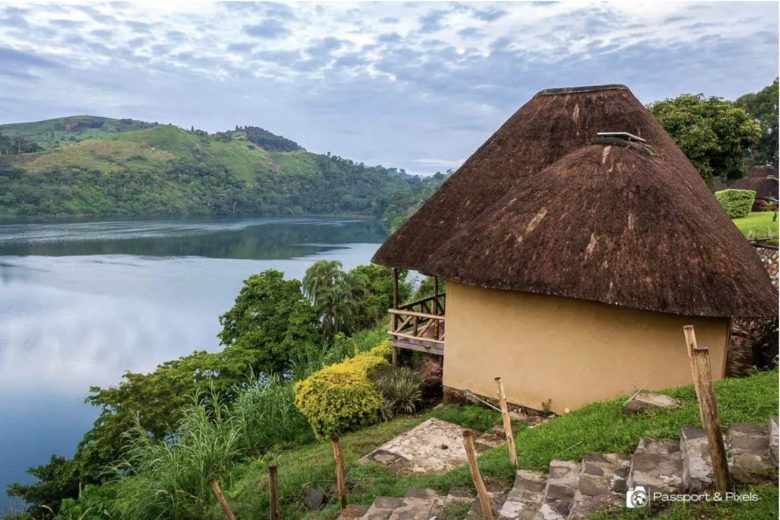
On my first visit I spent two nights at Crater Safari Lodge, a luxury eco-lodge perched right on the shore of Lake Nyinabulitwa. Our room had a veranda right over the lake and was huge, clean and comfortable.
However since my visit the lodge has received some mixed reviews and it does appear to be in need of modernisation. That said, on TripAdvisor it has 4.5/5 stars, so might be worth double checking.
If you’re unsure, here are some other hotels in the Kibale area you could try.
Top of the World Lodge Fort Portal – located a little way from the National Park but worth a stay for the comfortable rooms and amazing location.
Kibale River Camp – this place is a bit basic with cottages and safari tents, but it’s located right by the edge of the park in the forest for that real back-to-nature feeling.
Another great place to stay is the beautiful Kyaninga Lodge, a top-end luxury hotel complex perched like an eagle’s nest on the rim of an ancient volcanic crater, with breathtaking views out over the crater lake.
Or click here to see a selection of hotels near to Kibale.
Where to stay for chimpanzee trekking in Kyambura Gorge
On my second visit I went chimpanzee trekking in Kyambura Gorge which is on the edge of Queen Elizabeth National Park.
I stayed a short boat ride away in River Station Lodge with WildPlaces Africa.
River Station is a stunningly beautiful lodge right on the Kazinga Channel, with hippos and buffalo wandering around and a sunrise view from the breakfast table that’s like a scene from a David Attenborough documentary.
It was probably my favourite out of all the places I stayed during both my Uganda trips.
Related:
- These villages protected their forests. Now they’re seeing the financial benefits
- This day in history: The British wintery forest that made UFO contact
Ask us! What questions do you have about content, strategy, pop culture, lifestyle, wellness, history or more? We may use your question in an upcoming article!
Like MediaFeed’s content? Be sure to follow us.
This article originally appeared on Passport & Pixels and was syndicated by MediaFeed.co.