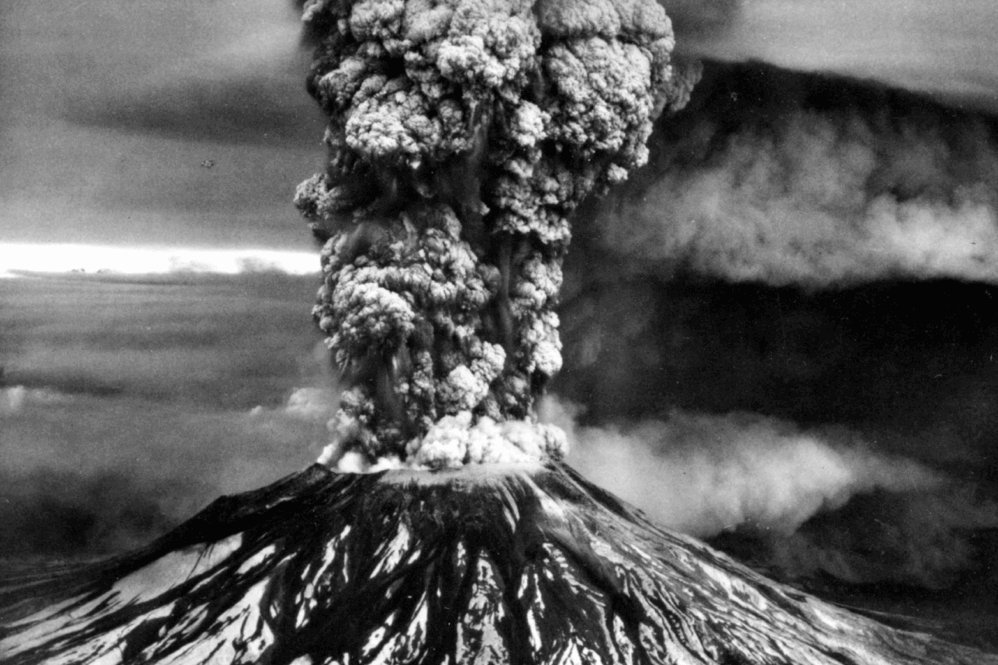
On the morning of May 18, 1980, one of the most powerful natural disasters hit the Pacific Northwest. Mount St. Helens, a snow-capped peak in the Cascade Range of Washington, erupted with a force that reshaped the landscape. Known by Native Americans as Louwala-Clough, or “The Smoking Mountain,” the volcano had been dormant for over 120 years before it awoke with a series of warnings that spring.
It all started two months earlier on March 16, when a series of small earthquakes signaled that the volcano was restless. By March 27, a minor eruption occurred, sending steam and ash through the mountain’s summit.
Over the next several weeks, more than 10,000 earthquakes shook the peak. Scientists noticed a terrifying development as a massive bulge on the mountain’s north face was growing outward by as much as six feet per day. This was caused by magma pushing its way up inside the mountain.
Authorities evacuated hundreds of people, though a few residents, including 83-year-old Spirit Lake lodge owner Harry Randall Truman, famously refused to leave his home.
At 8:32 a.m. on May 18, a 5.1-magnitude earthquake struck directly beneath the peak. This tremor caused the unstable north flank to collapse, triggering the largest landslide in recorded history. The volume of rock and ice sliding down was equivalent to one million Olympic-sized swimming pools.
As the mountain’s side fell away, it released the highly pressurized magma inside. A massive lateral blast of steam and volcanic gases exploded northward at high speeds. Within minutes, the blast stripped trees from slopes six miles away and leveled everything else for another 12 miles. Approximately 10 million trees were knocked down, leaving a wasteland of grey ash and fallen timber.
The heat melted the mountain’s glaciers, creating “lahars”, violent mudflows of water and rock fragments. These flows roared down the Toutle River valley at over 100 miles per hour, burying parts of the river under 150 feet of debris and destroying 200 homes, 47 bridges, and 185 miles of highway.
Simultaneously, a vertical column of ash mushroomed 12 miles into the sky. For nine hours, the mountain poured ash into the atmosphere. The city of Spokane, 250 miles away, was plunged into complete darkness. The ash cloud was so immense that it traveled across the United States in three days and circled the entire globe in just 15 days.
When the eruption finally subsided, Mount St. Helens was unrecognizable. The mountain had lost 1,300 to 1,700 feet of its height, replaced by a horseshoe-shaped crater. The disaster claimed 57 lives and thousands of animals.
In 1982, Congress designated the area as a protected research site. While the volcano saw renewed activity between 2004 and 2008, scientists keep a close watch on the peak.
Ask us! What questions do you have about content, strategy, pop culture, lifestyle, wellness, history or more? We may use your question in an upcoming article!
Like MediaFeed’s content? Be sure to follow us.
This article was syndicated by MediaFeed.co