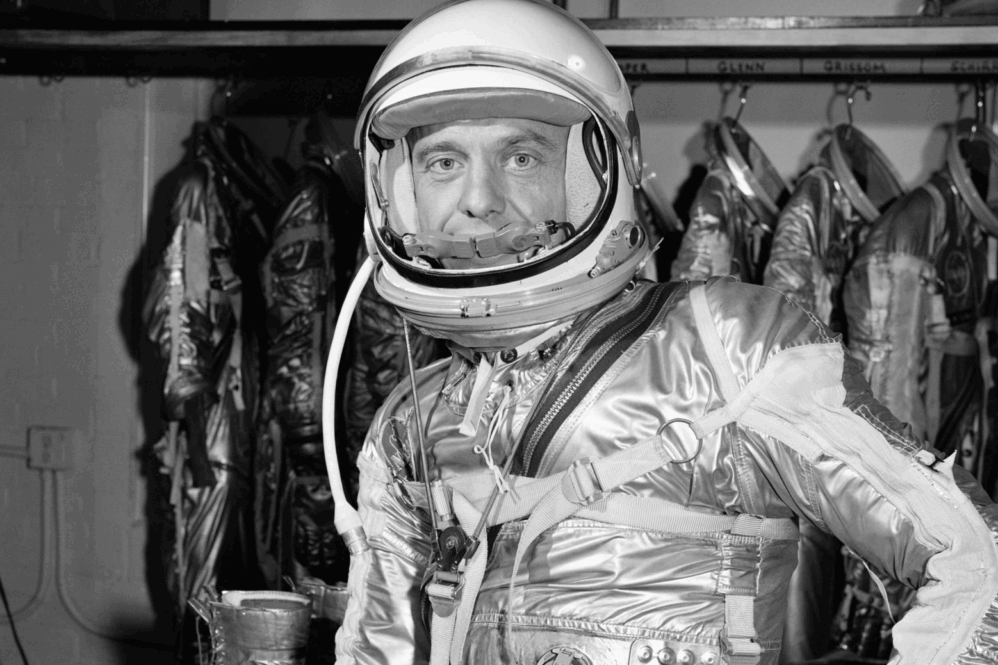
In the late 1950s, the United States and the Soviet Union were locked in a Space Race. The Soviets had already taken an early lead by launching the first satellite, Sputnik, in 1957. Just weeks before Shepard’s flight, on April 12, 1961, cosmonaut Yuri Gagarin became the first human in space, successfully orbiting the Earth.
The pressure on NASA was even higher after that. To catch up, they created Project Mercury. Out of 100 candidates, seven men were chosen for their skills as test pilots and their physical endurance, the Mercury 7. Among them was Alan Shepard.
Shepard named his capsule Freedom 7. The mission, known as Mercury-Redstone 3, was not an orbital flight like Gagarin’s. Instead, it was suborbital, in which the spacecraft follows a ballistic path shaped like a high arc before falling back to the earth.
Despite lasting only 15 minutes and 22 seconds, the mission was incredibly complex. Shepard reached an altitude of 116 miles and traveled at speeds over 5,000 miles per hour. Unlike the Soviet mission, where the pilot was mostly a passenger, Shepard took manual control of Freedom 7. While weightless for five minutes.
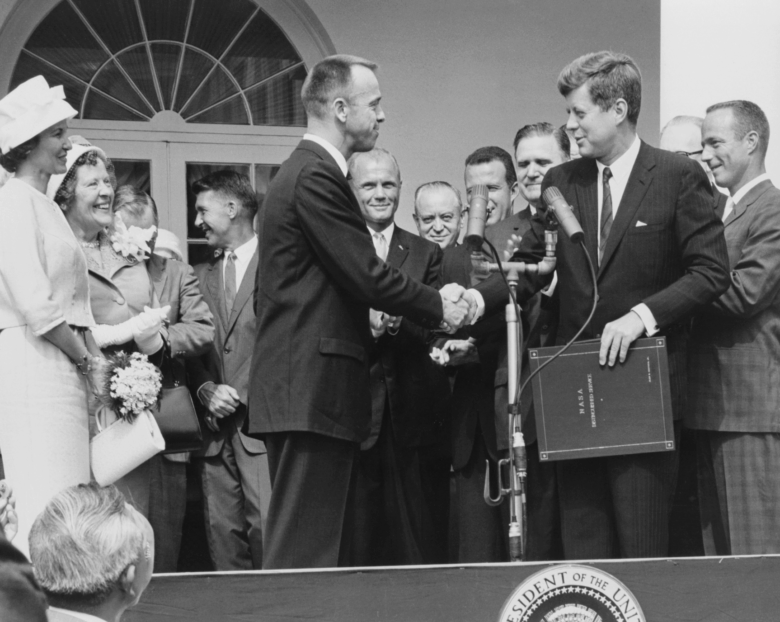
An estimated 45 million Americans watched the launch on live television, including President John F. Kennedy at the White House. When Shepard arrived back safely in the Atlantic Ocean, he was quickly recovered by a helicopter and brought to the aircraft carrier USS Lake Champlain.
Just three weeks later, President Kennedy was so inspired by Shepard’s flight that he stood before Congress and made a promise that the United States would land a man on the moon before the end of the decade.
Alan Shepard’s journey didn’t end with Project Mercury. A decade later, he returned to space as the commander of Apollo 14. He became the fifth person to walk on the moon and remains the only one of the original Mercury 7 to do so.
Today, the Freedom 7 capsule is on display at the Smithsonian’s National Air and Space Museum, Stephen F. Udvar-Hazy Center in Chantilly, Virginia.
Like MediaFeed’s content? Be sure to follow us.
This article was syndicated by MediaFeed.co