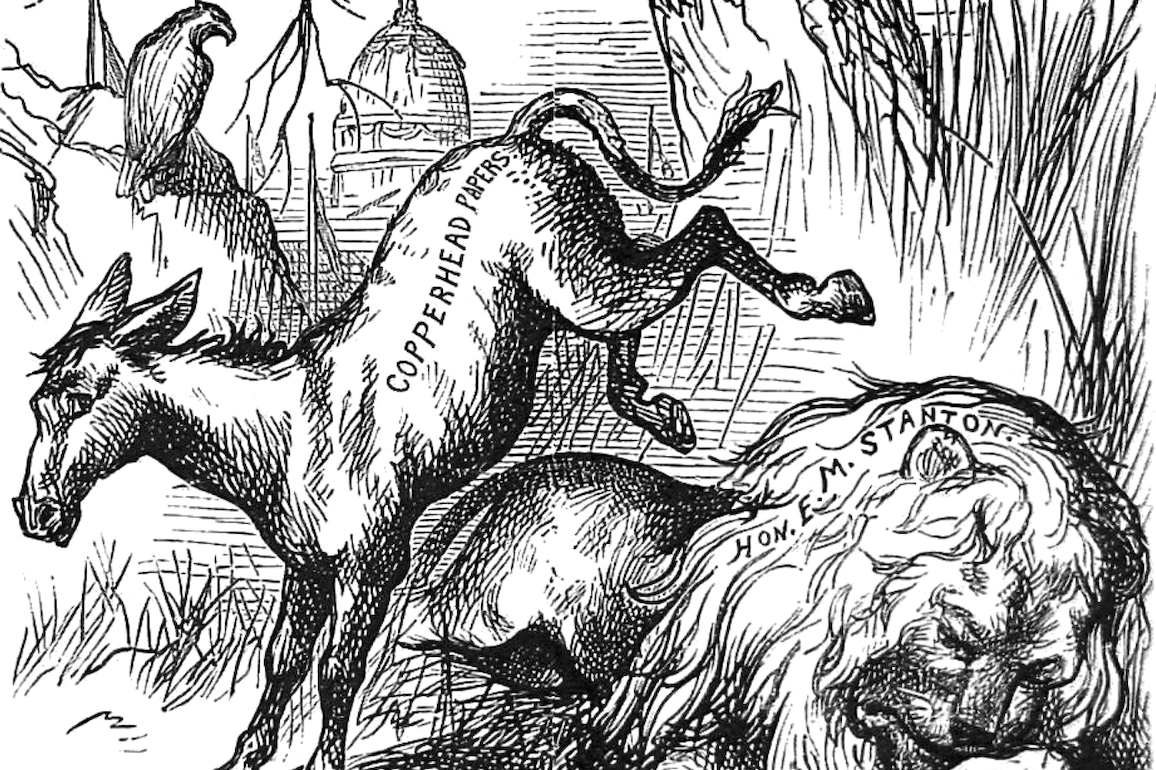
On January 15, 1870, political illustrator Thomas Nast published a cartoon in Harper’s Weekly that would come to be known as the Democratic Party’s symbol.
The cartoon was titled “A Live (Donkey) Kicking a Dead Lion” and commented on the newspapers and magazines against the civil war, and were pro-Democratic. In the image, the donkey is named Copperhead Paper. The lion represents Edwin Stanton, President Lincoln’s Secretary of War during the last three years of the Civil War. In the background is an eagle, meant to represent radical Republicans who held federal control over the recently defeated South as it faced Reconstruction.
The cartoon is said to have commented on the dishonoring of the Lincoln administration by the Copperhead Press.
The symbol of the donkey dates back to the Democratic Party in the 1830s, during Democrat Andrew Jackson’s presidency. Jackson was called a “donkey” by his national Republican opponents during the 1828 presidential election due to his populist beliefs. However, this did not seem to faze Jackson, who instead began using the image on his campaign posters.
4 years after Nast’s cartoon of the donkey, the elephant was used to symbolize the Republican Party in Harper’s Weekly cartoon titled “The Third-Term Panic”. The cartoon commented on the magazine’s response to President Ulysses S. Grant’s possible run for a third term.
The New York Herald is depicted as the donkey wearing the skin of a lion and labeled ‘Caesarism’, a government in which the ruler is entirely a dictator. The lion is shown to scare off other animals, which are labeled with the names of other newspapers. The elephant is labeled “republican vote” and hangs above a chasm labeled “chaos”. The cartoon’s caption reads, “An (donkey), having put on the lion’s skin, roamed about the forest and amused himself by frightening all the foolish animals he met with in his wanderings.”
Jimmy Stamp, a Smithsonian Magazine writer, wrote about the power of Nast’s imagery. “It was a time when political cartoons weren’t just relegated to a sidebar in the editorial page, but really had the power to change minds and sway undecided voters by distilling complex ideas into more compressible representations.”
The cartoons helped establish the visual identity of both parties and became symbolic representations synonymous with each one.
Related:
- Retro amusement park photos that look fun and also slightly terrifying
- Questionable childhood toys that parents let us play with in the ’70s
Like MediaFeed’s content? Be sure to follow us.
This article was syndicated by MediaFeed.org.