
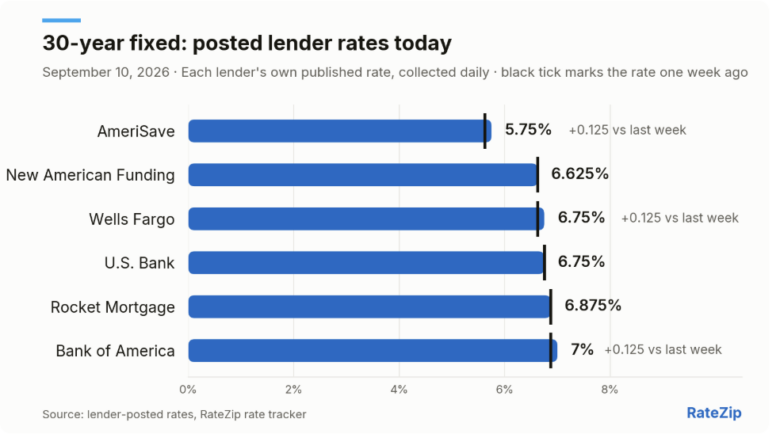
For the homeowner who has spent the past year waiting for a reason to refinance, this week offered none. The average 30-year fixed rate rose to 6.71% in the week ending September 3, up from 6.66% a week earlier, according to Freddie Mac’s weekly survey, and Thursday’s posted rates leaned the same direction. Wells Fargo lifted its 30-year fixed to 6.75%, Bank of America moved to 7%, and Rocket Mortgage raised its 15-year fixed to 6.125%.
The response from borrowers has been to stop asking about refinancing altogether. Refinance applications fell 6% in the week ending September 4 and sat 25% below a year earlier, HousingWire reported from the Mortgage Bankers Association’s weekly survey, dragging total applications down 2.7% even as purchase applications held roughly flat.
Where the demand went
RateZip’s Mortgage Demand Index, built from the mortgage inquiries consumers submit across our network, tells the same story from the homeowner’s side. Over the three months through August 2026, refinance fell to 2% of inquiries, from 39% in the same months a year earlier. Home-equity products, meaning HELOCs plus reverse mortgages, drew 76% of inquiries over that stretch, up from 43%. Homeowners are not leaving the market; they are tapping equity rather than replacing a rate they cannot beat. Total inquiry volume in August ran 11% above July and 157% above August 2025.
Buyers, meanwhile, appear to have made their peace with the high sixes. “Purchase demand has remained relatively stable indicating steady interest from buyers adapting to evolving market conditions,” Sam Khater, Freddie Mac’s chief economist, said in the survey release. They are shopping a somewhat fuller market: active single-family inventory through September 4 was 4.4% above the same week in 2025, though still 6.7% below 2019, with the median list price down about 2% year over year, according to Altos Research data cited by Calculated Risk.
The spread matters more than the day
For anyone still taking out a loan, Thursday’s table carries a sharper lesson than any single lender’s move. AmeriSave posted a 30-year fixed at 5.75% while Bank of America sat at 7%, a gap of 1.25 points. On a $400,000 loan that spread is about $327 a month, far larger than the eighth-of-a-point adjustments that make headlines on a given morning.
Some borrowers are looking past the 30-year fixed entirely. The MBA survey put the adjustable-rate share of applications at 8.5%, even as U.S. Bank raised its posted 7/6 ARM to 7.125% on Thursday, its fourth increase in three weeks, leaving that product up 1 point over the stretch.
Whether the refinance drought breaks depends on the one thing borrowers cannot control. “We expect mortgage rates to remain around 6.7% for the foreseeable future, with incoming economic data critical to their path,” Bob Broeksmit, president and CEO of the Mortgage Bankers Association, said last week.
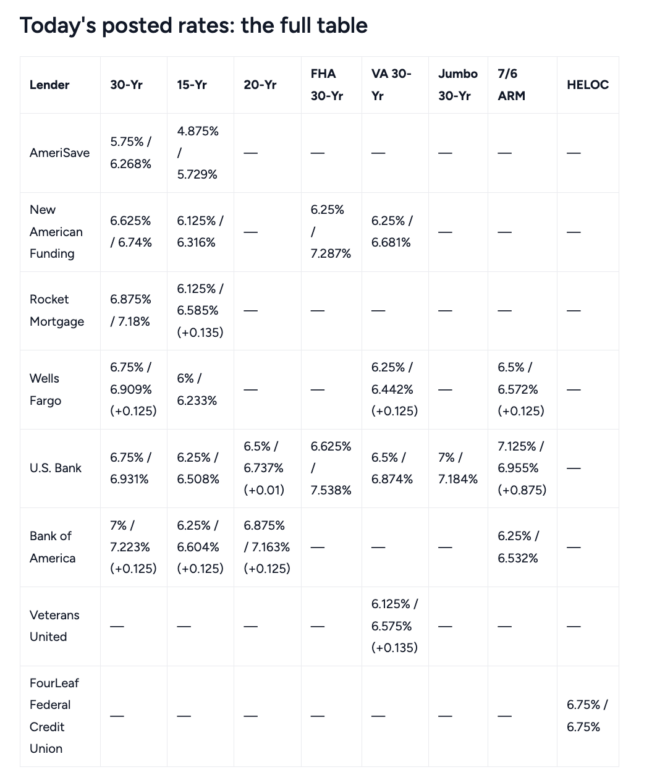
Rates are each lender’s own published rate as of 9:50 a.m. ET, collected from their public rate pages and feeds. The APR is the better cross-lender comparison; a figure in parentheses is today’s change; a ‘—’ means the lender doesn’t post that product. How we collect and publish this: our rate methodology.
Read more
RateZip is operated by Peklava LLC, DBA RateZip, a licensed mortgage broker (NMLS ID 1592292). We are compensated by some of the partners shown on this page, which may affect which offers appear and where. It does not affect our reporting or our recommendations. Rates shown were last updated September 10, 2026 at 9:50 a.m. ET. See our editorial standards and how we use AI.
How we track rates: methodology. Found an error? Tell us.
Ask us! What questions do you have about content, strategy, pop culture, lifestyle, wellness, history or more? We may use your question in an upcoming article!
Like MediaFeed’s content? Be sure to follow us.
This article originally appeared on RateZip and was syndicated by MediaFeed.co.