START WITH 1,500 TO 3,500 SQUARE FEET, THEN ASK BETTER QUESTIONS
For many universities, 1,500 to 3,500 square feet is a reasonable starting range for an esports facility. A smaller space can support varsity practice and competition, while a larger footprint gives you room for recreational gaming, broadcasting, meetings, storage, and spectators. If the goal is a true campus destination with classes, events, production, and significant spectator seating, you can move beyond 5,000 square feet pretty quickly.
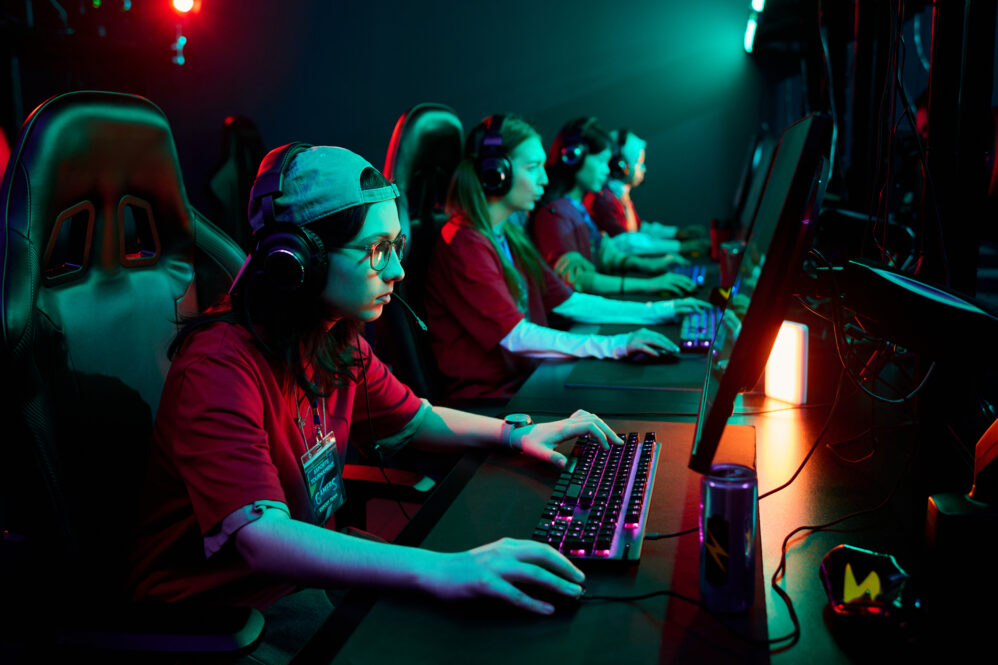
That gives administrators a number to put on a planning document, but square footage by itself doesn’t tell you much. We’ve seen spaces that looked enormous until everything the university wanted started going into them. Twenty gaming stations don’t require a tremendous amount of room on a floor plan. Twenty students, their chairs and backpacks, coaches walking behind them, broadcast equipment, spectators, storage, and accessible circulation are a different story.
START WITH WHAT PEOPLE WILL ACTUALLY DO THERE
A varsity practice room and a campus gaming center may both have gaming PCs, but they’re very different spaces. Varsity teams need dependable practice stations, coaching visibility, storage, and enough separation to focus. A recreational facility may need console gaming, check-in, social space, and room for students who want to be part of the gaming community without joining a team.
Then there’s the arena piece. A competition stage, large displays, production positions, accessible viewing areas, and permanent spectator seating can consume more square footage than people expect. If you’re expecting a large live audience twice a year, it may not make sense to build hundreds of permanent seats that sit empty the rest of the time. Flexible seating combined with a strong broadcast setup can sometimes give the university much more useful space.
This is why we like to talk about activities before dimensions. Once you know what needs to happen in the room, you can start figuring out how much room those activities actually require.
COMPUTERS TAKE UP LESS SPACE THAN PEOPLE
It’s surprisingly easy to put rectangles representing desks onto a floor plan and convince yourself everything fits. The real test is what happens when people arrive. Chairs roll backward, coaches move between stations, technicians need access to cables, and backpacks somehow find the exact walkway you were hoping to keep clear.
Southeastern Community College’s esports facility is a useful example of why station count shouldn’t be the only planning number. Gaming stations are only part of the space. Circulation, spectator areas, consoles, production, and places for students to gather all affect how comfortable and functional the finished facility feels.
Existing campus spaces add another wrinkle. Universities frequently look at former classrooms, bookstores, computer labs, or student union spaces because they’re already available. That’s a perfectly reasonable approach, but 2,500 square feet on a building plan doesn’t necessarily mean 2,500 square feet of useful esports space. Columns, entrances, windows, ceiling height, mechanical systems, power, cooling, and network access have a habit of joining the conversation once design begins.
ACCESSIBILITY HAS TO BE PART OF THE FLOOR PLAN
Accessibility isn’t something you solve at the end by putting an adjustable desk near the door. Students need accessible routes through the facility, appropriate clear floor and turning space, usable work surfaces, and access to the same competitive, broadcast, coaching, and spectator experiences as everyone else.
The U.S. Department of Justice’s ADA Standards for Accessible Design establish requirements covering accessible routes, clear floor space, work surfaces, wheelchair spaces, and spectator sight lines. Those requirements can directly affect layouts and circulation, so accessibility needs to be part of the earliest space-planning conversations. It’s much easier to move something on a drawing than after construction.
BROADCASTING CAN QUIETLY EAT A LOT OF SPACE
Broadcasting is another area that tends to grow as planning gets more serious. A basic stream might run from a production computer in the main room. A more developed program may need commentary positions, cameras, microphones, lighting, production monitors, audio equipment, racks, and secure storage. What started as “we’ll put streaming over here” can turn into a legitimate production operation.
The University at Albany’s esports program is a good example of a broader approach, with gaming, competition, and media production incorporated into the esports experience. If broadcasting will support regular events or academic programs, give it real space from the beginning rather than whatever corner is left over.
Don’t forget the less exciting rooms, either. Storage, repair space, offices, network equipment, check-in, and places for student belongings rarely make the architectural rendering, but you’ll notice immediately if they’re missing.
BUILD ENOUGH ROOM WITHOUT BUILDING TOO MUCH
A university doesn’t need to build the largest esports arena it might possibly use ten years from now. You can prepare power, networking, cooling, and cable pathways for future growth while opening with fewer stations and a smaller initial program.
For many institutions, 1,500 to 3,500 square feet can provide enough room for a strong collegiate esports facility. But I wouldn’t choose a final number until you know exactly what students, coaches, faculty, and staff are expected to do inside it.
The best esports facility isn’t the one that squeezes in the most computers. It’s the one where people can actually move, work, compete, broadcast, and spend time comfortably without everyone wondering where they’re supposed to put their backpack.
Ask us! What questions do you have about content, strategy, pop culture, lifestyle, wellness, history or more? We may use your question in an upcoming article!
Like MediaFeed’s content? Be sure to follow us.
This article originally appeared on Esport Supply and was syndicated by MediaFeed.co.