
Trading futures can provide opportunities for a range of investors. Some investors may trade futures contracts in order to hedge against risk or to speculate on the price movements of a given asset or security — or because their business will benefit if they lock in a commodity at a certain price. A large trucking company may buy oil futures as a way to protect itself against sudden spikes in the price of oil, for example.
A futures contract requires both parties to honor the terms, no matter what the price is in the market when the contract expires.
If you want to trade futures, there are various ways they can fit into your portfolio or plan.
Related: How does a margin account work?
What Are Futures?
Futures are derivatives that take the form of a contract in which two traders agree to buy or sell an asset for a specified price at a future date. Popular underlying assets for futures may include physical commodities like gold, corn or oil, as well as currencies (including crypto), or financial instruments like stocks. The most commonly traded futures contracts use standardized terms and are traded on a futures exchange.
For example, if you want to buy or sell corn futures, one contract would equal 5,000 bushels and be traded via the Chicago Board of Trade (CBOT). Oil is traded on the Chicago Mercantile Exchange (CME), and one oil futures contract equals 1,000 barrels of oil.
Traders buy and sell in increments specified by the contract. To buy 50,000 bushels of corn or 10,000 barrels of oil, you’d buy 10 contracts of each.
Given the quantities and dollar amounts of these trades, investors use leverage, thereby paying only a fraction of the total cost of the position (more on margin trading below).
Types of Futures
Futures contracts allow investors to make bets on the prices of a wide array of assets:
- Commodity futures, which allow investors to buy or sell physical goods like crude oil, pork bellies, natural gas, orange juice, corn, wheat and more
- Financial futures, including index contracts and interest rate or debt contracts
- Precious metal futures allow investors to bet on the future prices of gold, platinum and silver
- Currency futures for fiat currencies like the euro, yen, the British pound, as well as cryptocurrencies
- U.S. Treasury futures allow investors to make bets on the future value of government bonds
What are stock futures? Like futures contracts where the underlying is a physical commodity, some futures are tied to shares of a single stock or ETF. Stock index futures, however, are tied to the price movements of an index like the S&P 500 index.
What are Futures Contracts?
A quick recap as we explore: What are futures, and how do futures work? First, a futures contract obliges the buyer to buy a certain asset, or the seller to sell an asset, at an agreed-upon price, by a certain date. Each party must fulfill the terms of the contract, no matter what the market price or spot price is when the contract expires (or trade the contract before the expiration).
Futures contracts are standardized, as noted above, and each contract also spells out the contract terms, which includes, among other things:
- The unit of the trade (e.g., tons, gallons, bushels, etc.).
- The grade or quality of the commodity, where relevant. For example, there are different types of corn, oil, soy, etc.
- Terms of settlement (e.g., physical delivery or a cash settlement).
- Quantity of goods covered by the contract.
- Currency in which the contract is priced.
A futures contract allows investors to speculate on the direction of the underlying asset, either long or short, using leverage. (Leverage means the trader doesn’t have to put up the full amount of the contract. Instead, futures traders use a margin account.)
How Do Futures Work?
In order to answer the question, How do futures work?, it’s important to understand two key aspects of futures trading: hedging and speculation.
Hedging with Futures
Hedging is a big reason why investors buy futures contracts: It’s a way to protect against losses resulting from price changes in commodities.
Recommended: Why is it risky to invest in commodities?
Among the businesses that hedge using futures, the goal is to reduce the risk they face from unexpected price movements, and to guarantee the price they pay or receive for a particular asset.
If a large food manufacturer wants to lock in the price of corn, for example, they might enter into a contract for $10 a bushel. Since corn contracts are typically standardized at 5,000 bushels per contract, the total amount of the futures contract would be $50,000 ($10 x 5,000), to be delivered in six months. Entering into this futures contract would offer the buyer some protection against the possibility of rising corn prices in the future.
Let’s say the price of corn does rise to $12/bushel by the time the contract expires. In that case, the buyer still only pays the agreed-upon price of $10/bushel, even though the spot price is now $12/bushel.
For the corn producer in this scenario, even though it turned out that the futures contract terms weren’t quite as favorable as the actual market price — the contract guaranteed they would get at least $10/bushel, which provided a hedge against a potentially bigger loss.
Speculating with Futures
Although it’s possible to settle a futures contract for the physical asset specified in the contract, most futures contracts are cash-settled. That’s because speculation on price movements is one of the main reasons that investors purchase futures contracts. A futures contract gives traders the opportunity to speculate whether a commodity will go up or down and potentially profit from the price change.
If the underlying asset of the futures contract — such as gold, oil or corn — is above the price specified in the futures contract, then the investor can sell that contract for a profit before it expires. In that case, the contract would sell for the difference between the market price of the underlying commodity and the purchase price as specified in the contract.
In such a transaction, the underlying commodities don’t change hands between the counterparties of the contract. Instead, the trade would be cash-settled in the brokerage account of the investor.
Alternatively, an investor using futures for speculation could lose money if the price of the commodity is lower than the purchase price specified in the futures contract.
Difference Between Options and Futures
There are other financial derivatives with similar characteristics to futures contracts. One of the most common of these is options contracts. American-style options grant the buyer the right, but not the obligation, to buy or sell the contract’s underlying asset at any time until the contract expires.
Unlike a futures contract, however, options contracts don’t require the investor to purchase or sell the underlying asset. The investor can simply let the option expire. A futures contract, on the other hand, obligates the buyer to purchase the underlying asset, or to pay the seller of the futures contract the cash equivalent of that asset at the time of the contract’s expiration.
Recommended: How to trade options
How to Trade Futures
It’s common for some brokerages to have their own futures-trading capabilities, as well as their own rules about what an investor needs in terms of assets in order to trade futures contracts. Be sure to verify what those requirements are before selecting a broker.
Once you’re eligible to open a margin account and trade futures, those contracts trade on different exchanges, such as the Chicago Mercantile Exchange (CME), ICE Futures U.S. (Intercontinental Exchange) and the CBOE Futures Exchange (CFE).
Most investors in futures contracts have no interest in either receiving or having to deliver the physical commodities that underlie these contracts. Rather, they’re interested in the cash profit. The means of doing so is to trade the futures contract before its expiration date.
The standardized nature of most futures makes it so that a great many (but not all) futures contracts will expire on the third Friday of each month. Some commodities are seasonal, and only trade during specific months. High-grade corn trades on the CBOT in March, May, July, September and December, for example.
The Risks of Trading Futures
Owing to the nature of futures trading, i.e., the binding nature of the contracts and the use of leverage, there are some obvious risks to bear in mind.
In a speculative trade, a futures contract allows you to bet on a commodity’s price movement. If you bought a futures contract, and at expiration the price of the commodity was trading above the original contract price, you’d see a profit. However, you could also lose if the commodity’s price was lower than the purchase price specified in the futures contract.
The potential risks here can be greater than they seem because trading on margin permits a much larger position than the actual amount held by the brokerage. As a result, margin investing can amplify gains, but it can also magnify losses.
Imagine a trader who has $5,000 in their brokerage account and is in a trade for a $50,000 position in crude oil. If the price of oil moves against the trade, the losses could far exceed the account’s $5,000 initial margin amount. In this case, the broker would make a margin call requiring additional funds to be deposited to cover the market losses.
Speculators can also take a short position if they believe the price of the underlying asset will decline. An investor would realize a gain if the underlying asset’s price was below the contract price, and a loss if the current price was above the contract price. Again, using leverage to place these bets, long or short, can potentially expose investors to more risk than they intended.
FAQs
What are futures trading hours?
Unlike the stock market, which is active five days a week from 9:30 a.m. to 4 p.m. Eastern Time, you can trade futures nearly 24 hours a day, six days a week — from 6 p.m. on Sunday to 5 p.m. on Friday — depending on the asset or commodity. Check local times.
Can you day trade futures?
Yes. Some investors believe that trading futures is well suited to day trading, as the price of the underlying asset determines the value of the contract, allowing traders to take either short or long positions, depending on the circumstances. Also, the Pattern Day Trading rule (often called the PDT) does not apply to futures traders, removing the $25,000 margin account minimum.
Can futures prices predict the market?
Not exactly, but futures can be an indicator of certain market movements. Owing to the global nature of today’s markets, there may be market activity overseas that could impact U.S. markets — but many investors wouldn’t know for certain until the U.S. stock market opened. Owing to that lag, some investors look to futures — which trade virtually 24/7 — to gauge possible market trends.
Are there futures in cryptocurrency trading?
Yes. Cryptocurrency futures operate much the same as other types of futures contracts. Traders agree to buy (or sell) a contract tied to an underlying cryptocurrency for a specified price on an agreed-upon date in the future.
The Takeaway
Futures contracts allow traders to enter into a contract to buy or sell an underlying asset for a specific price at a future date. Futures trading offers investors the opportunity to hedge against the risk of price changes of certain assets and commodities, or to use futures contracts to speculate and potentially profit from those price movements.
Because futures contracts are generally liquid, they can be bought and sold up until the expiration date, which is a valuable feature for traders who don’t own or intend to own the physical asset.
Unlike trading most securities, the futures market is active nearly 24 hours a day, six days a week, allowing futures traders more opportunity and flexibility. But trading futures is not without risks. Because futures traders use leverage, that can allow them to place bigger bets on asset price movements, which can amplify gains but exacerbate losses.
Learn More:
This article
originally appeared on SoFi.com and was
syndicated by MediaFeed.org.
SoFi Invest
The information provided is not meant to provide investment or financial advice. Investment decisions should be based on an individual’s specific financial needs, goals and risk profile. SoFi can’t guarantee future financial performance. Advisory services offered through SoFi Wealth, LLC. SoFi Securities, LLC, member FINRA / SIPC . SoFi Invest refers to the three investment and trading platforms operated by Social Finance, Inc. and its affiliates (described below). Individual customer accounts may be subject to the terms applicable to one or more of the platforms below.
1) Automated Investing—The Automated Investing platform is owned by SoFi Wealth LLC, an SEC Registered Investment Advisor (“Sofi Wealth“). Brokerage services are provided to SoFi Wealth LLC by SoFi Securities LLC, an affiliated SEC registered broker dealer and member FINRA/SIPC, (“Sofi Securities).
2) Active Investing—The Active Investing platform is owned by SoFi Securities LLC. Clearing and custody of all securities are provided by APEX Clearing Corporation.
3) Cryptocurrency is offered by SoFi Digital Assets, LLC, a FinCEN registered Money Service Business.
For additional disclosures related to the SoFi Invest platforms described above, including state licensure of Sofi Digital Assets, LLC, please visit www.sofi.com/legal. Neither the Investment Advisor Representatives of SoFi Wealth, nor the Registered Representatives of SoFi Securities are compensated for the sale of any product or service sold through any SoFi Invest platform. Information related to lending products contained herein should not be construed as an offer or pre-qualification for any loan product offered by SoFi Lending Corp and/or its affiliates.
Crypto: Bitcoin and other cryptocurrencies aren’t endorsed or guaranteed by any government, are volatile, and involve a high degree of risk. Consumer protection and securities laws don’t regulate cryptocurrencies to the same degree as traditional brokerage and investment products. Research and knowledge are essential prerequisites before engaging with any cryptocurrency. US regulators, including FINRA, the SEC, and the CFPB have issued public advisories concerning digital asset risk. Cryptocurrency purchases should not be made with funds drawn from financial products including student loans, personal loans, mortgage refinancing, savings, retirement funds or traditional investments. Limitations apply to trading certain crypto assets and may not be available to residents of all states.
Exchange Traded Funds (ETFs): Investors should carefully consider the information contained in the prospectus, which contains the Fund’s investment objectives, risks, charges, expenses, and other relevant information. You may obtain a prospectus from the Fund company’s website or by email customer service at [email protected]. Please read the prospectus carefully prior to investing. Shares of ETFs must be bought and sold at market price, which can vary significantly from the Fund’s net asset value (NAV). Investment returns are subject to market volatility and shares may be worth more or less their original value when redeemed. The diversification of an ETF will not protect against loss. An ETF may not achieve its stated investment objective. Rebalancing and other activities within the fund may be subject to tax consequences.
Advisory services are offered through SoFi Wealth, LLC an SEC-registered Investment adviser. Information about SoFi Wealth’s advisory operations, services, and fees is set forth in SoFi Wealth’s current Form ADV Part 2 (Brochure), a copy of which is available upon request and at adviserinfo.sec.gov .
More from MediaFeed:
50 investment phrases, decoded

Any new endeavor — from rock climbing to investing — means getting familiar with new words and phrases. Some investment terms may seem complex, but this list will take the mystery out of the most common investing terminology, so you can feel even more confident as you start your investing journey.
Related: Is there such a thing as a safe investment?
DepositPhotos.com

Alpha is used to gauge the success of an investment strategy, portfolio, portfolio manager, or trader compared with a relevant benchmark. You may also hear alpha defined as “excess return” in that it refers to returns that can be attributed to active management, over and above market returns.
DepositPhotos.com

An asset is anything that holds value that can be converted to cash. Personal assets might include your home, a car or other valuables. Business assets might include machinery or patents. When it comes to investing, assets are typically the securities you invest in.
DepositPhotos.com

An asset class is a group of investments with similar characteristics that is likely to perform differently in the market than another asset class. Types of asset classes include stocks, bonds, real estate, currencies and more. Given the same market conditions, stocks and bonds often move in opposite directions. Most financial advisers recommend you invest in multiple asset classes in order to have a well-diversified portfolio and minimize risk.
1989_s/ istockphoto

An asset allocation fund is a diversified portfolio consisting of various asset classes. Most asset allocation funds have a mix of stocks, bonds and cash equivalents. These types of funds can be popular as some advisors stress the importance of having diverse portfolios to minimize potential losses.
GaudiLab // istockphoto

Beta refers to how risky or volatile a security or portfolio is compared with the market overall. Calculating the beta of the stocks in your portfolio can help you determine how your portfolio might respond to market volatility. You can also gauge the beta of a stock to help determine how much risk it might add to your portfolio.
PeopleImages

A bear market occurs when the market declines, typically when broad market indexes fall 20% or more in two months or less. Bear markets can accompany a recession, but not always. They often signal that investors feel pessimistic about their investments’ ability to make money and the market’s ability to rebound.
monsitj / istockphoto
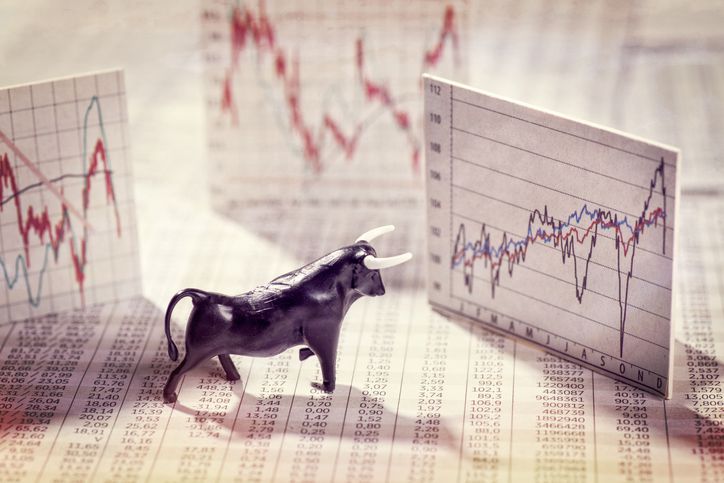
A bull market is the opposite of a bear market, meaning prices are rising or are expected to rise for extended periods of time. Bull markets usually mean security prices are rising for months or even years at a time.
gopixa / istockphoto

Blue chip companies are generally thought to be well-established, financially sound, and therefore high-quality investments. Blue chip stocks are typically large companies, and many of them are household names. In some cases, blue chips may be more expensive to invest in since they can be considered relatively stable and likely to grow.
zimmytws / istockphoto
When governments or corporations need to borrow money they issue bonds. Investors who buy the bonds are effectively loaning that entity cash, which will be repaid according to the terms of the bond (e.g. a 10-year bond with an interest rate of 3%). Bonds are often considered to be relatively stable, lower-risk investments compared with stocks.
DepositPhotos.com

An investment broker, whether a person or a firm, acts as a middleman to help investors buy and sell securities. Brokers may be necessary because some securities exchanges only allow members of that exchange to make an investment order. A broker’s primary function is to help clients place trades, although many brokers also help clients with market research and investment planning.
Antonio_Diaz / istockphoto

You’ve probably heard that you should aim to have a diversified portfolio. That means investing in a range of asset classes that are likely to behave differently under different market conditions, in order to mitigate risk. A portfolio of only stocks, for instance, could be more vulnerable to market volatility than a portfolio that also included bonds, real estate, commodities and so on.
SARINYAPINNGAM / istockphoto

When a company shares their profits with investors, these are called dividends. Dividends are often paid in cash (although they can be paid in stocks). Some companies — e.g. many blue chip firms — pay dividends, but not all companies do. Ordinary dividends are taxed differently than qualified dividends, so you may want to consult a tax professional if you own dividend-paying stocks.
ipopba/ istockphoto

Also called fractional share investing, dollar based investing is a way for investors to buy partial shares of stocks. Instead of buying shares of a company, you instead invest a dollar amount. Dollar based investing is a great way for smaller investors to buy into popular companies that they may otherwise be priced out of.
Antonistock / istockphoto

EBITDA is a way to evaluate a company’s performance that is considered more precise than simply looking at net income. EBITDA stands for: earnings before interest, taxes, depreciation, and amortization. To calculate EBITDA, use the following formula: Net Income + Interest + Taxes + Depreciation + Amortization.
DepositPhotos.com
EBIT is a simpler way to calculate a company’s profits than EBITDA, as it’s only one part of the EBITDA equation (literally!). It stands for “earnings before interest and taxes.” It’s calculated using this formula: Net Income + Interest + Taxes.
DepositPhotos.com
EPS stands for earnings per share, which is a common way investors measure how well a stock is performing. EPS is calculated by finding a company’s quarterly or annual net income and dividing it by the company’s outstanding shares of stock. Increases in EPS can be a sign that the company’s profit performance is on the upswing, whereas a decrease can be a red flag for investors.
SlavkoSereda / istockphoto

Exchange-traded funds, or ETFs, are similar to mutual funds in that the fund’s portfolio can include dozens or even hundreds of different securities, and investors buy shares of the fund. Unlike mutual funds, ETF shares can be traded like stocks throughout the day (mutual fund shares are traded once a day). Most ETFs are considered lower-cost, passive investments because they track an index, although there are actively managed ETFs.
TimArbaev / iStock

An expense ratio is an annual fee investors pay to cover the operating costs of mutual funds, index funds, ETFs and other types of funds. Fees are typically deducted from your investments automatically (you don’t pay a separate charge), and they can reduce your returns over time so it’s wise to shop around for lower fees. Expense ratios are calculated using this formula: Total Funds Costs / Total Fund Assets Under Management.
Bet_Noire / istockphoto

Free cash flow is the money a company has after it has paid its expenses. This number is important to investors because it can show them how likely it is that a company could have extra cash for dividends or share buybacks. A continuous decrease in free cash flow over a few years can also be a red flag to investors.
jat306 / istockphoto

Growth stocks are shares in a company that’s growing faster than its competitors, typically showing potential for higher revenue or sales. Growth stock companies may be considered leaders in their industry.
Depositphotos

Hedge funds are usually managed by an LLC or limited partnership that invests in securities and other assets using money from multiple investors. Hedge funds tend to be more risky and expensive than mutual funds or ETFs, which often makes them accessible to more wealthy investors.
g-stockstudio/istockphoto

Index funds are a type of mutual fund that invest in securities that mirror a particular index, such as the S&P 500 Index or the MSCI World Index. Indexes track many different sectors, from smaller U.S. companies to big global companies to various kinds of bonds. Each index acts as a proxy for how that market sector is performing; the corresponding index funds reflect that performance.
William_Potter // istockphoto

The interest rate is the amount a lender charges to borrow money — and it can also mean the amount your cash earns in a savings, money market or CD account. The baseline interest rate in the U.S. is set by the Federal Reserve. This rate in turn influences savings rates, mortgage rates, credit card rates and more. Generally, when the Federal Reserve lowers interest rates, the stock market tends to rise.
Depositphotos

A large-cap company has $10 billion or more in market capitalization. These companies are often considered industry leaders, and are relatively conservative, low-risk, and safe investments. A company’s stock may be considered large cap, mid cap or small cap.
Fokusiert/ istockphoto

Market capitalization, or market cap, is the value of a company’s total outstanding shares. It’s often used to measure a company’s value and build a diversified portfolio. You can calculate market cap by multiplying the number of outstanding shares by the current price per share. Companies with lower market caps usually have more room to grow and usually are associated with newer companies, meaning they can also be riskier.
Алексей Белозерский/ istockphoto

Mid-cap companies are usually between $2 billion to $10 billion in market capitalization, putting them somewhere between small- and large-cap companies. Many mid-cap companies are in a growth phase, making them attractive to some investors who believe the company may grow into a large-cap over time, although this is not guaranteed to happen.
nortonrsx

Mega-cap companies are the largest companies you can invest in, with a market value of $1 trillion or more. Mega-cap stocks are typically industry leaders and household name brands, like Apple or Microsoft.
oxtain / istockphoto
Mutual funds may invest in stocks, bonds and other securities — or a combination of these (e.g. a blended fund). Mutual funds can also be industry-specific (such as a mutual fund consisting only of energy stocks, green bonds, or tech companies and so on).
DepositPhotos.com

When talking about investing, net income usually refers to how much a company makes (or its total losses) after it has paid all its expenses. Net income is therefore usually calculated by subtracting a company’s expenses from its revenue. Investors may want to know a company’s net income because it can help determine how profitable the company is, although EBITDA (defined above) is another measure.
SARINYAPINNGAM / istockphoto

Not all stocks are publicly traded. These “private” stocks, often called over-the-counter stocks, usually have to be traded through a broker. Companies may offer OTC stocks if they don’t meet the requirements to be traded publicly. Such companies are often startups or other small companies. So, while these companies may eventually grow to be able to trade publicly, investing in them also carries the risk that they may fold or even engage in fraudulent activity since the market is far less regulated than publicly traded markets are.
Victoria Gnatiuk / istockphoto

Investors commonly use P/E or price-to-earnings ratios to gain insight into how profitable a company is compared to its stock price. In other words, price-to-earnings ratios can help investors decide if the price of a stock is worth it when compared to how much a company is making.
gopixa / istockphoto

Banks are likely to offer their best customers — those with the best credit histories and the lowest risk of defaulting — a prime interest rate for a loan. The prime interest rate is generally the lowest rate the bank will offer. A bank’s criteria for determining their prime interest rate may vary, but most banks consider the federal funds rate when setting any interest rate.
Zerbor/istock

Portfolio management simply refers to how you select and manage the investments in your portfolio. There are many different management styles, such as active or passive, growth or value. Additionally, you can elect to manage your own portfolio or hire an individual or group to manage it for you.
William_Potter / istockphoto

A preferred stock means investors own shares in a company and get scheduled dividends, similar to how bond interest payments work. Preferred socks may not fluctuate in price like common stocks do, meaning they are often less volatile and risky.
DepositPhotos.com

You probably know what profit and losses are, but do you know how to read a company’s P&L or profit & loss statement? It can help you determine a company’s bottom line, as it can show you how well a company is doing compared to its peers in the same industry. If you’ve never read one before, this article about profit & loss statements could give you some tips on what to look for.
small smiles/ istockphoto

Companies that offer stocks, bonds and mutual funds to investors are required to file a prospectus with the Securities and Exchange Commission that provides details about the investment they are offering (e.g. the expense ratio, the constituents of a fund and more). Investors can use the prospectus to better understand a given security and how it might fit in their portfolio, or not.
DepositPhotos.com

A recession is a period of economic contraction. The National Bureau of Economic Research (NBER) defines a recession further as a decline in monthly employment, personal income, and industrial production. As an investor, a recession may indicate a drop in the value of your portfolio, although this may be temporary: When looking at the history of U.S. recessions, the stock market has typically rebounded after recessions.
DepositPhotos.com

Real estate investment trusts (REITs) are a way that investors can further diversify their portfolios. Instead of having the responsibility of managing an investment property yourself, you can invest in REITs, which are generally large-scale real estate projects that investors can help fund in exchange for partial ownership. Most REITs are publicly traded and pay dividends to investors.
DepositPhotos.com

When looking for a company’s net income statement, you may come across the term “retained earnings,” also sometimes called unappropriated profit, uncovered loss, member capital, earnings surplus, or accumulated earnings. In general, retained earnings is the amount of money a company keeps and potentially reinvests after it gives its investors a dividend payout.
As an investor, knowing whether a company had positive retained earnings can help you determine how much money it has to continue growing. If its retained earnings are negative, that could be a sign the company is in debt and may not be a good investment.
artisteer / istockphoto

Return on equity, sometimes called return on net worth, can help investors compare how well companies are managing their stockholders’ contributions. You can calculate it using this formula: Net income/Average shareholder equity. A higher return on equity can signal to investors that a company is managing its money efficiently.
Depositphotos

Return on investment (ROI) is just that: the return you get after making an investment in a stock, bond, mutual fund, and so forth. Investors generally hope for a positive ROI, meaning that their investment has made a profit. While a good ROI will vary depending on the type of investments you’re making, some investors look to the historic return of the stock market (about 7%) as a barometer.
Melpomenem/istock

A small-cap company usually has a market cap of $250 million to $2 billion. Investors may be attracted to a small-cap company because they believe it has growth potential or may be undervalued.
DepositPhotos.com

SPAC stands for special purpose acquisition company. SPACs are shell companies that list shares on an exchange to raise money so they can merge with a privately held company. Once the merger between the public SPAC and the private company is complete, that company is now in effect a public company — which is why a SPAC is sometimes called a backdoor IPO. Many companies may elect to use SPACs instead of traditional IPOs because they are often faster and less expensive.
iQoncept / istockphoto

If you’ve made it this far, you probably know what a stock is. To review, a stock is a way to buy a piece of ownership into a company. You can buy and sell your stocks depending on whether you anticipate your stocks will decrease or increase in value.
AUDINDesign / istockphoto

A stock exchange is the place where you buy, sell, or trade stocks. Common U.S. stock exchanges are the New York Stock Exchange (NYSE) and the Nasdaq.
NicoElNino / istockphoto

A stop-loss order can help investors have more control over their stocks. When a stock reaches a certain price that you choose, your broker will sell, buy, or trade that stock. Having a stop-loss order can help you limit how much money you make or lose in the stock market.
insta_photos/istock

A target date fund is a type of mutual fund that includes a mix of asset classes to provide investors with a portfolio that adjusts over time to become more conservative as they age. Target date funds are often used to help investors plan their retirements. Target funds are typically constructed around various target retirement years (e.g. 2030, 2040, 2050) so investors can pick a date that corresponds with their hoped-for retirement.
Deposit Photos

A value stock is a stock that investors believe is undervalued and/or inexpensive compared to its past prices on the stock market or with its competitors. Investors may consider a stock’s price-to-earnings ratio to help them determine if something is a value stock.
Deposit Photos

Venture capital is money a startup uses to grow its business. This money usually comes from private investors or venture capital firms. Investors may elect to invest venture capital into startups they believe have the potential to be profitable with time.
Ahmetov_Ruslan/istock

Yield is another way of referring to the return of an investment over a set period of time, expressed as a percentage. You may hear the term in relation to bonds (e.g. high-yield bonds), but yield is more accurately a measure of the cash flow an investor gets on the amount they invested in a security during that time period, and is different from total return.
HAKINMHAN/istockphoto

Getting familiar with a few key investing words and phrases can go a long way in helping you gain confidence when you’re new to investing. Getting fluent with investing terminology is like any other pursuit — there’s a learning curve at first, but the terms will feel more natural as you move forward and start investing regularly.
Learn more:
This article originally appeared on SoFi.comand was syndicated by MediaFeed.org.
SoFi Invest
The information provided is not meant to provide investment or financial advice. Investment decisions should be based on an individual’s specific financial needs, goals and risk profile. SoFi can’t guarantee future financial performance. Advisory services offered through SoFi Wealth, LLC. SoFi Securities, LLC, member FINRA/ SIPC. SoFi Invest refers to the three investment and trading platforms operated by Social Finance, Inc. and its affiliates (described below). Individual customer accounts may be subject to the terms applicable to one or more of the platforms below.
1) Automated Investing—The Automated Investing platform is owned by SoFi Wealth LLC, an SEC Registered Investment Advisor (“Sofi Wealth“). Brokerage services are provided to SoFi Wealth LLC by SoFi Securities LLC, an affiliated SEC registered broker dealer and member FINRA/SIPC, (“Sofi Securities).
2) Active Investing—The Active Investing platform is owned by SoFi Securities LLC. Clearing and custody of all securities are provided by APEX Clearing Corporation.
3) Cryptocurrency is offered by SoFi Digital Assets, LLC, a FinCEN registered Money Service Business.
For additional disclosures related to the SoFi Invest platforms described above, including state licensure of Sofi Digital Assets, LLC, please visit www.sofi.com/legal. Neither the Investment Advisor Representatives of SoFi Wealth, nor the Registered Representatives of SoFi Securities are compensated for the sale of any product or service sold through any SoFi Invest platform. Information related to lending products contained herein should not be construed as an offer or pre-qualification for any loan product offered by SoFi Lending Corp and/or its affiliates.
Fund Fees
If you invest in Exchange Traded Funds (ETFs) through SoFi Invest (either by buying them yourself or via investing in SoFi Invest’s automated investments, formerly SoFi Wealth), these funds will have their own management fees. These fees are not paid directly by you, but rather by the fund itself. these fees do reduce the fund’s returns. Check out each fund’s prospectus for details. SoFi Invest does not receive sales commissions, 12b-1 fees, or other fees from ETFs for investing such funds on behalf of advisory clients, though if SoFi Invest creates its own funds, it could earn management fees there.
Exchange Traded Funds (ETFs): Investors should carefully consider the information contained in the prospectus, which contains the Fund’s investment objectives, risks, charges, expenses, and other relevant information. You may obtain a prospectus from the Fund company’s website or by email customer service at [email protected]. Please read the prospectus carefully prior to investing. Shares of ETFs must be bought and sold at market price, which can vary significantly from the Fund’s net asset value (NAV). Investment returns are subject to market volatility and shares may be worth more or less their original value when redeemed. The diversification of an ETF will not protect against loss. An ETF may not achieve its stated investment objective. Rebalancing and other activities within the fund may be subject to tax consequences.
Investment Risk: Diversification can help reduce some investment risk. It cannot guarantee profit, or fully protect in a down market.
Advisory services are offered through SoFi Wealth, LLC an SEC-registered Investment adviser. Information about SoFi Wealth’s advisory operations, services, and fees is set forth in SoFi Wealth’s current Form ADV Part 2 (Brochure), a copy of which is available upon request and at adviserinfo.sec.gov.
DepositPhotos.com
Featured Image Credit: Ridofranz // istockphoto.