
There’s something to be said about long-tenured employees. They know the ropes, have some seniority and are probably pretty comfortable. Still, there’s also something to be said about earning more money. And if that’s your goal, you may need to leave that comfort zone — and your ZIP code.
The newest LendingTree study delves into data on workers who took new jobs that entailed a relocation — either in state or out of state — finding an average earnings jump of 11%. We also look at how job-hopping pays off based on a company’s location, size, age and industry.
What we tracked & why
In this study, LendingTree analysts compared average quarterly earnings before and after a job switch that entailed a relocation, whether in state or out of state. Job-hopping can often be the best way for employees to boost their earnings — especially among those earlier in their careers. Where you job-hop can also affect how big a salary boost you can expect.
Why does job-hopping frequently pay off? The reasons vary, says Jacob Channel, LendingTree senior economic analyst.
“When you’re negotiating for a job with a new employer, your new salary will likely be much less dependent on your current one than it would be had you been negotiating a raise with your current employer,” he says. “As a result, it might be easier to negotiate a higher salary than you would have if you had kept your old job, as you likely won’t have your new employer comparing what you’re currently making to what you’re asking for.
“Job-hopping may also pay off because people are less likely to switch jobs for a smaller pay raise. After all, changing jobs, learning all your new responsibilities and meeting all your new co-workers can be a daunting and overwhelming experience, so it might not make sense to take a new job unless you were being offered substantially more money.”
Where workers who switch jobs & move see the largest average pay increases
Looking for a big salary boost? Be prepared to round up some moving boxes. Workers who switched jobs and moved (either within or outside of their state of residence) saw an average salary bump of 11%.
This data isn’t tracked at the national level, so we averaged the findings from the states with available data from the fourth quarter of 2020 — which coincides with the end of the first partial year of the coronavirus pandemic. The findings show that job relocations to 42 of these 43 states resulted in average earnings jumps.
Buckle down and start searching for work in the Buckeye State for your best shot at the biggest earnings boost. People whose new jobs moved them to or within Ohio increased their quarterly earnings by 33%, on average — the largest boost of any state.
The state reported 171,073 new business filings in 2020 — more than 40,000 above the 2019 record of 130,621. (While there’s no guarantee that business filings turn into profitable, job-creating businesses, it is a good indicator.) Specifically, a LendingTree study on where entrepreneurship boomed amid the pandemic found business applications spiked year over year in 2020 by at least 25% in the Cleveland, Akron, Dayton, Columbus and Cincinnati metro areas. This could lead to a competitive jobs market where earnings have to be raised significantly to attract employees.
Moves to and within Connecticut and New Jersey followed, with workers in these states earning an average of 26% more than at their previous jobs. Both are among the states with the highest per capita personal incomes in the U.S. They also have above-average living costs, which likely forces employers to pay more to make jobs there attractive.
Largest pay increases after switching jobs, moving

Source: LendingTree analysis of U.S. Census Bureau Longitudinal Employer-Household Dynamics job-to-job flows database.
Moving can be expensive, and even more so now because of the pandemic. While a bigger salary is great, you’ll have to weigh the bigger financial picture — including the possibility of needing to get a mortgage with a new job and owing debt accumulated during the move. While taking on temporary debt may pay off in the long run, be sure you have a plan to pay it off in place with tools such as a debt consolidation loan.
Where workers who switch jobs, move see the smallest average pay increases
Moving doesn’t always equal a salary bump though — especially if you’re headed to Wyoming, the only one of 43 states with available data where workers saw a quarterly earnings decrease after switching jobs. The average nosedived from $12,128 to $10,684 after a move to or within Wyoming — a 12% decrease.
As for why, a concept discussed in more detail later in this LendingTree study may better help explain. We’ll note later that the mining industry is the most lucrative for job-hoppers. But at the time of this data from the fourth quarter of 2020, the largest job losses in Wyoming were in this industry. In fact, the state lost more than 5,900 jobs that quarter in this industry. It makes sense then that a state like Wyoming would see the opposite impact in our study when it loses the most jobs in an industry like that. (The state also has a below-average cost of living, which can factor into how an employer pays you.)
Other states where job-hopping only provided a small average increase in earnings (a few of which also have below-average living costs) include North Dakota, Nebraska, Maine, Idaho and Montana. Workers moving to new jobs in these states saw an average pay increase of no more than 4%.
Smallest pay increases after switching jobs, moving

Source: LendingTree analysis of U.S. Census Bureau Longitudinal Employer-Household Dynamics job-to-job flows database.
Workers at largest firms benefit most from job-hopping
California as a case study
Beyond locale, the payoff for job-hopping is often affected by the type of job to which you’re hopping. Because this demographic data isn’t available at the national level, we used California as a case study, since it provides the largest sample size.
Size matters when it comes to job-hopping. When we delved into job changes by the type of company — again, this is based on California because it provides the largest sample size with no national-level data available — it was workers who moved to or among larger companies that saw the biggest pay increases.
Those moving to a company with 500-plus employees saw an average salary increase of 15%, while those moving to smaller companies only saw a 5% to 6% increase.
A larger company’s diversification could make it easier to overcome the headwinds businesses faced during the pandemic. For example, a second COVID-19 wave during the fourth quarter of 2020 had many small businesses increasingly worried about their futures.
Pay changes after switching employers (by size of companies)

Source: LendingTree analysis of U.S. Census Bureau Longitudinal Employer-Household Dynamics job-to-job flows database
Head to an established company if you’re looking for a bigger pay increase
Moving to a more established firm often can pay off, too, with those going to a firm that’s been around for at least 11 years increasing their earnings by an average of 13%.
Those who moved to newbie companies less than a year old only saw an increase of 2%, and those who jumped to companies that have been around four to five years saw an average decrease in their salary of 3%.
This isn’t surprising, perhaps, given that 18.4% of private-sector businesses in the U.S. fail within the first year; after five years, 49.7% have faltered. And while 65.5% of businesses have failed after 10 years, those that remain standing likely have regular customers in place and a steady flow of funds.
Pay changes after switching employers (by age of companies)

Source: LendingTree analysis of U.S. Census Bureau Longitudinal Employer-Household Dynamics job-to-job flows database
Mining for a new job? Consider California’s mining industry
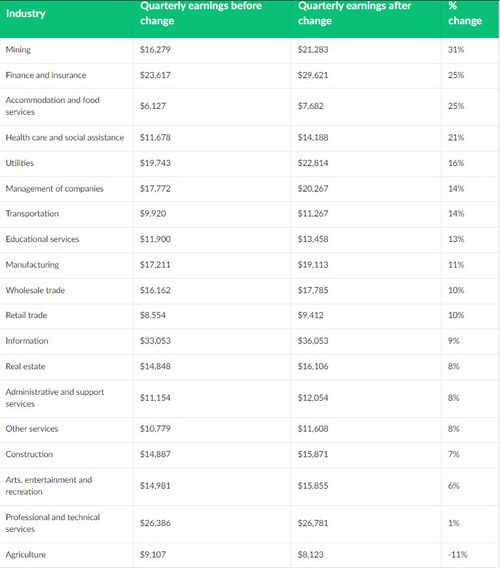
To potentially strike it rich — or at least richer than you were at your previous job — check out the mining industry in California. Those who switched to companies that extract coal, crude petroleum and natural gas, among other things, increased their earnings by an average of 31% in the fourth quarter of 2020.
Other top California industries that paid off for job-switchers include finance and insurance and accommodation and food services (hotels and restaurants), each where hopping resulted in an average 25% salary increase.
Those are pretty big bumps — especially when compared to job switchers in the California agriculture industry (think farms, ranches, dairies, greenhouses, nurseries, orchards or hatcheries), where job-hoppers saw earnings decrease by an average of 11%.
Just above agriculture were professional and technical services (fields that require a lot of training and expertise, such as law, architecture and research) and arts, entertainment and recreation, with workers switching to jobs in these industries only increasing their average income by 1% and 6%, respectively.
Pay changes after switching employers (by industry)
Source: LendingTree analysis of U.S. Census Bureau Longitudinal Employer-Household Dynamics job-to-job flows database
5 job-hunting tips
Thinking about job-hopping to boost your salary? Channel offers the following tips to help you, well, hop to it:
- Know your worth: When searching for a new job and a raise, Channel says that employees should be sure they can clearly communicate how much money they’re worth. “They should highlight their relevant skills and point out to prospective employers why those skills are worth top-dollar,” he says.
- Negotiate: You should be willing to negotiate and unafraid to be open and honest about what you want. “The worst thing an employer can say is ‘no,’” Channel says. “After all, how can someone expect to get what they’re after if they never ask for it in the first place?”
- Proceed with caution: Job seekers who want a raise should be sure they aren’t quitting their current job and rushing into something new before they fully understand. “Be wary of quitting your current job without having a new job set up,” he says. “Just because you’re not working, that doesn’t mean that things like your debt obligations go away. The last thing you want to do is tank your credit score or default on a loan because you quit your job, couldn’t find a new one and didn’t have any income to make your payments.”
- Consider the whole picture: When moving for a higher-paying job, it’s important to consider the cost of living in the area in which you want to move, as well as moving expenses. A higher wage in a big city may be worth less than a lower wage in a small city or town. And a higher wage might not necessarily pay off right away if you spend a fortune moving across the country. You should also consider whether you’ll like the place you’re thinking about moving. “Extra money might not be worth it if your new surroundings make you completely miserable,” Channel says.
- Explore remote possibilities: Since the pandemic, more jobs are being performed remotely, and you may want to explore such options before making a move. “In today’s work environment, you may be able to get a higher-paying job at an employer headquartered a thousand miles away from you, without ever needing to leave your house,” he says.
Methodology
To rank the states where workers received the largest increases in earnings after switching jobs and moving, we compared earnings for job switchers in the fourth quarter of 2020 — the latest information available. Specifically, we compared the earnings of workers before they switched jobs and moved and then again after. We ranked the states from highest percentage increase to lowest.
We then compared job movers across various demographics (including industry size, industry age and more) using the same method as with the state analysis. Because this data isn’t available at the national level, we used California as our subject due to it having the largest sample size.
LendingTree analyzed data from the U.S. Census Bureau Longitudinal Employer-Household Dynamics job-to-job flows database.
This article originally appeared on LendingTree and was syndicated by MediaFeed.org.
More from MediaFeed
Want a raise? You may want to move to this state

Whenever rising inflation makes headlines, businesses are impacted in two key ways: They need to spend more on production costs and spend more to hire new workers or keep the ones they have. But what does that mean for wages?
To find out, LendingTree analysts looked at the latest available U.S. Census Bureau data to see the states where wages increased the most between the second quarter of 2020 and the second quarter of 2021. In this period, just one state saw average weekly wages increase by more than 10%. And only two states saw a decrease.
Here’s what else researchers found.
SPONSORED: Find a Qualified Financial Advisor
1. Finding a qualified financial advisor doesn’t have to be hard. SmartAsset’s free tool matches you with up to 3 fiduciary financial advisors in your area in 5 minutes.
2. Each advisor has been vetted by SmartAsset and is held to a fiduciary standard to act in your best interests. If you’re ready to be matched with local advisors that can help you achieve your financial goals, get started now.
DepositPhotos.com

- Average weekly wages rose 4.8% in the U.S. between the second quarter of 2020 and the second quarter of 2021. Wages were up in this year-over-year period despite falling 5.5% in the most recent quarter for which data was available.
- Only one state saw wages increase by greater than 10% year over year.
- Wages didn’t grow in the same period in just two states.
- The leisure and hospitality industry saw the biggest year-over-year wage increase, but this sector still could see a lot of growth. The industry saw wages rise from $464 in the second quarter of 2020 to $526 in the second quarter of 2021 — a 13.4% jump. But only one other industry examined — other services, including jobs such as auto service technicians and hairdressers — has average wages below $1,000.
DepositPhotos.com

According to the latest available data, average weekly wages increased 4.8% between the second quarter of 2020 — the first full quarter during the pandemic — and the second quarter of 2021 — when vaccine distribution was first ramping up.
More of the increase came earlier in the year-over-year period, as weekly wages fell 5.5% between the first and second quarters of 2021.
But, according to LendingTree senior economic analyst Jacob Channel, that kind of quarterly decrease isn’t surprising.
“Typically, consumer demand for a variety of goods and services tends to increase in the fourth quarter, which means that many workers need to work longer hours to satisfy that demand,” Channel says. “These longer hours mean that workers are on the clock for more time and, as a result, their average weekly wages tend to increase. These higher wages typically last through the first quarter, but eventually decline as the consumer demand falls.”
So, because of this phenomenon, a year-over-year comparison is more telling when it comes to economic trends, he adds.
istockphoto

- Average weekly wages, Q2 2020: $1,147
- Average weekly wages, Q2 2021: $1,124
- Percentage change: -2.00%
Chilkoot

- Average weekly wages, Q2 2020: $1,022
- Average weekly wages, Q2 2021: $1,017
- Percentage change: -0.50%
DenisTangneyJr

- Average weekly wages, Q2 2020: $1,117
- Average weekly wages, Q2 2021: $1,119
- Percentage change: 0.20%
danlogan

- Average weekly wages, Q2 2020: $1,399
- Average weekly wages, Q2 2021: $1,407
- Percentage change: 0.60%
traveler1116

- Average weekly wages, Q2 2020: $1,516
- Average weekly wages, Q2 2021: $1,525
- Percentage change: 0.60%
Boogich

- Average weekly wages, Q2 2020: $1,054
- Average weekly wages, Q2 2021: $1,065
- Percentage change: 1.00%
sequential5

- Average weekly wages, Q2 2020: $1,582
- Average weekly wages, Q2 2021: $1,600
- Percentage change: 1.10%
Rolf_52

- Average weekly wages, Q2 2020: $1,359
- Average weekly wages, Q2 2021: $1,375
- Percentage change: 1.20%
aimintang

- Average weekly wages, Q2 2020: $1,238
- Average weekly wages, Q2 2021: $1,255
- Percentage change: 1.40%
James_Lane

- Average weekly wages, Q2 2020: $987
- Average weekly wages, Q2 2021: $1,004
- Percentage change: 1.70%
DenisTangneyJr

- Average weekly wages, Q2 2020: $1,039
- Average weekly wages, Q2 2021: $1,057
- Percentage change: 1.70%
Art Wager

- Average weekly wages, Q2 2020: $1,161
- Average weekly wages, Q2 2021: $1,186
- Percentage change: 2.20%
weaver1234

- Average weekly wages, Q2 2020: $916
- Average weekly wages, Q2 2021: $936
- Percentage change: 2.20%
DepositPhotos.com

- Average weekly wages, Q2 2020: $1,148
- Average weekly wages, Q2 2021: $1,178
- Percentage change: 2.60%
mdgmorris

- Average weekly wages, Q2 2020: $1,109
- Average weekly wages, Q2 2021: $1,138
- Percentage change: 2.60%
haveseen

- Average weekly wages, Q2 2020: $964
- Average weekly wages, Q2 2021: $991
- Percentage change: 2.80%
JoeChristensen

- Average weekly wages, Q2 2020: $892
- Average weekly wages, Q2 2021: $917
- Percentage change: 2.80%
DepositPhotos.com

- Average weekly wages, Q2 2020: $952
- Average weekly wages, Q2 2021: $979
- Percentage change: 2.80%
Thomas Kelley

- Average weekly wages, Q2 2020: $913
- Average weekly wages, Q2 2021: $939
- Percentage change: 2.80%
Davel5957

- Average weekly wages, Q2 2020: $968
- Average weekly wages, Q2 2021: $996
- Percentage change: 2.90%
DepositPhotos.com

- Average weekly wages, Q2 2020: $999
- Average weekly wages, Q2 2021: $1,029
- Percentage change: 3.00%
FierceAbin

- Average weekly wages, Q2 2020: $976
- Average weekly wages, Q2 2021: $1,006
- Percentage change: 3.10%
Michael Pham

- Average weekly wages, Q2 2020: $1,211
- Average weekly wages, Q2 2021: $1,251
- Percentage change: 3.30%
SPONSORED: Find a Qualified Financial Advisor
1. Finding a qualified financial advisor doesn’t have to be hard. SmartAsset’s free tool matches you with up to 3 fiduciary financial advisors in your area in 5 minutes.
2. Each advisor has been vetted by SmartAsset and is held to a fiduciary standard to act in your best interests. If you’re ready to be matched with local advisors that can help you achieve your financial goals, get started now.
DenisTangneyJr

- Average weekly wages, Q2 2020: $907
- Average weekly wages, Q2 2021: $938
- Percentage change: 3.40%
Rex_Wholster

- Average weekly wages, Q2 2020: $929
- Average weekly wages, Q2 2021: $961
- Percentage change: 3.40%
dschreiber29

- Average weekly wages, Q2 2020: $1,199
- Average weekly wages, Q2 2021: $1,243
- Percentage change: 3.70%
JoeChristensen

- Average weekly wages, Q2 2020: $1,017
- Average weekly wages, Q2 2021: $1,056
- Percentage change: 3.80%
dypics

- Average weekly wages, Q2 2020: $1,212
- Average weekly wages, Q2 2021: $1,261
- Percentage change: 4.00%
ibsky

- Average weekly wages, Q2 2020: $1,008
- Average weekly wages, Q2 2021: $1,050
- Percentage change: 4.20%
eyecrave

- Average weekly wages, Q2 2020: $791
- Average weekly wages, Q2 2021: $824
- Percentage change: 4.20%
stevegeer

- Average weekly wages, Q2 2020: $950
- Average weekly wages, Q2 2021: $993
- Percentage change: 4.50%
marekuliasz
- Average weekly wages, Q2 2020: $1,240
- Average weekly wages, Q2 2021: $1,298
- Percentage change: 4.70%
Jacob Boomsma / istockphoto

- Average weekly wages, Q2 2020: $1,013
- Average weekly wages, Q2 2021: $1,063
- Percentage change: 4.90%
” 4kodiak”

- Average weekly wages, Q2 2020: $1,110
- Average weekly wages, Q2 2021: $1,166
- Percentage change: 5.00%
HaizhanZheng

- Average weekly wages, Q2 2020: $1,165
- Average weekly wages, Q2 2021: $1,224
- Percentage change: 5.10%
DenisTangneyJr

- Average weekly wages, Q2 2020: $879
- Average weekly wages, Q2 2021: $924
- Percentage change: 5.10%
YinYang

- Average weekly wages, Q2 2020: $913
- Average weekly wages, Q2 2021: $960
- Percentage change: 5.10%
Rdlamkin

- Average weekly wages, Q2 2020: $914
- Average weekly wages, Q2 2021: $962
- Percentage change: 5.30%
SeanPavonePhoto

- Average weekly wages, Q2 2020: $943
- Average weekly wages, Q2 2021: $994
- Percentage change: 5.40%
James Deitsch

- Average weekly wages, Q2 2020: $1,038
- Average weekly wages, Q2 2021: $1,096
- Percentage change: 5.60%
” Darwin Brandis”

- Average weekly wages, Q2 2020: $1,084
- Average weekly wages, Q2 2021: $1,146
- Percentage change: 5.70%
SeanPavonePhoto

- Average weekly wages, Q2 2020: $877
- Average weekly wages, Q2 2021: $928
- Percentage change: 5.80%
knowlesgallery

- Average weekly wages, Q2 2020: $959
- Average weekly wages, Q2 2021: $1,016
- Percentage change: 5.90%
f11photo

- Average weekly wages, Q2 2020: $1,073
- Average weekly wages, Q2 2021: $1,142
- Percentage change: 6.40%
wanderluster

- Average weekly wages, Q2 2020: $1,830
- Average weekly wages, Q2 2021: $1,949
- Percentage change: 6.50%
DepositPhotos.com

- Average weekly wages, Q2 2020: $1,021
- Average weekly wages, Q2 2021: $1,088
- Percentage change: 6.60%
SPONSORED: Find a Qualified Financial Advisor
1. Finding a qualified financial advisor doesn’t have to be hard. SmartAsset’s free tool matches you with up to 3 fiduciary financial advisors in your area in 5 minutes.
2. Each advisor has been vetted by SmartAsset and is held to a fiduciary standard to act in your best interests. If you’re ready to be matched with local advisors that can help you achieve your financial goals, get started now.
AlizadaStudios

- Average weekly wages, Q2 2020: $1,014
- Average weekly wages, Q2 2021: $1,096
- Percentage change: 8.10%
Swarmcatcher

- Average weekly wages, Q2 2020: $1,465
- Average weekly wages, Q2 2021: $1,588
- Percentage change: 8.40%
mlauffen

- Average weekly wages, Q2 2020: $1,011
- Average weekly wages, Q2 2021: $1,099
- Percentage change: 8.70%
Elisa.rolle

- Average weekly wages, Q2 2020: $1,439
- Average weekly wages, Q2 2021: $1,572
- Percentage change: 9.20%
4nadia

- Average weekly wages, Q2 2020: $1,219
- Average weekly wages, Q2 2021: $1,367
- Percentage change: 12.10%
DenisTangneyJr

New Hampshire was the only state that saw wages jump by more than 10% between the second quarters of 2020 and 2021. This could be a result of the rising demand for workers as people opt out of the workforce.
In April 2021 at the start of the second quarter, New Hampshire’s unemployment rate was 2.8%, generally in line with pre-pandemic levels. But the state’s employment-to-population ratio — which provides a broader look at the labor market — hadn’t recovered, sitting at a similar level to just after the Great Recession in late 2009.
New Hampshire residents also have median household incomes nearly $14,000 more than the U.S. average, which could contribute to their ability to choose job options that work for them — and lead to more wage increases.
Washington state came in second, with a 9.2% increase in wages during the period examined. Although there was a slight decrease in the number of employees during this time, the state’s gross domestic product (GDP) surpassed pre-pandemic levels by the third quarter of 2020 after seeing a dip when the pandemic hit. The same quick economic recovery was also seen in Florida, which could help explain wage increases.
Overall, residents in the top five states saw weekly wages increase by between $82 (Tennessee) and $148 (New Hampshire).
jacoblund/istockphoto

Wages in Alaska (-2.0%) and Vermont (-0.5%) decreased between the second quarters of 2020 and 2021 — the only two states where this happened. Interestingly, both Alaska and Vermont had minimum wage increases during that time. But those weren’t enough to make up for overall wages.
It’s worth noting that oil is a large contributor to Alaska’s economy. Crude oil prices dived at the onset of the pandemic, barely recovering by April 2021, so that could have negatively impacted wages. Tourism is another big industry in the state. And the fact that the pandemic lowered demand for related services could have contributed to the decrease.
Vermont’s economy, on the other hand, faced challenges of its own. Part of that is due to the state’s size and the fact that it houses a small number of large employers. With fewer employment options, it’s more difficult to find opportunities to increase wages.
The other states on this end of the wage spectrum saw wage increases, but those were all less than 1%.
DepositPhotos.com

The leisure and hospitality industry saw wages increase from $464 in the second quarter of 2020 to $526 in the second quarter of 2021. (For context, the industry consists of arts, entertainment, recreation, accommodation and food services jobs.)
This marked increase in earnings could partially be because benefits spending in this sector decreased from the second quarter of 2020 to the second quarter of 2021.
That said, leisure and hospitality is also the industry with the most room for growth, given its low earnings.
Although every examined sector saw growth within the studied period, only one other industry — “other services,” which includes jobs such as auto service technicians and hairdressers — has average wages below $1,000.
Given that some workers in these two low-wage industries may fall under laws around minimum wages for tipped employees (cash wages can be as low as $2.13 an hour), these low figures are perhaps less surprising.
DepositPhotos.com

Wage increases may feel particularly difficult to navigate for small businesses. But there are ways to make it work:
- Take advantage of state and federal programs: “In the wake of the COVID-19 pandemic, many state and federal programs were put in place to help small business owners make ends meet,” Channel says. Though some programs may be closed to applications, it’s still worth looking into.
- Check with the SBA: “There are still many grants and other forms of relief that small businesses can receive,” Channel says. “By checking with the U.S. Small Business Administration, you can find a variety of resources that could help you get through these difficult times.”
- Find opportunities to cut business costs: Asking for supplier discounts, reducing office-related costs through virtual options and looking for opportunities to bundle services to save may help offset the costs of higher wages.
- Look into wage-increase alternatives: Other incentives, like more vacation days or free meals, might be a viable option to keep employees happy without breaking the bank. Overall, these kinds of changes may cost less than raising wages across the board, depending on the circumstances.
“Though paying employees a higher wage can be a challenge for many small businesses, higher wages aren’t necessarily all bad news,” Channel says. “Instead, higher wages can often mean that there is more demand for consumers and, in turn, more money coming to businesses.”
AleksandarNakic

LendingTree analyzed U.S. Census Bureau Quarterly Census of Employment and Wages data. Researchers compared wage data for all 50 states and the District of Columbia. between the second quarters of 2020 and 2021. States were ranked from highest to lowest based on this percentage change. Researchers also analyzed wages data at the industry level in the same period.
Related:
This article originally appeared
on LendingTree.comand was syndicated
by MediaFeed.org.
DepositPhotos.com

DisobeyArt/ iStock
Featured Image Credit: anantachat/ istockphoto .