
A Guide to Building a Resilient Company: A Big Dogs Network Leadership Conversation with Joe Carlucci
In a world where business success hinges on adaptability and strategic foresight, few leaders offer more practical wisdom than Joe Carlucci. This article, the second in a new monthly series from the Big Dogs Network, highlights insights from our recent conversation with Joe, founder of The Innovation Geek and former Director of Innovation Programming at Guidewell, a Blue Cross Blue Shield company in Florida. The Big Dogs Network is a professional network of business leaders and entrepreneurs with experience working for or with Fortune 1000 companies, dedicated to fostering collaboration, leadership, and continuous growth. Each month, we feature programming that delivers practical insights on business development and marketing, often led by luminaries in marketing, strategy, and innovation.
Joe helps companies and organizations practically apply innovation methods and systems to plan, build, and grow their short and long-term strategies. His journey is one of continuous exploration and a drive to find practical solutions to complex business challenges. Our conversation with him explored his expertise in “stress testing” a business model using the Business Model Canvas.
A Better Way to “Stress Test” Your Business Model
On August 28, 2025, Joe gave a presentation on how to “stress test” a business model using the Business Model Canvas. This powerful tool is a framework that helps you test new ideas, evaluate an existing business model, and clearly communicate the “what, why, and how” of a company’s operations. The core concept of the presentation was that the Business Model Canvas is not a typical static strategy document, but a “living document” meant to be continuously tested, iterated on, and refined over time.
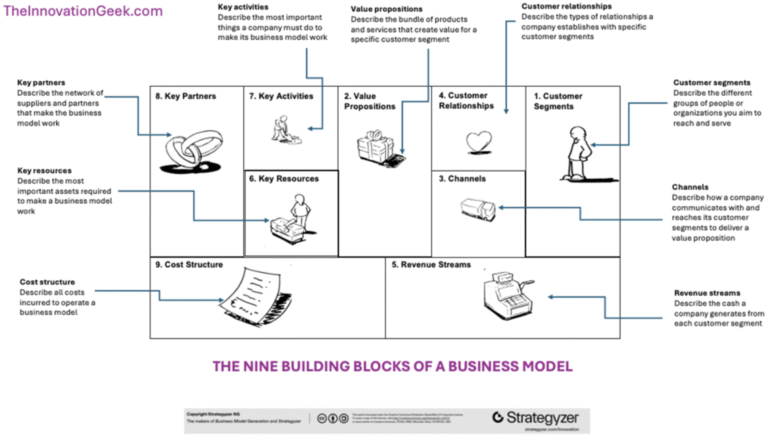
Joe emphasized that the canvas is a collaborative, cross-functional exercise that brings together people from different departments who have diverse knowledge sets. It’s designed to be a rapid, collaborative tool that gets people thinking and working together. The process starts with a brainstorming session where stakeholders spend about ten minutes adding ideas to each section using sticky notes. Initially, it’s a guesstimate, as you don’t need to have all the answers. The real value of the model is in identifying the assumptions and hypotheses that need to be researched and tested to build a truly robust business.
The tool is divided into nine essential building blocks, which are categorized into three sections: desirability, feasibility, and viability. By examining each of these blocks, you can create a holistic view of your business and pinpoint areas of strength, weakness, and opportunity.
1. Desirability (The “Front of the House”)
This section represents everything the customer sees and experiences. It focuses on the fundamental question: will customers actually want and desire what you are offering? Joe stressed that you must always start here to ensure you’re selling to the right customer with a compelling solution.
- Customer Segments: This block is about defining the people or organizations for whom you are creating value. It’s crucial to be specific. Are you targeting B2B or B2C clients? Are they a niche market or a broad audience? Understanding your customer segments is the foundation of your business model.
- Value Proposition: The value proposition is the heart of your business—the specific bundle of products and services that create value for each customer segment. This is not just a list of features; it’s a description of how you solve a problem or fulfill a need for your customers. What makes your offering different and better than the competition?
- Channels: Channels are the touchpoints through which you will interact with customers and deliver your value proposition. This includes both communication channels (how you tell customers about your offering) and distribution channels (how you get the product or service to them). Think about your website, social media, physical stores, or partners.
- Customer Relationships: This block defines the types of relationships you will establish with your customers and how you will acquire and retain them. Will your relationship be personal and hands-on, or automated and self-service? How will you build loyalty and a sense of community?
2. Feasibility (The “Back of the House”)
This part of the canvas deals with the internal infrastructure needed to create and deliver value. This section helps answer the critical “build-or-buy” question, which determines whether a company should develop capabilities in-house or partner with an outside organization.
- Key Resources: These are the indispensable assets required to make your business model work. This could include physical resources (a factory or office), intellectual property (patents or trademarks), human resources (a skilled team), or financial resources (capital).
- Key Activities: These are the most important things your business needs to perform exceptionally well to make the value proposition work. This could include manufacturing, marketing, problem-solving, or operational tasks.
- Key Partners: No company owns all the resources or performs all the activities itself. Key partners are the external entities that help you leverage your business model. These could be suppliers, strategic alliances, or joint ventures.
3. Viability (Profitability)
The bottom section of the canvas addresses the most practical question of all: is the business model profitable?
- Revenue Streams: Documenting your revenue streams involves more than just a price list. It describes the pricing mechanisms and cash management through which your business captures value and gets paid. Will you use a subscription model, one-time sales, or something else entirely?
- Cost Structure: This block outlines all the costs associated with running the business. This includes everything from fixed costs (rent, salaries) to variable costs (raw materials, production). By understanding your cost structure, you can determine if your revenue streams will be sufficient to generate a profit.
Putting the Canvas into Practice: A Case Study
To illustrate the power of the Business Model Canvas, Joe presented a case study from his previous role at a large healthcare payer. The company was seeking a new program to support expectant mothers at risk of postpartum depression. Instead of getting lost in a sea of ideas, they used the canvas to structure their thinking and create a clear, actionable plan.
The customer segment was defined as expectant mothers who might be at an elevated risk of postpartum depression. The value proposition was to use early detection and behavioral health to support maternal mental health, with PCPs playing a role in recommending care.
The team partnered with existing digital health platforms and outreach providers rather than building tools from scratch. This allowed the payer to test the concept quickly and cost-effectively while leveraging the expertise of established partners.
The program began with a small pilot group to test the concept before expanding. Providers were considered as potential partners but ultimately not included in the initial rollout, as integration was seen as a major lift. During the brainstorming process, someone suggested white labeling the program for other payers an idea that was parked for future consideration.
The revenue stream for the healthcare payer was not direct payment from the mothers, who received the service for free. Instead, the business model was viable because it focused on cost savings. The program demonstrated meaningful cost savings by reducing ER visits and hospitalizations, reinforcing the payer’s return on investment in preventative care. This demonstrates how the canvas helps you see the bigger picture beyond a simple transaction and considers how each piece of the business model affects the other.
The Canvas as a Living Document
Joe emphasized that the Business Model Canvas is not just a planning tool but a dynamic framework for innovation. It’s meant to be used throughout the year, with each block being a hypothesis that needs to be tested. The process follows a “build-test-learn” cycle, which involves creating a minimum viable product, testing it in the real world, and measuring the results to see if your hypothesis is correct. This continuous loop of testing allows a business model to adapt to external challenges such as changes in the industry, political climate, or technology. It helps you identify when an idea is not working so you can pivot or abandon it before sinking too many resources into a failed venture.
Joe noted that the tool is highly versatile: it can be applied to for-profits, nonprofits, and service delivery models alike. He also discussed how the canvas can help identify potential cannibalization scenarios, using Apple’s decision to launch the iPhone before the iPad as an example of managing value propositions strategically.
The Business Model Canvas is a valuable tool for anyone looking to build, test, and grow their short and long-term strategies. It provides a simple, visual, and effective way to map out and understand your business, ensuring that you are not just creating a great product, but a sustainable and successful business model. A workbook and additional resources were made available for those who attended the presentation, highlighting the practical application of the concepts discussed.
Key Takeaways
- The Business Model Canvas is a “living document” for continuous testing and iteration, not a static strategy plan.
- Start with assumptions, not answers; the value is in testing hypotheses, not filling in boxes.
- It is made up of nine building blocks divided into three sections: desirability (customer focus), feasibility (infrastructure focus), and viability (profitability focus).
- Joe recommends starting with desirability to ensure your solution is compelling to the right customers.
- The tool is a collaborative, cross-functional exercise designed to bring together diverse perspectives to test and improve business ideas, often facilitated in short, hands-on workshops.
- The “build-test-measure” cycle is a critical component of using the canvas, allowing you to validate or invalidate hypotheses and adapt to market changes.
- The canvas helps you identify your core assumptions and test them in the real world before committing significant resources to an unproven idea.
Related:
From Corporate Powerhouse to Entrepreneur: Andrea Hogan on Reinvention, Energy, and Growth
Brands, Publishers, and the Power of Editorial Storytelling in the Age of AI
Like MediaFeed’s content? Be sure to follow us.
This article originally appeared on Linkedin.com and was syndicated by MediaFeed.org