

A homebuyer comparing 30-year mortgage rates on Wednesday would have found advertised numbers far apart. AmeriSave’s 30-year fixed posted rate was 5.99%, while New American Funding’s was 7.5%, according to RateZip’s tracking of lender-posted rates.
Related: Today’s mortgage rates
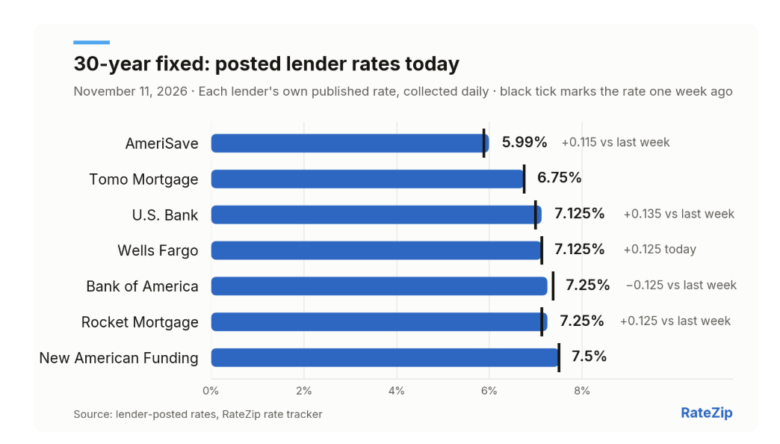
The national benchmark sits between those advertised figures. The average 30-year fixed rate was 7.18% in the week ending Nov. 5, down from 7.24% a week earlier, according to Freddie Mac’s weekly survey. That survey figure is a weekly average of interest rates, not an APR, and it covers an earlier week than Wednesday’s postings. Among the lenders RateZip tracks, Rocket Mortgage posted 7.25% for a 30-year fixed on Nov. 11 and Wells Fargo posted 7.125%. Both are close to the survey average, while AmeriSave and New American Funding posted well below and well above it.
That means a single national average can sit in the middle of advertised rates that range widely. The comparison cannot show what rate any particular borrower would be offered.
Sam Khater, Freddie Mac’s chief economist, was describing that past week’s dip in the survey average when he said on Nov. 5: “Mortgage rates continued their downward trajectory this week, improving the environment for prospective homebuyers against a backdrop of strong economic growth,” Trading Economics reported.
In dollar terms, the weekly dip in the survey average was small. In a hypothetical illustration, not an actual borrower or offer, a $400,000 30-year fixed loan at the newer average carries monthly principal and interest of $2,709.74. At the earlier average, the same loan costs $2,725.99, a difference of $16.25. The figures exclude taxes, insurance, mortgage insurance, points, fees and closing costs.
A lender’s posted rate and its APR can tell different stories. In RateZip’s tracking, AmeriSave’s 30-year fixed carried a posted APR of 6.527%, well above its advertised rate. APR reflects costs beyond the interest rate, such as points and fees, so a low advertised rate can come with upfront charges that a higher advertised rate may not carry. Lenders also build their posted rates on different assumptions about credit, loan size and eligibility. The spread between lenders is therefore not a set of comparable offers open to one borrower, and it does not measure savings.
What forecasters expect next
Khater’s remarks looked back at a single week. Looking ahead, the Mortgage Bankers Association forecasts that the Federal Reserve’s next step will be an increase, not a cut, and in its view that leaves little room for mortgage rates to come down in the near term, Mortgage Professional America reported on Nov. 6. The labor market has also run hotter than expected. Employers added 165,000 jobs in October, against economists’ projection of 59,000, and the jobless rate slipped to 4.1%, the publication reported on Nov. 9.
Whichever way the national average moves from here, it remains a weekly snapshot of interest rates. The advertised rates a shopper sees still reflect each lender’s own assumptions about credit, points, fees and eligibility, so they can land well above or below that headline number.
National mortgage-rate benchmark cited in this article. Source: Freddie Mac Primary Mortgage Market Survey via FRED®, Federal Reserve Bank of St. Louis.
RateZip is operated by Peklava LLC, DBA RateZip, a licensed mortgage broker (NMLS ID 1592292). We are compensated by some of the partners shown, which may affect which offers appear and where. It does not affect our reporting or recommendations. See our editorial standards.
Read more
RateZip is operated by Peklava LLC, DBA RateZip, a licensed mortgage broker (NMLS ID 1592292). We are compensated by some of the partners shown on this page, which may affect which offers appear and where. It does not affect our reporting or our recommendations. Rates shown were last updated November 11, 2026 at 9:50 a.m. ET. See our editorial standards and how we use AI.
How we track rates: methodology. Found an error? Tell us.
Ask us! What questions do you have about content, strategy, pop culture, lifestyle, wellness, history or more? We may use your question in an upcoming article!
Like MediaFeed’s content? Be sure to follow us.
This article originally appeared on RateZip and was syndicated by MediaFeed.co.