

On average, the cost of raising a child is $12,980 per year for children born in 2015 into a middle-income, two-child family with married parents.
For more context on child-raising costs, take a look at the following table.
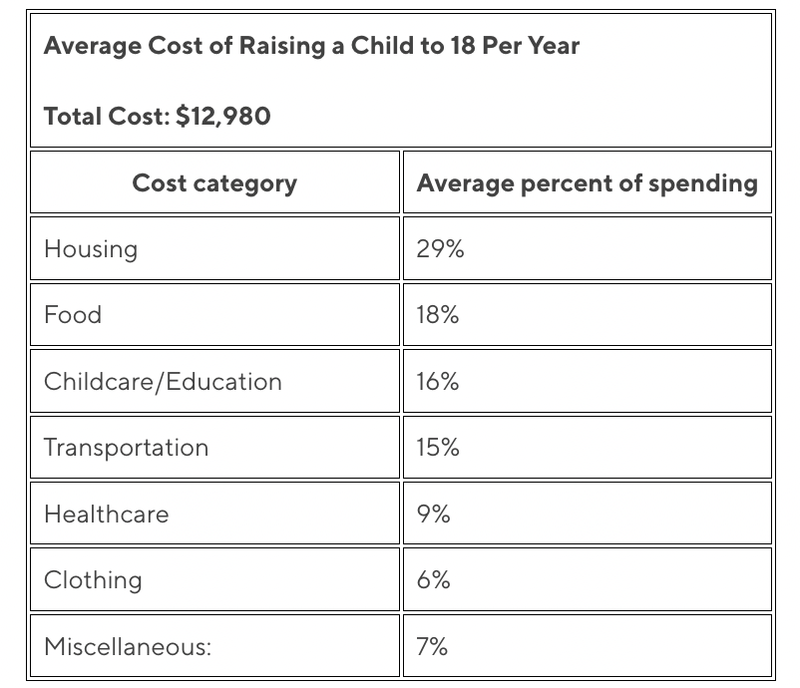
Image Credit: Pekic/istockphoto.
Which State Has the Lowest Childcare Costs?

Where someone lives can impact how much it costs to raise a child. South Dakota residents are lucky to have the lowest average childcare costs at $6,677 per year, representing 23.7% of income. Massachusetts residents aren’t so lucky: They spend $10,000 more each year than South Dakota parents do. The average cost of childcare in Massachusetts is $16,781 per year, accounting for 51.4% of income.
Image Credit: PeopleImages/istockphoto.
How Much Does It Cost to Raise a Child?

The average cost of raising a child each year comes to $12,980 for children born in 2015, which leads to an overall cost of $233,610 to raise a child through the age of 17. When adjusted for inflation, the figure rises to $284,570. None of these numbers account for the cost of a college education, which many parents like to budget for far in advance.
For more insight into how much it costs to raise a child, there are free calculators online that can help parents to better estimate their spending based on their particular family needs. You may also be curious to learn how to financially plan for child No. 2.
Image Credit: Photodjo/istockphoto.
Are You Able to Afford a Child?

Whether or not you can afford a child depends on your particular financial circumstances, as well as factors like childcare needs and the cost of living in your area.
There is no one salary figure that means someone is able to afford a child. It’s important to research how having a child will impact housing, food, and healthcare costs, how much of your disposable income will go toward clothing, equipment, childcare and education, even toys. This way, you’ll have a clear idea of how having a child will impact your budget.
Image Credit: Goodboy Picture Company/istockphoto.
How to Budget for a Baby

Speaking of budgets, these are some expenses parents need to budget for when they plan to have a baby join their family. They can use a budgeting app, spreadsheet, or even good old fashioned pen and paper to create a new budget.
Some examples of baby expenses that should go in a budget include:
- Food
- Medical care
- Housing
- Childcare
- Education
- College savings
- Clothing
- Equipment (high chair, car seat)
- Toys
- Recreational activities
- Care items (diapers, baby wipes, etc.)
Once parents know what their total expenses are, they can subtract that amount from their take-home income to determine how much money is left for fun (like dinners out and vacations) and savings goals. Some parents even like to create an investment plan for their newborn.
Image Credit: kate_sept2004/istockphoto.
How to Reduce the Costs of Raising a Child

Because raising a child can cost a pretty penny, it can be helpful to think strategically about how to save money while raising kids. Here are some tips that can make it possible to spend less as a parent.
- Buy second-hand clothes. No hand-me-downs at the ready? Shopping second-hand can be a great way to save money on baby and kids’ clothes. Most children grow out of their clothes very quickly, so new or lightly worn clothes are always available at thrift stores.
- Spend less on housing. Even if you can afford to buy a larger house, you may want to consider living below your means. Housing is a major ongoing expense for any family, so saving here can really make an impact.
- Buy generic. When it comes to things like formula and diapers, lower cost generics can get the job done just as well as fancy name brands.
- Head to the library. Looking to keep kids entertained? Don’t forget about the local library. Alongside books, many libraries offer DVD rentals, story time, and tons of free events that can keep little ones active. So cancel those expensive streaming subscriptions and skip the overpriced petting zoos for now.
Image Credit: PeopleImages/istockphoto.
Example List of Expenses for Raising a Child

To help parents plan better, below are some common expenses that come with raising a child and the percentage of a parent’s income that goes toward each expense:
- Housing: 29%
- Food: 18%
- Childcare and education: 16%
- Transportation: 15%
- Healthcare: 9%
- Clothing: 6%
- Miscellaneous: 7%
Image Credit: PeopleImages/istockphoto.
The Takeaway

The average cost of raising a child in the U.S. is about $13K per year. Knowing this can help families create a budget that makes it easier to reach their savings goals while raising young kids. The biggest child-related expense is for housing, followed by food and childcare or education. Things like clothes and toys will barely make a blip on your budget, if you take advantage of hand-me-downs.
Learn More:
This article originally appeared on SoFi.com and was syndicated by MediaFeed.org.
Please understand that this information provided is general in nature and shouldn’t be construed as a recommendation or solicitation of any products offered by SoFi’s affiliates and subsidiaries. In addition, this information is by no means meant to provide investment or financial advice, nor is it intended to serve as the basis for any investment decision or recommendation to buy or sell any asset. Keep in mind that investing involves risk, and past performance of an asset never guarantees future results or returns. It’s important for investors to consider their specific financial needs, goals, and risk profile before making an investment decision.
The information and analysis provided through hyperlinks to third party websites, while believed to be accurate, cannot be guaranteed by SoFi. These links are provided for informational purposes and should not be viewed as an endorsement. No brands or products mentioned are affiliated with SoFi, nor do they endorse or sponsor this content.
Communication of SoFi Wealth LLC an SEC Registered Investment Advisor
SoFi isn’t recommending and is not affiliated with the brands or companies displayed. Brands displayed neither endorse or sponsor this article. Third party trademarks and service marks referenced are property of their respective owners.
Communication of SoFi Wealth LLC an SEC Registered Investment Adviser. Information about SoFi Wealth’s advisory operations, services, and fees is set forth in SoFi Wealth’s current Form ADV Part 2 (Brochure), a copy of which is available upon request and at www.adviserinfo.sec.gov. Liz Young is a Registered Representative of SoFi Securities and Investment Advisor Representative of SoFi Wealth. Her ADV 2B is available at www.sofi.com/legal/adv.
Image Credit: Hispanolistic/istockphoto.
More from MediaFeed

Heading to college? Here’s where to find free money
Image Credit: PeopleImages/istockphoto.


