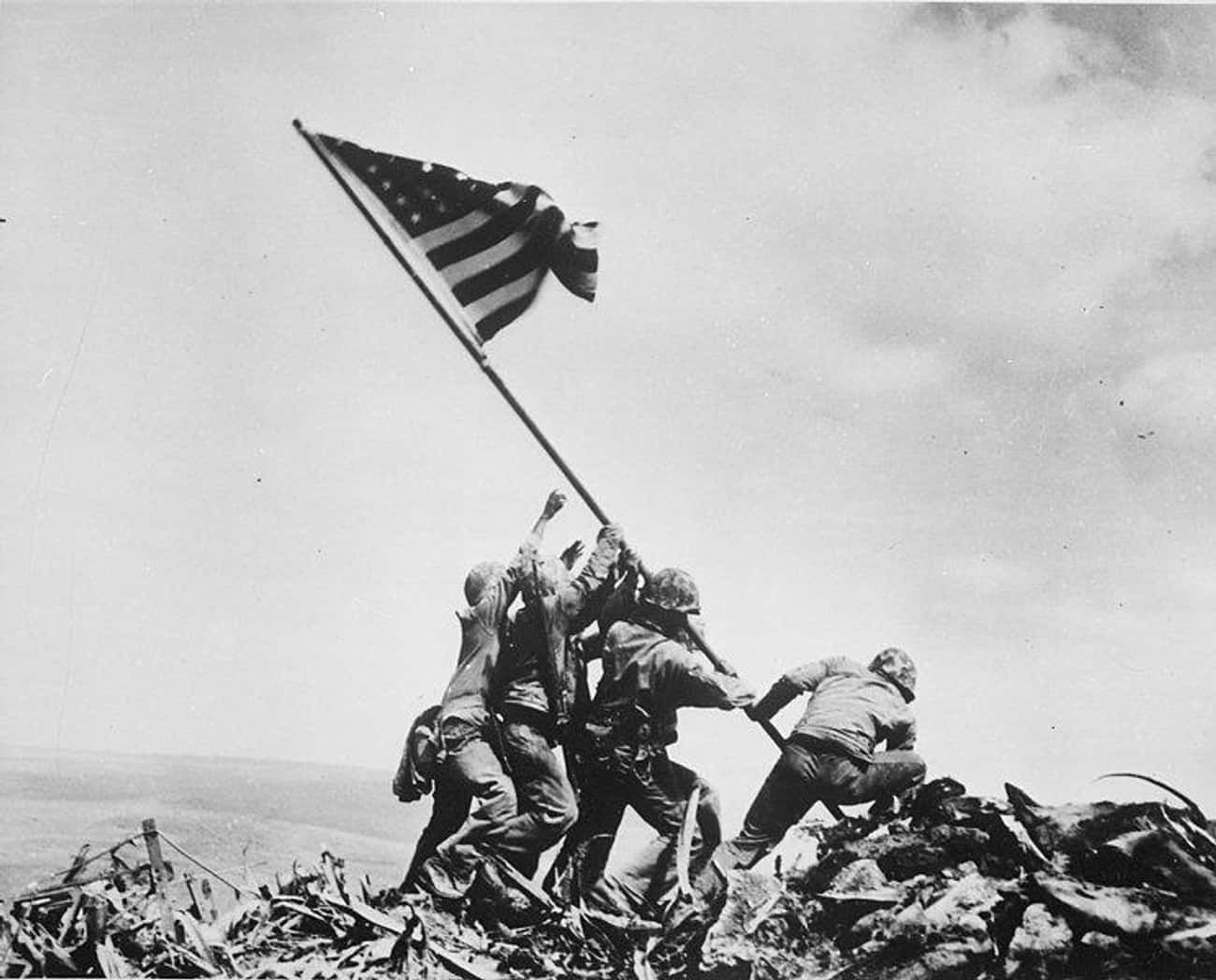
On February 23, 1945, during the Battle of Iwo Jima in World War II, United States Marines raised an American flag atop Mount Suribachi, the island’s highest point. The event became one of the most iconic moments of the war and a defining image of American military history.
The battle for Iwo Jima began on February 19, 1945, when U.S. forces launched an amphibious invasion of the Japanese-held island. Located roughly 750 miles south of Tokyo, Iwo Jima was strategically important because it provided airfields that could be used by American bombers and fighter escorts operating over Japan. Japanese forces, commanded by General Tadamichi Kuribayashi, had fortified the island with an extensive network of tunnels, bunkers, and artillery positions, making the assault particularly difficult.
On the morning of February 23, members of the 2nd Battalion, 28th Marines, 5th Marine Division reached the summit of Mount Suribachi after days of intense fighting. A small American flag was raised first to signal that the mountain had been secured. Later that day, a larger flag was brought up to replace it so that troops across the island could see it more clearly.
The second flag-raising was photographed by Associated Press photographer Joe Rosenthal. His image captured six Marines—Sergeant Michael Strank, Corporal Harlon Block, Private First Class Franklin Sousley, Private First Class Ira Hayes, Private First Class Rene Gagnon, and Navy corpsman John Bradley—straining together to plant the flagpole in the rocky ground. The photograph quickly became a symbol of American resolve and unity.
Rosenthal’s photograph was widely circulated in newspapers across the United States and later won the Pulitzer Prize. It was also used to promote war bond drives, raising millions of dollars to support the war effort. The image inspired the design of the U.S. Marine Corps War Memorial in Arlington, Virginia, which was dedicated in 1954.
Although the flag-raising marked the capture of Mount Suribachi, the battle for Iwo Jima continued for more than a month. The fighting was among the bloodiest in the Pacific theater, resulting in heavy casualties on both sides.
The raising of the American flag on February 23, 1945, remains one of the most enduring symbols of World War II. It represents both the sacrifices made during the Battle of Iwo Jima and the broader Allied effort in the Pacific campaign.
Related:
- The state that’s the exception to America’s fall car theft rates
- The germiest things in your home that you use every day
Want more insights?
Check out better. magazine, our free digital zine! Get all things better – better ideas, better eating, better health, better entertainment & more.
Like MediaFeed’s content? Be sure to follow us.
This article was syndicated by MediaFeed.org.