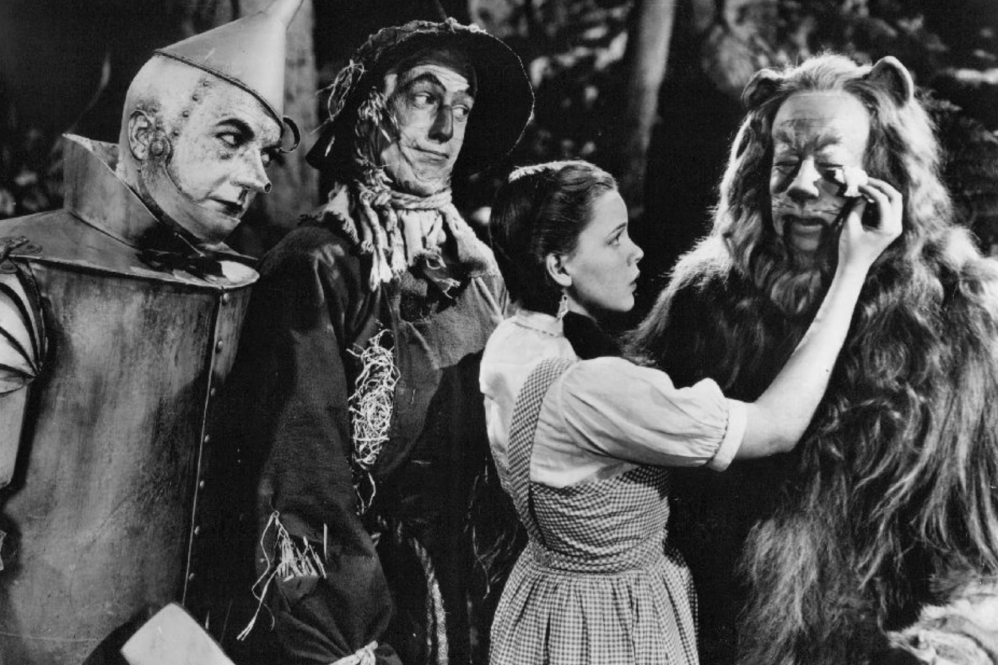
Based on L. Frank Baum’s children’s novel The Wonderful Wizard of Oz. On August 25, 1939, The Wizard of Oz opened in theaters around the United States to become one of the best-loved movies in history.
In January 1938, Metro Goldwyn-Mayer purchased the rights to Baum’s novel The Wonderful Wizard of Oz.
With a production budget of $2.8 million ($51.6 million today), it was MGM’s most expensive production to-date.
The first of ten screenwriters to work on the screenplay was Herman Mankiewicz. In his first draft, Mankiewicz chose Kansas as the land where the story would take place, but then they thought there wouldn’t be much emphasis on the adventure through Oz.
Producer Mervyn LeRoy didn’t like the first draft, so he replaced Mankiewicz with Noel Langley, who made the most progress on the adaptation.
His idea was that the Scarecrow and Tin Man would appear as farmhands in Kansas, as well as Miss Gulch, who would transform into the Wicked Witch of the West.
Though the scenes in Kansas were shot in traditional black and white, Oz appears in vivid Technicolor, a relatively new film process at the time.
Studio executives worried the film wouldn’t succeed, so they used early test screenings of The Wizard of Oz in small towns like Cape Cod, Massachusetts, and Oconomowoc, Wisconsin, to see the audience reactions. The feedback was much better than they expected, not only that, they used it to help create their promotional strategies for the official Hollywood premiere.
The Hollywood premiere of the film followed on August 15, then it opened nationwide on August 25, 1939.
Even though theaters were packed with people excited to watch the movie, it wasn’t an immediate commercial success, earning just $3 million on its initial release and falling short of marketing and distribution costs. But that changed on the 1949 re-release.
The film’s first review came in June 1939, by the director Joseph Breen. He wrote, “the picture is a superb musical extravaganza, with much of the flavor of Snow White, and a special musical score.”
A year later, The Wizard of Oz was supposed to make the official United States entry at the Cannes Film Festival, but the event was canceled because of World War II.
Despite the difficulties the film faced, its popularity continued to grow, especially after it was televised for the first time in 1956.
Ask us! What questions do you have about content, strategy, pop culture, lifestyle, wellness, history or more? We may use your question in an upcoming article!
Like MediaFeed’s content? Be sure to follow us.
This article was syndicated by MediaFeed.co