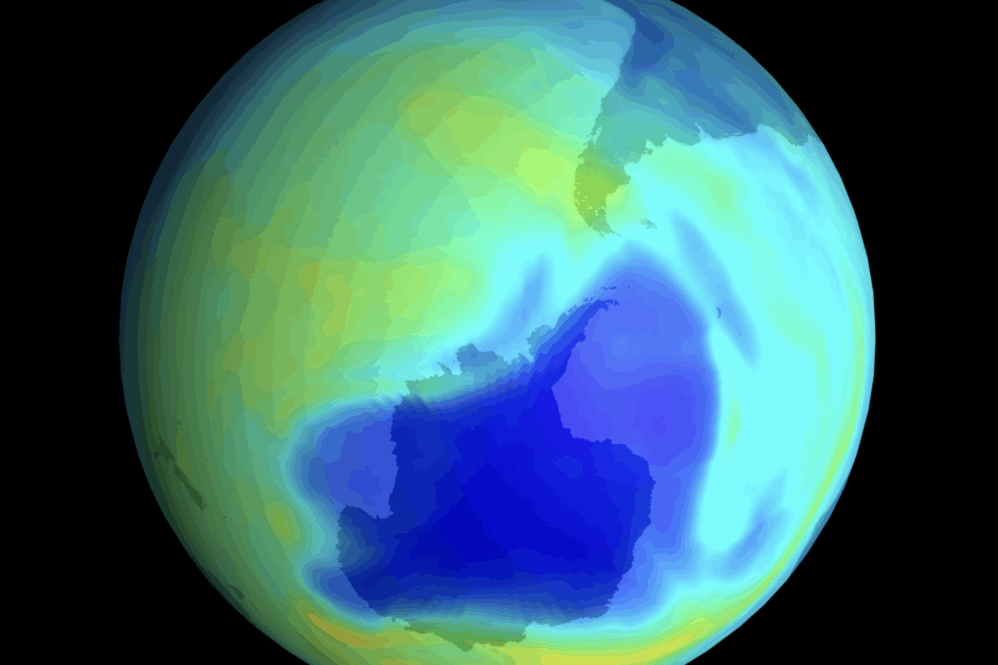
On May 16, 1985, three scientists from the British Antarctic Survey (BAS), Joe Farman, Brian Gardiner, and Jonathan Shanklin, published a paper in the journal Nature, revealing a massive, seasonal depletion of the ozone layer over Antarctica, now known as the ozone hole. This discovery provided the first clear evidence that human activity could rapidly and severely damage the Earth’s life-support systems.
The ozone layer is composed of trioxygen molecules that absorb most of the sun’s harmful ultraviolet-B (UV-B) radiation. Without this protective shield, life on Earth would face devastating consequences, including a rise in skin cancer, cataracts, and damage to entire ecosystems and food crops.
The main reason behind the destruction was man-made chemicals called chlorofluorocarbons (CFCs), commonly used at the time in aerosol sprays, refrigerators, and air conditioners. While scientists had mentioned the dangers of CFCs since the 1970s, the BAS team’s data proved the reality of the threat.
The Antarctic was particularly vulnerable due to its unique geography, during the freezing polar winter, ice clouds form in the stratosphere. These clouds provide a surface for chemical reactions that convert chlorine from CFCs into an active, ozone-destroying form. When the sun returns in the spring, this active chlorine rapidly breaks down ozone molecules.
The discovery was almost missed. Jonathan Shanklin, a young physicist at the time, looked at the data to prove that concerns over CFCs or supersonic aircraft like the Concorde weren’t alarming, expecting to find that ozone levels had remained constant over the decades. Instead, he found a systematic decline. By 1984, the ozone layer over the Halley Research Station was only about two-thirds as thick as it had been in the 1950s.
NASA’s Total Ozone Mapping Spectrometer (TOMS) instrument on the Nimbus 7 satellite had been collecting data since 1979, but the dramatic drop in ozone over Antarctica was not formally reported as the computer code for processing TOMS data was programmed to flag ozone levels below a certain threshold as “bad data” or “outliers,” assuming they were due to sensor malfunctions rather than real atmospheric changes.
The ground-based measurements from the BAS team, taken with a device called a Dobson spectrophotometer, forced a re-evaluation of the satellite data, which then confirmed that the hole spanned the entire Antarctic continent.
In 1987, just two years after the Nature paper, 46 nations signed the Montreal Protocol. This historic treaty, eventually ratified by every UN member state, aimed to phase out the production and consumption of ozone-depleting substances. Former UN Secretary-General Kofi Annan later called it “perhaps the single most successful international agreement to date.”
Research estimates that without the Montreal Protocol, global skin cancer cases would have been 14% higher by 2030. Furthermore, because CFCs are also potent greenhouse gases, the treaty helped slow global warming, preventing an estimated additional 2.5°C of temperature rise by the end of the century.
A 2026 study published in Nature warned that increased industrial emissions of certain chemicals used as feedstocks could potentially delay the full recovery of the ozone layer until closer to 2073.
Ask us! What questions do you have about content, strategy, pop culture, lifestyle, wellness, history or more? We may use your question in an upcoming article!
Like MediaFeed’s content? Be sure to follow us.
This article was syndicated by MediaFeed.co