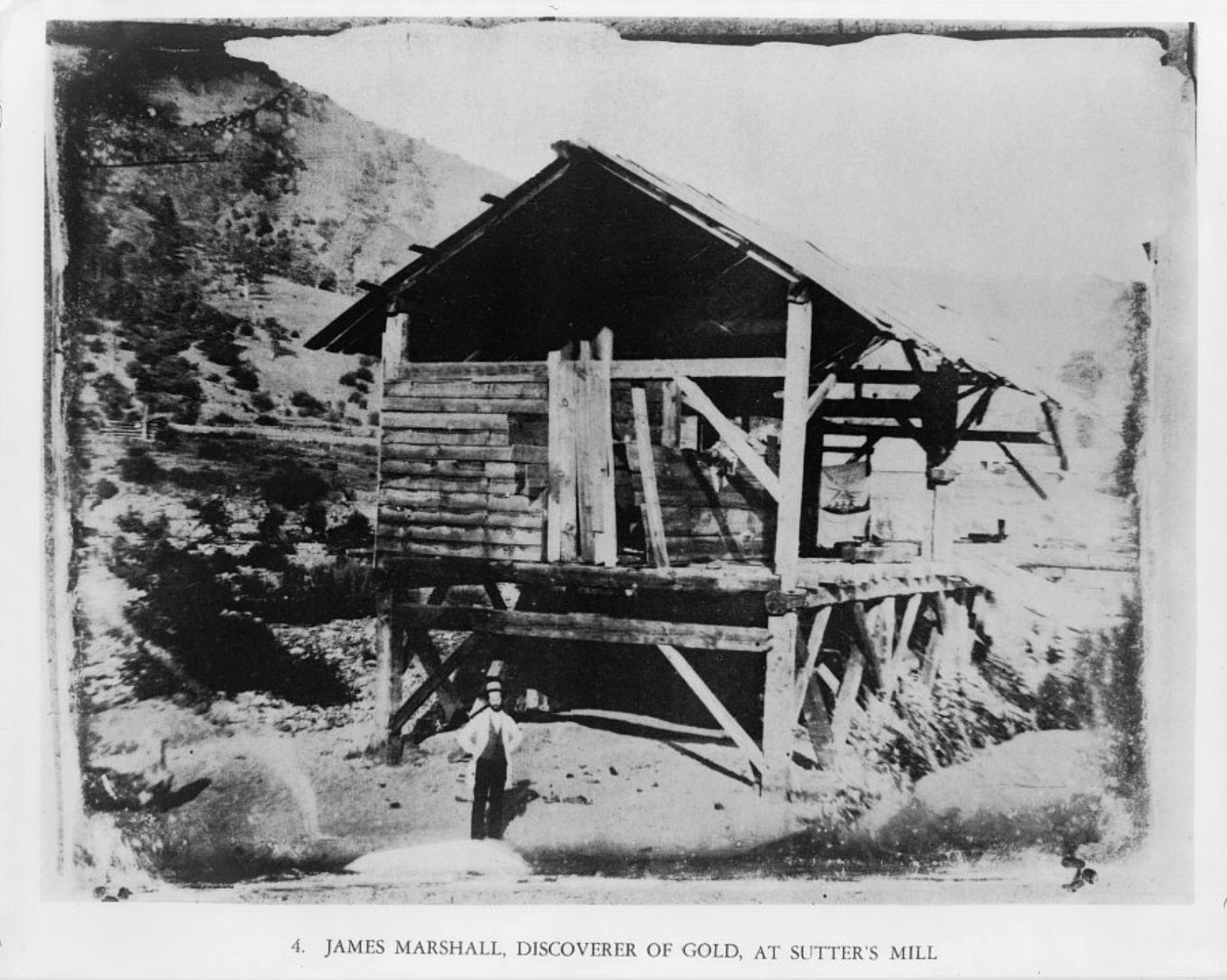
On January 24, 1848, a discovery along the banks of Sutter’s Creek in California changed the course of American history. James W. Marshall ,an American carpenter and sawmill operator, was examining the channel below the sawmill in Coloma, California, when he spotted a glimmer of yellow in the water.
James W. Marshall told James Hutchings in an interview for his California Magazine in 1857:
I picked up one or two pieces and examined them attentively; and having some general knowledge of minerals, I could not call to mind more than two which in any way resembled this– sulphuret of iron, very bright and brittle; and gold, bright, yet malleable; I then tried it between two rocks, and found that it could be beaten into a different shape but not broken.
According to the National Park Service, this single discovery of gold flakes along the South Fork of the American River transformed a remote territory into a booming state almost overnight.
Initially, the discovery was meant to stay a secret, thinking that a rush of gold-seekers would likely ruin the dream of building an agricultural empire, as laborers would surely abandon his fields for the mines. However, the news proved impossible to contain. Rumors leaked through letters and word of mouth, eventually reaching San Francisco.
By May 1848, entrepreneur Sam Brannan packed some of the precious metal into a bottle on his way back to San Francisco. As he stepped off the ferry waved the bottle and shouted, “Gold! Gold! Gold! Gold from the American River!” By the middle of June, three-quarters of the male population had left town for the mines.
Although President James Polk didn’t officially confirm the gold discovery to Congress until December 1848, which was far too late for East Coast residents to begin a journey that year, the delay only heightened the anticipation. By the time spring arrived in 1849, the nation saw the start of its largest-ever migration, with 25,000 people setting out for California in that year alone.
By 1849, the migration reached its peak with the arrival of the “forty-niners,” over 100,000 fortune-seekers who traveled by land across the Great Plains or by sea around Cape Horn.
The Gold Rush was a catalyst for massive demographic and economic shifts. San Francisco transformed from a tiny port of fewer than 1,000 people to a metropolis of 25,000 in just a few years.
Ultimately, the Gold Rush didn’t provide for Sutter what he was aiming for. Instead of providing labor, prospectors overran his land and destroyed his crops.
By 1852, his land was ruined. Sutter spent the rest of his life unsuccessfully petitioning the government for compensation for the losses caused by the very discovery he had unintentionally triggered.
Marshall died in Kelsey on August 10, 1885. In May 1890, five years after Marshall’s death, Placerville Parlor #91 of the Native Sons of the Golden West successfully advocated the idea of a monument to the State Legislature, which appropriated a total of $9,000 for the construction of the monument and tomb
The monument was rededicated October 8, 2010, in honor of the 200th Anniversary of James W. Marshall’s birth.
Ask us! What questions do you have about content, strategy, pop culture, lifestyle, wellness, history or more? We may use your question in an upcoming article!
Related:
Like MediaFeed’s content? Be sure to follow us.
This article was produced and syndicated by MediaFeed.us.