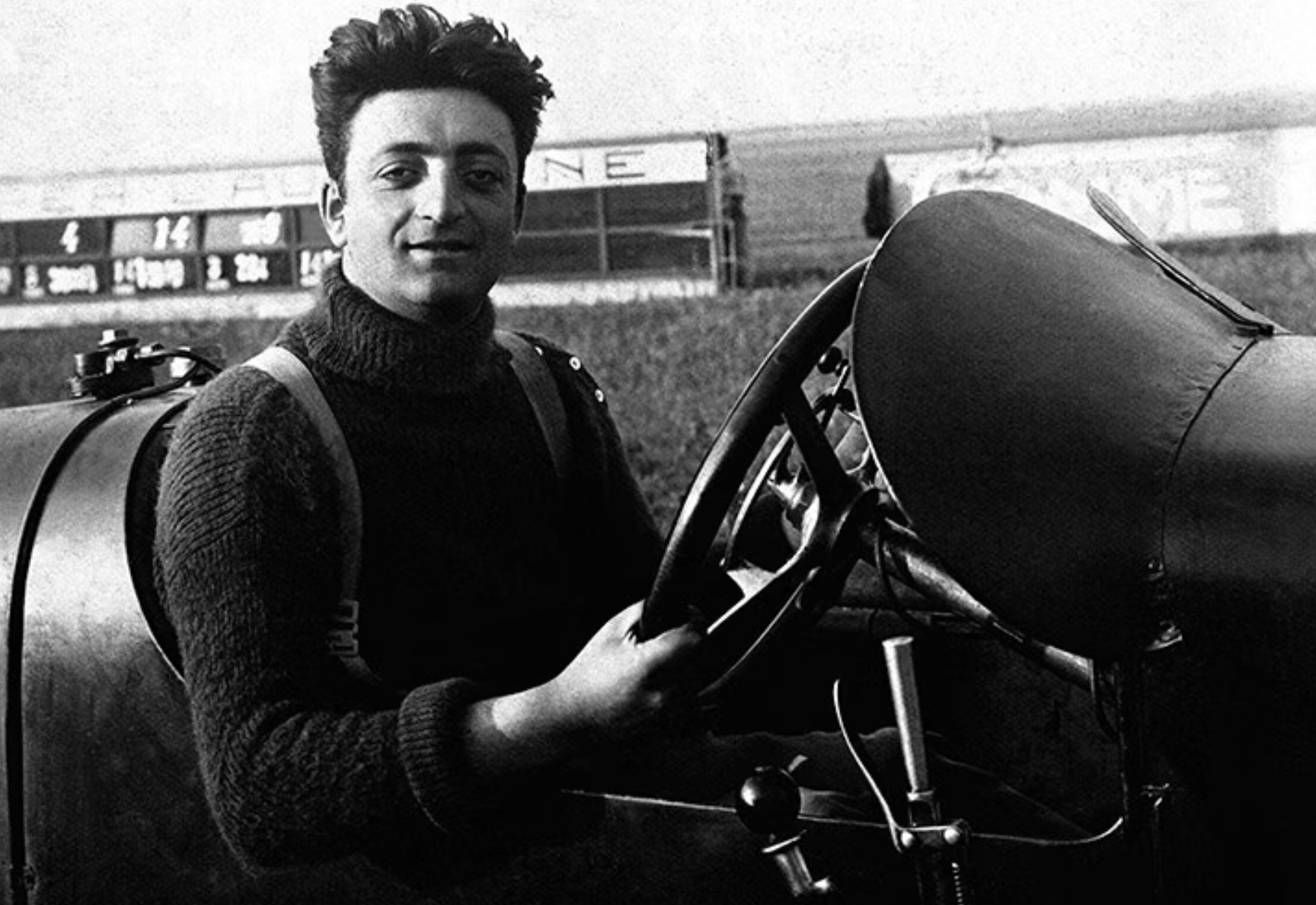
On February 18, 1898, a boy named Enzo Ferrari was born in Modena, Italy. While he grew up in a humble environment, he would eventually become one of the most powerful figures in automotive history.
Enzo’s love for cars began at a young age. After serving in World War I, he sought work in the automotive industry. He eventually found success as a racing driver for Alfa Romeo in the 1920s. While he was a talented driver, his true gift lay in organization and leadership. In 1929, he founded Scuderia Ferrari. At that time, Ferrari did not build its own cars, instead, it served as the official racing department for Alfa Romeo.
When the partnership with Alfa Romeo eventually ended, and after World War II, Enzo understood that to stay at the top, he needed the best engineers and the fastest machines. In 1947, the first car to carry his name, the Ferrari 125 S, rolled out of his factory in Maranello. This marked the official birth of the Ferrari automobile.
For Enzo, selling road cars was often just a way to fund his true passion, which was Grand Prix racing. His road cars became symbols of status and performance, known for their powerful V12 engines and the iconic Horse logo, but the racetrack remained his primary focus.
Under Enzo’s leadership, Ferrari became a dominant force in Formula 1. He was known as a demanding and sometimes difficult leader, often referred to as Il Commendatore. He managed his team with a mix of passion and strategy.
Enzo Ferrari passed away in 1988 at the age of 90, but his influence never faded. He turned a small racing stable into a global empire. Today, Ferrari is synonymous with speed, luxury, and the red color that has come to represent Italian racing excellence.
Despite his fame, Enzo Ferrari often faced financial struggles due to the high costs of racing. In 1960, he incorporated his firm as SEFAC and began receiving subsidies from Fiat. A famous 1963 deal with Ford collapsed because Ferrari refused to surrender control of his racing identity to Detroit. Following this, Ford famously sought revenge on the track, eventually beating Ferrari at Le Mans in 1966. By 1969, Ferrari officially became a subsidiary of Fiat.
Later in life, Enzo became deeply concerned with racing safety as car speeds began to outpace driver control. After years of criticism regarding track fatalities, he pushed for better safety measures .
After the deaths of his son and his wife from muscular dystrophy, he became a major donor to research for the disease. He lived a quiet, dedicated life in Modena, rarely vacationing and focusing on his cars. Identifiable by his white hair and signature dark glasses, he resigned in 1977 but supervised racing operations until his death in 1988 at age 90.