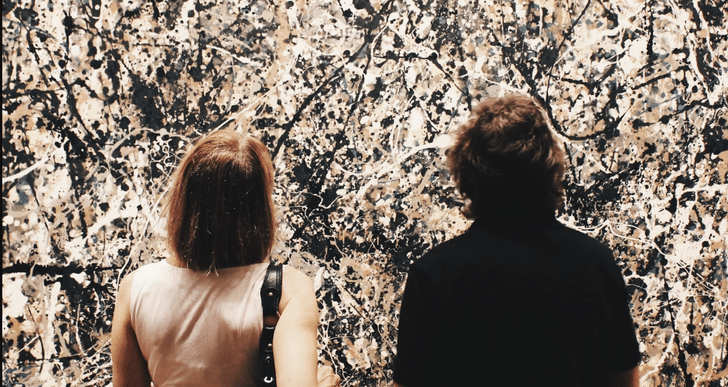
Did you know the second most expensive painting in the world (Interchange by Willem de Kooning) is an abstract artwork?
Abstraction in art uses various shapes, forms, and colors to encourage the viewer’s involvement and imagination. You can get an impression of the artist’s vision and emotions, which you can interpret the way you want.
That’s one of the reasons why some abstract art pieces sell for hundreds of millions of dollars at private sales and auction houses.
Let’s take a closer look at the 10 most expensive abstract art pieces ever sold and a few other expensive artworks by master artists.
Think you can’t afford to invest in art? Think again. Learn more at Masterworks.
1. Interchange – Willem de Kooning
Interchange (1955) by Willem de Kooning (April 24, 1904 – March 19, 1997) was a Dutch-American abstract expressionist artist. (Private collection of Kenneth C. Griffin) pic.twitter.com/66cil2F5E2
— frauletizia (@letiziafrau) November 19, 2022
Price and Year of Sale: Around $300 million, 2015
Seller: David Geffen Foundation
Buyer: Kenneth C. Griffin
Interchange isn’t just the highest-grossing abstract art piece — it’s also the most expensive piece of Contemporary Art ever sold.
Willem de Kooning, an icon of art history, changed his style of painting after this artwork. He went from painting human figures to more Abstract Expressionist landscapes.
The focus of this 1955 abstract artwork is a large pink shape that portrays a reclining female figure. The abstraction also includes blue, yellow, and orange colors that highlight the woman’s outline.
In 2015, Geffen sold this piece to hedge fund manager Kenneth Griffin for a total of $500 million along with another artwork, Number 17A by Jackson Pollock.
Before this sale, the painting exchanged hands several times. The most notable deal was at a Sotheby’s auction in 1989, when the artwork sold for $20.6 million.
2. Number 17A – Jackson Pollock
Number 17A, 1948, Jackson Pollock. pic.twitter.com/VrfGtlI5va
— Art Depot (@Art_Depot) December 31, 2020
Price and Year of Sale: Around $200 million, 2015
Seller: David Geffen Foundation
Buyer: Kenneth C Griffin
Number 17A, created by the Abstract Expressionist Jackson Pollock in 1948, is considered the most expensive drip painting in the world.
The painting was featured in a 1949 edition of Life Magazine. Another version of Number 17, painted in 1949, was acquired by Sotheby’s auction house in 2003 before being sold to a private buyer.
How is a drip painting made?
To create a drip painting, an artist usually splashes paint on a horizontal surface. While the strokes of most drip paintings appear randomly distributed, a good-quality drip painting usually stands out with subtle, precise brush strokes.
3. No. 6 (Violet, Green and Red) – Mark Rothko
I colori
Mark Rothko, No. 6 (Violet, Green and Red), 1951 pic.twitter.com/FmaFjBO4se
— carmeladonnafugata (@carmedonnafugat) November 27, 2020
Price and Year of Sale: $186 million, 2014
Seller: Cherise Moueix
Buyer: Dmitry Rybolovlev
No. 6 is an expensive abstract painting that remains true to the style of Mark Rothko. The modern art icon is well-known for expressing various emotions through color.
When Rothko painted this artwork in 1951, he used dark hues to reference an unsettling period of his life.
Do you know the controversy surrounding this abstract artwork?
The last buyer of this expensive abstract art, Russian billionaire Dmitry Rybolovlev, sued art dealer Yves Bouvier who overcharged him for the No. 6 painting. Complaints by Dmitry Rybolovlev and other clients against Yves Bouvier have resulted in a legal battle known as the Bouvier Affair.
Think you can’t afford to invest in art? Think again. Learn more at Masterworks.
4. No. 5 – Jackson Pollock
Consider No. 5 by Jackson Pollock.
Auction price: $140,000,000 pic.twitter.com/sDBPvnpSyk
— Brian Roemmele (@BrianRoemmele) August 30, 2020
Price and Year of Sale: $140 million, 2006
Seller: David Geffen
Buyer: David Martinez
Have you ever wondered why Jackson Pollock paintings always have a number as the title?
His contemporary art pieces lack a descriptive title so that they could stand independently as art. It gives viewers more space for interpretation and creativity.
Jackson Pollock created this abstract artwork in 1948 alongside the more expensive abstract painting Number 17A.
Although the abstraction wasn’t well received at the start, it became the most expensive artwork in the world in 2006 — cementing Pollock’s status as a pillar of western art history.
David Martinez acquired the expensive painting at a private sale through the Sotheby’s auction house.
5. Woman III – Willem de Kooning
Woman III, 1953
William de Kooning#painting pic.twitter.com/voG0DtHrHW— Brindille (@Brindille_) October 19, 2017
Price and Year of Sale: $137.5 million, 2006
Seller: David Geffen
Buyer: Steven A. Cohen
Willem de Kooning painted Woman III in 1953. This work of abstract expressionism belongs to a series of six paintings — all of them focused on women. The artist created all of these between 1951 and 1953.
From the late 1970s to 1994, this abstract painting was housed at the Tehran Museum of Contemporary Art in Iran. However, after the 1979 revolution, the museum couldn’t display the painting. This was due to the strict rules imposed by the government, especially on western art themes such as women and sexuality.
David Geffen bought the abstract painting in 1994 from the museum and sold it to Steven A. Cohen for $137.5 million in 2006.
6. Anna’s Light – Barnett Newman
Anna’s Light by Barnett Newman – $105.7 Million. #Art pic.twitter.com/nyW62vctYv
— Sports Plus (@PrepSportsPlus) March 28, 2018
Price and Year of Sale: $106 million, 2013
Seller: DIC Corporation
Buyer: Anonymous
Anna’s Light is a canvas 9 feet tall and 20 feet wide. It’s considered the largest painting Barnett Newman produced in his career.
This rectangular abstraction is a red canvas that invokes a feeling of calmness.
The DIC corporation of Japan sold the expensive abstract painting in October 2013 to an anonymous buyer for $105.7 million (excluding sales commissions and other costs).
7. Orange, Red, Yellow – Mark Rothko
‘Orange, Red, Yellow’.
Mark Rothko, 1961 pic.twitter.com/JjmVD7yEqL
— Hipsteria (@hipst_eria) March 15, 2022
Price and Year of Sale: $87 million, 2012
Seller: David Pincus’s estate
Buyer: Anonymous
Mark Rothko created this abstract art painting in 1961.
The expensive painting features a red background with a yellow stripe on top and two orange rectangles right below it.
It’s a part of the Color Field abstraction technique (that contains other color-focused pieces like White Center) portraying emotions as large, colorful rectangular figures.
From 1964 to 1967, this work of abstraction was displayed at several museums in London, Philadelphia, and Pennsylvania. In 1967, art collector David Pincus acquired this abstract painting.
An anonymous buyer purchased the modern art piece from the David Pincus collection at a 2012 Christie’s auction in New York.
8. Black Fire I – Barnett Newman
Barnett Newman ‘Black Fire I’ 1961 pic.twitter.com/4b9XzWFMpX
— Paul Brightwell (@brightwell08) October 29, 2022
Price and Year of Sale: $84 million, 2014
Seller: Private Collection
Buyer: Anonymous
Black Fire I perfectly represents Newman’s uncompromising passion for aesthetic, reductive abstract art.
Barnett Newman painted Black Fire I in 1961, when he was grieving the death of his younger brother. The stark color contrast in the abstract art painting portrays the tension between the light and the dark.
Black Fire I is one of several paintings Newman created between 1958 and 1966. He painted all of them using black paint on exposed canvas.
An anonymous art collector acquired this abstraction at a 2014 Christie’s auction in New York.
9. No. 10 – Mark Rothko
Mark Rothko, No. 10, 1950 #museumarchive #markrothko https://t.co/tSyh1pZcdN pic.twitter.com/LHeGQwDkrr
— Mark Rothko (@artistrothko) October 12, 2022
Price and Year of Sale: $82 million, 2015
Seller: Anonymous
Buyer: Anonymous
When No. 10 by abstract expressionist Mark Rothko sold for $82 million in 2015, the work of abstraction set a record as one of the highest-grossing 20th century art pieces.
The canvas depicts a large rectangle with a smooth blend of yellow and blue hues exuding warmth.
No. 10 by Mark Rothko was sold to a private art collector at a 2015 Christie’s auction in New York.
Think you can’t afford to invest in art? Think again. Learn more at Masterworks.
10. False Start – Jasper Johns
Bon dia
False Start, 1959
Jasper Johns pic.twitter.com/rjAry9gVYz— Anna Gener (@agenersurrell) October 27, 2021
Price and Year of Sale: $80 million, 2006
Seller: David Geffen
Buyer: Kenneth C. Griffin
Jasper Johns created this abstract painting in 1959.
This artwork plays with perceptual cues. For example, Johns wrote the word “Orange” in white text against a red background.
The painting is filled with these little markings, which make it an intriguing, puzzle-like creation.
David Geffen sold the abstract art painting to Kenneth Griffin in 2006 through a private sale.
Now let’s look at some other expensive artwork by famous artists.
Other Expensive Artworks Sold in Modern History

This article originally appeared on MasterWorks.com and was syndicated by MediaFeed.org.
*[Please note: All investing activities involve risks and art is no exception. Risks associated with investing through the Masterworks platform include the following: Your ability to trade or sell your shares is uncertain. Artwork may go down in value and may be sold at a loss. Artwork is an illiquid investment. Costs and fees will reduce returns. Investing in art is subject to numerous risks, including physical damage, market risks, economic risks and fraud. Masterworks has potential conflicts of interest and its interests may not always be aligned with your interests.
Liquidation timing is uncertain. Expenses and fees are listed in our Offering Circulars. Note: Fees are 1.5% per annum (in equity), 20% profit share, and certain expenses are allocated to the investment vehicle. Investors should review the offering circular for a particular offering to learn more about fees and expenses associated with investing in offerings sponsored by Masterworks. Masterworks will receive an upfront payment, or “Expense Allocation” which is intended to be a fixed non-recurring expense allocation for (i) financing commitments, (ii) Masterworks’ sourcing the Artwork of a series, (iii) all research, data analysis, condition reports, appraisal, due diligence, travel, currency conversion and legal services to acquire the Artwork of a series and (iv) the use of the Masterworks Platform and Masterworks intellectual property. No other expenses associated with the organization of the Company, any series offering or the purchase and securitization of the Artwork will be paid, directly or indirectly, by the Company, any series or investors in any series offering. For more information, see “IMPORTANT DISCLOSURES” at Masterworks.com/cd]
More From MediaFeed:
Did this artist vandalize his own artwork?!

What makes someone vandalize a precious artwork?
For some, it could be a political statement and a means of protest. Personal interest can also become a reason as for many young provocateurs who have targeted others’ artworks, sometimes as part of their own.
And others could be a call from a higher power or a self-fulfillment from the artist.
Below are 10 iconic instances of art-world vandalism, from a call from God to climate protests.
DepositPhotos.com

The vandalism of famous artworks is often tied to significant political strife, as was the case when a suffragette vandalized by slashing Diego Velazques’s Rokeby Venus (1647-51) at London’s National Gallery.
Mary Richardson was moved to action by the arrest of Emmeline Pankhurst, a fellow suffragette who had been protesting at Buckingham Palace in an effort to get British women the right to vote.
Richardson, when asked about her reasoning for the attack, stated, “I have tried to destroy the picture of the most beautiful woman in mythological history as a protest against the government for destroying Mrs. Pankhurst, who is the most beautiful character in modern history.”
The ultimate damage done was a cut on Venus’ hip, however, it was enough to damage for the museum to close for two weeks during the restoration process.
Richardson was sentenced to a six-month prison sentence, during which she led a hunger strike resulting in the prison freeing her after no more than a few weeks.
Think you can’t afford to invest in art? Think again. Learn more at Masterworks.
guruXOOX

In 1953, artist Robert Rauschenberg began a project that would involve vandalizing a preexisting artwork by erasing, and creating a new one in the process. He tried it first with his own drawings but found it a failed experiment.
Rauschenberg then approached Willem de Kooning, a celebrated Abstract Expressionist painter, asking for a work of art he could destroy. De Kooning reluctantly agreed and provided a drawing that was densely worked on.
Rauschenberg worked for months to erase the drawing using a variety of different erasers until de Kooning’s drawing was faded and almost unrecognizable.
The work is now held in the San Francisco Museum of Modern Art collection and is recognized as an example of Neo-Dadaist conceptual artwork.
San Francisco Museum of Modern Art / Facebook

Laszlo Toth, an unemployed geologist, walked into the chapel on Pentecost Sunday 1972 and vandalized Michelangelo’s Pietà using a geologist hammer, shouting, “I am Jesus Christ; I have risen from the dead!”
With 12 blows, he removed Mary’s arm at the elbow and knocked off her nose.
After the attack, the Vatican Museum undertook a painstaking 10-month-long restoration process in which restorers reassembled her arm and nose. Ultimately, the piece was restored and then exhibited behind bulletproof glass.
As for Toth, he was deemed mentally unstable by a Roman court and placed in the custody of a mental hospital, then released two years later and deported from Italy to Australia, his home country.
Masterworks.com

Da Vinci’s Mona Lisa can not elude vandalism attempts. In the past 110 years alone, she has been stolen, hit with a teacup, nearly sliced, and most recently caked.
But by far the most memorable vandalism of the piece involved a Japanese woman named Tomoko Yonezu and a can of spray paint.
In 1974, the work had gone on your from the Louvre in Paris to the National Museum in Tokyo, which had instituted crowd control measures that many disability activists deemed discriminatory.
Enraged by what she believed was an instance of ableism, Yonezu attempted to spray paint the Mona Lisa. The attempt was largely unsuccessful because of the bulletproof glass placed following a previous vandalism attack.
Yonezu was made to pay 300,000 yen for damages, and the National Museum set aside a day when the disabled could pay a visit to the painting to help refute any other similar attempts.
Masterworks.com

In 1975, Rembrandt’s largest painting, The Night Watch (1642) was targeted by a man wielding a bread knife, saying he was sent from a higher power.
Teacher Wilhelmus de Rijk had been sent to Amsterdam’s Rijksmuseum, he said by “the lord,“ who had ordered him to slice the painting.
Although guards had initially attempted to hold him back, a dramatic scene transpired when he successfully vandalized the painting and cut a foot-long piece from the painting.
Because the work was in such pristine condition before the attack, restorers at the museum were able to get the painting back to its original form after four years.
Masterworks.com

A Canadian art student, Jubal Brown, was on a mission to send a message to the world, wanting to subvert bourgeois culture. He did so in less than favorable tactics, with the climax occurring at the Museum of Modern art in New York.
Brown projectile vomited a blue substance on Piet Mondrian’s Composition With Red and Blue in November of 1996.
What is more surprising is that he had executed a similar demonstration months earlier. On May 15th, 1996, Brown entered the Art Gallery of Ontario and threw up red vomit on Raoul Dufy’s painting Harbor at le Havre after eating red gelatin and red cake icing.
Neither of the paintings was damaged, and both were successfully cleaned. The galleries initially believed that the incidents were accidental, but in early December 1996, Brown admitted that his actions were deliberate.
He said that they were part of a “performance art trilogy” entitled “Responding to Art” that targeted “oppressively trite and painfully banal” works. He said Harbor at le Havre “was just so boring it needed some color,” and he found Composition With Red and Blue “lifelessness threatening.”
Brown’s intention was to attack three paintings, each with one of the three primary colors: blue, red, and yellow, but, as far as we know, he never vandalized a third with yellow.
Think you can’t afford to invest in art? Think again. Learn more at Masterworks.
Masterworks.com

In 2012, Houston art student Uriel Landeros vandalized a painting by spray painting a bull and Spanish word onto Pablo Picasso’s Woman in Red Armchair (1932). The word — Conquista, meaning conquer — seemed to confound most outlets that covered it at the time, especially since Landeros wasn’t immediately available to explain it.
He fled to Mexico, where he remained for six months, evading authorities in the United States. Ultimately, he was detained and given two years in prison.
It wasn’t until 2014, when he was released on parole, that he expounded on the political meaning of his message, which he said was a reference to the Conquistadors, Spanish and Portuguese settlers who led violent expeditions in Latin America centuries earlier.
DepositPhotos.com

The elusive street artist Banksy has long been known for showing unexpected art in unexpected places, but his most provocative gesture came up when he vandalized his own artwork.
The 2006 painting Girl With Balloon was up for auction in 2018 at Sotheby’s London, where it sold for $1.4 million. Seconds after the hammer came down; the painting appeared to slip through its frame and partially shred itself.
Whether the auction house had been made aware of the stunt in advance remained unclear as the room filled with gasps. The artist later admitted to the stunt through his social media, showcasing the behind-the-scenes of assembling the shredder within the frame of the painting.
Girl With Balloon now exists in its partially destroyed state as an entirely different artwork, which Banksy has titled Love is in the Bin. The work went on to sell for $25.3 million at Sotheby’s London in 2021.
rrodrickbeiler / iStock

In a turn of events, a museum staff member was the vandal behind this case.
In 2021 at the Yeltsin Center in Yekaterinburg, Russia a guard drew two eyes using a ballpoint pen on a group of faceless figures in a painting by Anna Leporskaya.
The mystery surrounding the case deepened when the museum waited two weeks to report the vandalism to the police. Initially, no charges were pressed. But by 2022, the guard, Aleksander Vasiliev, was charged with criminal vandalism and fined.
The story grew complex when Vasiliev gave an interview to E1 in which he discussed how his service had severely altered his mental and physical health in wars in Afghanistan and Chechnya.
He also claimed that a group of teens pressured him into vandalizing the work.
marvod / iStock

In 2022 climate activists began a series of protests in which they glued themselves to frames of iconic artworks as well as walls near the works across Europe, all in an attempt to move governments to act more speedily against ecological disaster.
These protestors took things to a new level when at the National Gallery in London during Frieze Week, two activists with Stop Oil vandalized a significant piece of the collection when they threw tomato soup on Vincent Van Gogh’s Sunflowers (1888).
Because the painting was under glass, it wasn’t damaged. The protestors have stated that they intend to not harm the artwork, however, these acts have still brought a massive outcry led by conservatives for the environmentalists to halt.
Other similar protests came in its wake, including one in which mashed potatoes were tossed at a Monet in Germany and another in which oil was splashed across a Klimt in Vienna.
The most recent news in this series of vandalism is Just Stop Oil released a statement in which they stated that they may take things a step further, following in the footsteps of the Suffragette movement, and begin slashing the paintings.
This article originally appeared on MasterWorks.com and was syndicated by MediaFeed.org.
The content is not intended to provide legal, tax, or investment advice. Past performance is not indicative of future performance. Investing involves risk. See important disclosures at masterworks.com/cd
Masterworks.com
rrodrickbeiler / iStock
Featured Image Credit: Masterworks.com.