
A power of attorney (POA) can help families plan for a loved one’s future care by naming someone to make financial, legal, or health care decisions if the principal becomes incapacitated or simply needs help as they age. But misconceptions about power of attorney can delay planning, lead families to rely on generic forms, or create confusion about an agent’s authority. Understanding what a POA can and cannot do helps families choose the right document, appoint a trusted agent, and know when to ask an elder law attorney for guidance.
What is a power of attorney?
agent may be able to make specified financial, legal, or health care decisions for them if they become incapacitated because of dementia, a brain injury, or a condition that affects cognitive ability.
The person who creates the POA is typically called the principal. The person appointed to act on the principal’s behalf is called the agent.[01]
A POA can help your family prepare for a time when your loved one can no longer manage certain decisions. Your loved one may need both a financial POA and a health care POA because the documents cover different decisions.
“The worst-case scenario is when a person has no legal documents in place, they lose capacity, and family members fight over who’s going to be the one to make decisions,” says Melissa O’Connor, an estate lawyer and elder law attorney based in the Miami-Fort Lauderdale area.
Misconception #1: A person can complete a POA at any time
No. Your loved one must be able to understand the POA and what it allows when they sign it. [02] For instance, a senior who has severe dementia likely won’t be able to sign a valid POA if they no longer understand the document or its consequences.
Once a person loses mental capacity, they cannot sign any legal document, including a power of attorney or living trust, according to Stuart Furman, an elder law attorney in Valley Center, California and author of The ElderCare Ready Book. [03]
This is why it’s important to complete a POA while your loved one still understands the document and choose who will act for them.
Misconception #2: A generic online POA form will meet everyone’s needs
A generic power of attorney document found online may not account for important details, such as your loved one’s end-of-life wishes, their circumstances, or state requirements.
By working with an attorney who specializes in elder care, families can be confident that a power of attorney document will include:
- Specific, customized instructions regarding financial or medical care decisions
- Details appropriate to the senior’s situation
- Legal requirements specific to their state
Power of attorney documents that are vague or ambiguous can invite challenges and differing interpretations, Furman says. Because estate planning documents help guide a senior’s future care, they should come from a trusted source. And if a senior couldn’t understand the POA when they signed it, the document may be invalid or open to challenge.
“Everybody should make informed decisions, and I don’t know that people can understand the full breadth of their decisions if they don’t consult with an experienced professional,” says O’Connor.
Use the National Academy of Elder Law Attorneys’ search tool to help you find an elder law attorney in your area.
Misconception #3: A power of attorney grants an agent the right to do what they please with your estate
The opposite is true. By law, the person your loved one appoints must follow the POA, act in your loved one’s best interests, and avoid using the role for personal gain.
A POA document will typically list financial transactions that the agent is or isn’t allowed to make, including property sales, insurance transactions, and tax matters.
It’s important to carefully consider the person your loved one appoints. They should be trustworthy, dependable, and able to act with integrity.
Misconception #4: There is one standard type of power of attorney
This is false. In fact, there are several types of POA, each of which serves different circumstances and gives agents different levels of authority. Depending on the document and state law, a POA may be made durable so the appointed person can continue acting after incapacity.
The most common power of attorney types include:
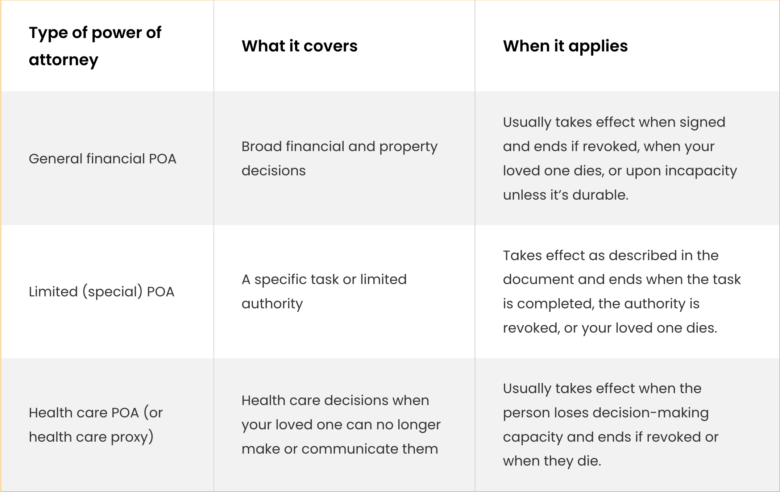
General power of attorney
This type can give the person your loved one appoints broad authority over financial and legal matters, and is sometimes used for a short period of time, such as when a person is traveling. It terminates when the principal dies or becomes incapacitated. [04]
Limited or special power of attorney
This POA lets an agent make only certain decisions or take a specified action on behalf of the principal.[05]
Health care power of attorney
This power of attorney allows an agent to manage health decisions should the principal become incapacitated.[06]
When a durable power of attorney takes effect
Depending on how the POA is written, the person your loved one appoints may act right away or only after a specified event.
Currently effective durable power of attorney
The person your loved one appoints can act as soon as the POA is signed and can continue acting after incapacity.
Springing durable power of attorney
The person your loved one appoints can act only after an event defined in the document, such as incapacity.
Compare the different types of power of attorney
When to consult an elder law attorney about power of attorney
Consider consulting an elder law attorney if your loved one has complex finances, specific care wishes, or questions about which POA they need. An attorney can explain state requirements, define the appointed person’s authority, and help your loved one complete a POA while they still can.
Related:
Like MediaFeed’s content? Be sure to follow us.
This article originally appeared on APlaceForMom.com and was syndicated by MediaFeed.co