
Can I get a tax credit if an elderly parent lives with me?
Caring for an aging parent at home can be financially demanding, but certain tax benefits may help offset some of the costs. Depending on your situation, you may qualify for tax credits such as the Credit for Other Dependents or the Child and Dependent Care Credit. You may also be able to deduct unreimbursed medical expenses that exceed 7.5% of your adjusted gross income (AGI) if you itemize deductions. Understanding these tax breaks can help reduce the financial burden of supporting a parent who lives with you.
Can I claim my parent as my dependent?
Yes, you can claim your parent or another direct relative as a dependent on your federal income tax return if you and they meet the following requirements:
- You can’t be claimed as a dependent on someone else’s tax return.
- You provided more than half of your parent’s financial support during the year.
- Your parent’s gross income for the year was below the IRS limit ($5,200 for tax year 2025).
- Your parent didn’t file a joint tax return with a spouse, unless they filed only to claim a refund.
- Your parent meets the IRS relationship and residency requirements.
- Your parent is a U.S. citizen, U.S. national, U.S. resident alien, or a resident of Canada or Mexico.
What caregiver tax credits are available to family caregivers?
Two types of tax credits are available to family caregivers: the Child and Dependent Care Credit and the Credit for Other Dependents, according to the U.S. Internal Revenue Service (IRS). If you’re unsure whether you can claim your loved one as a dependent, use the IRS’ interactive tool to see if they qualify. You can also discuss your tax situation with a tax preparer.
How can I qualify for the Child and Dependent Care Credit?
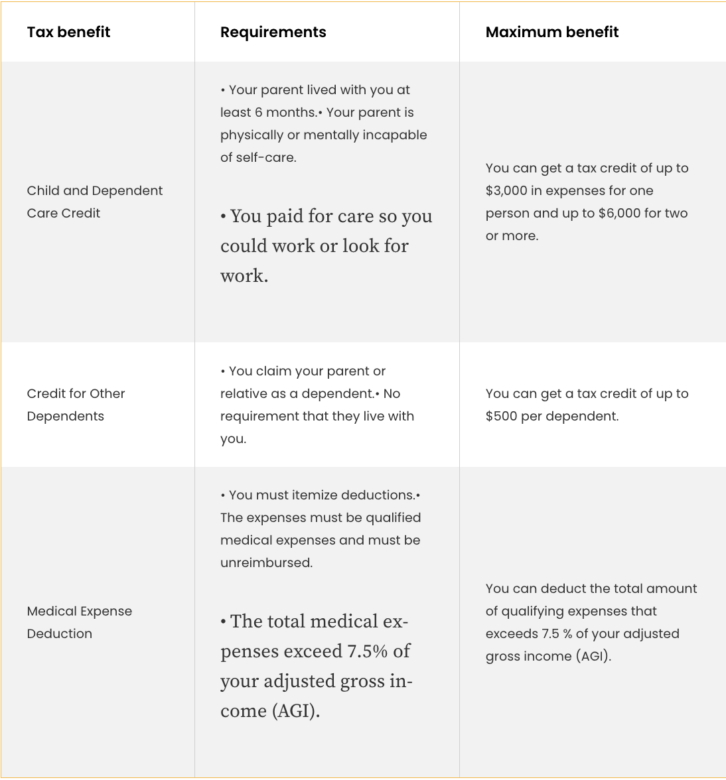
You and your loved one must have lived together for at least six months during the tax year and meet all the following requirements to take advantage of the Child and Dependent Care Credit:
- Partial Dependency. Your loved one must either qualify as your dependent or meet all requirements for a dependent, except having a maximum income of more than $5,200 in 2025 or filing jointly with their spouse.
- Incapacity. They must be physically or mentally incapable of caring for themselves.
- Employment. You must pay for a home care worker, adult day care, or other assistance to care for your loved one while you work or look for work.
- Spousal employment. If you’re married, your spouse must also work, be a full-time student, or be disabled.
How much is the Child and Dependent Care Credit?
You can claim a credit of up to $3,000 in caregiving costs for one person, or up to $6,000 for two or more people for the 2025 tax year.
How can I qualify for the Credit for Other Dependents?
If you can claim your parent or elderly relative as a dependent, then you’re eligible for the Credit for Other Dependents. Your loved one doesn’t have to live with you for you to claim this tax credit.
How much is the Credit for Other Dependents?
The Credit for Other Dependents provides a maximum tax credit of $500 per dependent for the 2025 tax year.
What caregiver tax deductions are available to family caregivers?
A dependent’s unreimbursed medical expenses can be deducted from a federal tax return when:
- A health care provider has documented the need for the service or product as part of an overall care plan.
- Your total qualifying medical expenses exceed 7.5% of your adjusted gross income (AGI).
Medical expenses that can be deducted include:
- Premiums for Medicare Part B and Part D, as well as supplemental insurance
- The cost of prescription drugs or insulin
- Dental treatment, including X-rays, oral surgery, and fillings
- Payments made for nursing services
- In-home medical equipment or home modifications required for medical care
- The portion of a nursing home or long-term care facility’s entry fee designated for medical care
- Transportation to medical appointments
- Surgeries or other inpatient procedures
This list isn’t exhaustive. Check IRS Publication 502 for more details and a full list of qualifying medical expenses.
Long-term care expenses for people who are chronically ill are also tax deductible. The IRS defines a chronically ill person as someone whose health care provider has determined that they need assistance with activities of daily living (ADLs). These include:
- Bathing
- Continence
- Dressing
- Eating
- Toileting
- Transferring
- Supervision to stay safe. This means that many memory care expenses are also tax deductible.
Keep in mind that your own medical expenses can count towards your total deduction. So, include your own prescriptions, medical care for other dependents such as a spouse and children, and your parent’s medical expenses when itemizing for this deduction.
Tax benefits for caregivers: credits vs. deductions
How to file taxes as a caregiver
Filing taxes as a caregiver involves a few key steps to claim credits, deductions, and dependent status correctly.
- Determine whether you can claim your loved one as a dependent
Your loved one must be your dependent for you to qualify for tax credits and to deduct their medical expenses from your income.
- Gather records
Be sure you have previous years’ returns available for both you and your loved one. Reviewing documents from the past three years can often help prepare you for filing.
- Organize supporting documents
Use a file folder or online program to collect important documents, such as:
- Bank statements
- W-2 forms
- 1099 forms
- Payroll stubs
- Receipts from tax-deductible medical expenses
- Caregiving expense receipts
- Documentation from senior living communities
- Dividend distribution and gain and loss statements
- Donation receipts
- Real estate transactions
- Receipts from estimated or quarterly taxes paid throughout the year
- File electronically
Filing electronically is often more efficient than filing by mail. Plus, most tax prep software programs offer reviews by a tax professional before submission. Consider these free e-file options:
- eFile. This program from the IRS lets you prepare and file your federal individual income tax return for free using brand-name tax-preparation-and-filing software if your AGI is $84,000 or less. However, state tax preparation may not be available through eFile. You may qualify for free online federal tax preparation, e-filing, and direct deposit or payment options.
- IRS. The IRS offers Free Fillable Forms, which can be completed online and then filed electronically regardless of your income level.
- MilTax. Members of the U.S. Armed Forces and qualified veterans may use MilTax, a free tax service offered by the U.S. Department of Defense through Military OneSource.
- Double-check your work
Review everything from receipts to income amounts before filing or consider having a tax professional look over your work. Sometimes, small errors can lead to serious consequences.
Consider asking for help
Consulting an accountant or tax preparer can be especially helpful when:
- You and your siblings contributed to your loved one’s support throughout the year. Any sibling who paid 10% or more can qualify to claim their parent as a dependent. However, the other siblings must sign the Multiple Support Declaration stating that they won’t claim their parent as a dependent.
- You may qualify to file as Head of Household. This filing status can increase the amount of tax credits you receive but determining whether you’re eligible may not be straightforward. In general, you’re eligible for this status if:
- You’re unmarried or “considered unmarried” on the last day of the year.
- You can claim your parent as a dependent based on the above criteria, even if they don’t live with you full time. You paid more than half the cost of mortgage, rent, or managing your parent’s home.
Also, the IRS makes two tax preparation programs available for people with low-to-moderate incomes, people who have disabilities, people who have limited English proficiency, and the elderly. The Volunteer Income Tax Assistance (VITA) and Tax Counseling for the Elderly (TCE) programs are available at no charge. Download the free IRS2Go app or call 800-906-9887 for information on free tax return preparation.
Related:
- 10 things experts predict about Bitcoin over the next 20 years
- 10 things to know about ‘phased retirement’
Ask us! What questions do you have about content, strategy, pop culture, lifestyle, wellness, history or more? We may use your question in an upcoming article!
Like MediaFeed’s content? Be sure to follow us.
This article originally appeared on a Place for Mom and was syndicated by MediaFeed.co.