In honor of Black History Month, Intuit QuickBooks commissioned a survey of 1,000 Black business owners to highlight their small business struggles and successes. Survey results emphasize persisting economic and social inequalities. Despite facing these challenges, Black business owners remain optimistic about their future, future generations, and the potential for successful Black businesses to strengthen Black communities. Key findings include:
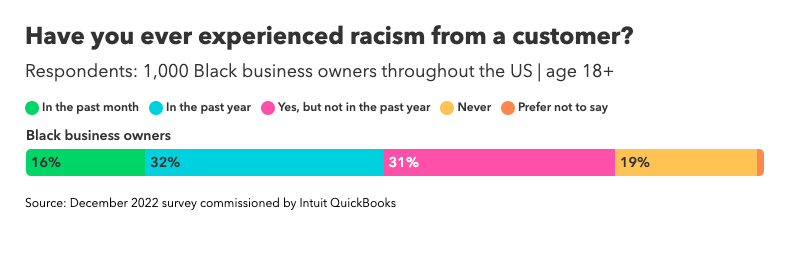
- 79% of Black business owners have experienced racism from a customer.
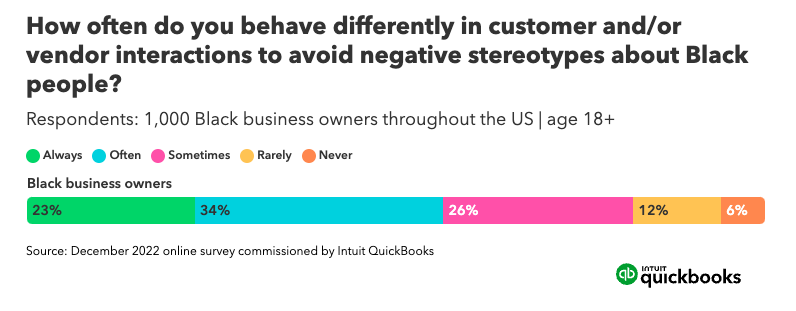
- 82% of Black business owners say they behave differently in customer and vendor interactions to avoid negative racial stereotypes.
- 57% of Black respondents indicate that they were denied a bank loan at least once when they started their businesses—compared to 37% of non-Black business owners.
- On average, it cost Black respondents approximately $21,000 to start their businesses—compared to $16,000 for their non-Black peers.
- 85% of Black respondents were able to pay themselves in 2022.
- 75% of Black business owners agree that successful Black businesses are critical for a thriving Black community.
- 55% of Black business owners agree that more mentorship from other Black business owners and easier access to financing are the resources needed the most for successful Black businesses.
In addition to the pressures of running a business, Black business owners must navigate racism and biases that threaten their success.
Dealing with racism
More than three in four Black business owners (79%) say they have experienced racism from a customer—with 48% saying they’ve experienced racism in customer interactions at least once in the past year.
Higher expectations for Black-owned businesses
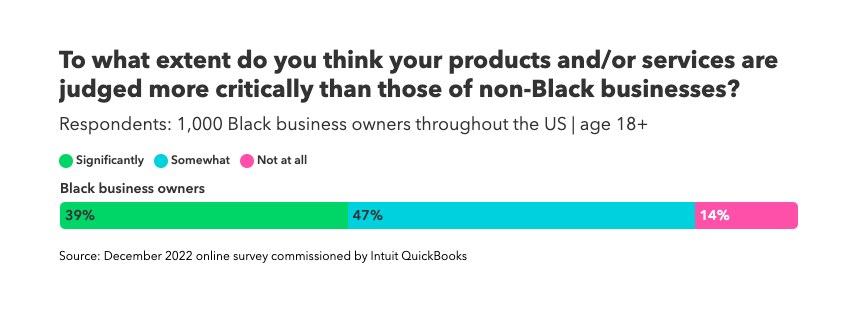
Biased perceptions can affect how consumers evaluate the performance and quality of Black-run enterprises. A majority of Black business owners (86%) say Black businesses are judged more critically than non-Black businesses.
Advertising as “Black-owned” and non-Black customers
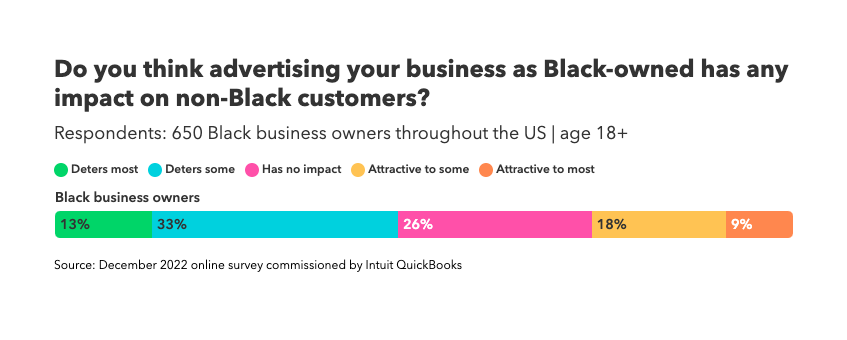
In the wake of George Floyd’s murder and the COVID-19 pandemic, a wave of awareness called attention to the reality of Black individuals across America—including Black business owners. The push to identify and support Black businesses outside of Black communities advanced, but more than two in five (46%) Black business owners who advertise their businesses as “Black-owned” think it is a deterrent to non-Black customers.
Fighting against stereotypes
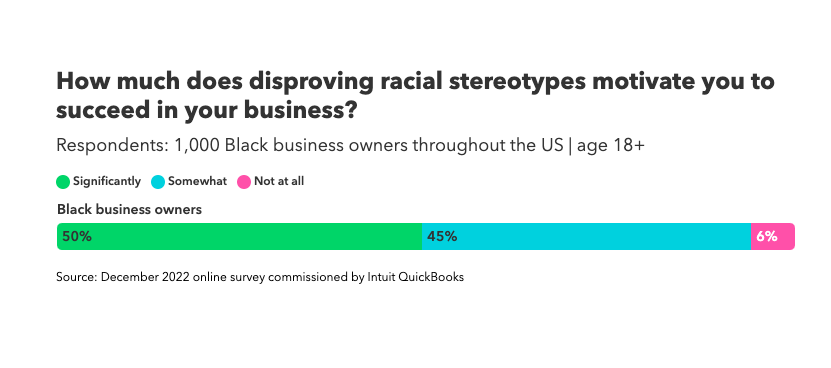
Inequities in how Black businesses are judged create an added pressure for Black business owners. Almost all survey respondents (94%) report that they are motivated to succeed by a desire to disprove racial stereotypes.
The impact of stereotypes on behavior in business interactions
Black business owners feel the impact of racial disparities in everyday business dealings. More than eight in ten (82%) Black business owners say they behave differently in customer and vendor interactions to avoid negative racial stereotypes—with only 6% reporting they are unaffected.
Related:
- Black business owners and workers face greater financial and health care challenges, according to new QuickBooks survey
- Special report: Access to funding remains a challenge for women-owned businesses
This article originally appeared on the Quickbooks Resource Center and was syndicated by MediaFeed.org.
More from MediaFeed:
5 tips for organic business growth

It’s no secret that startups have a prodigious failure rate. In fact, according to a recent Entrepreneur.com study, the four-year survival rate for a startup is just 49%.
With demoralizing stats like this in mind, entrepreneurs may be tempted to grow their profits through any means necessary, including inorganic strategies like acquisitions or mergers. However, the truth is that business owners can achieve impressive growth through organic strategies as well, allowing them to retain control of the companies they built from the ground up.
DepositPhotos.com

Also known as “true growth,” organic growth refers to the process of growing a business by reducing costs and increasing sales, either by finding more customers or enhancing output to current clients. On the other hand, inorganic growth occurs when a company merges with or is acquired by a second business. Entrepreneurs should take the time to familiarize themselves with the advantages of organic and inorganic growth, as well as some of the top strategies for execution, so they can decide which is the best choice for their business.
As a new business owner, you’ll likely want to increase profits as quickly as possible. By employing inorganic strategies like mergers and acquisitions, startups can grow their businesses more quickly while taking advantage of resources such as stronger credit lines and expanded market resources. Additionally, joining with another company lets you take advantage of its expertise and experience in the industry to develop your own brand.
DepositPhotos.com

By merging with another business, you agree to hand over some of your control and equity to another company. Not only can your initial vision become diluted, but you may also be forced to take on new business and managerial challenges before you’re truly ready. In some cases, you may have to rush to grow your staff and production capabilities to keep up with demand.
On the other hand, organic growth techniques allow you to grow your business on your own timeline. Because you aren’t sharing control with another company, you can hire employees and expand sales at your own pace. Additionally, entrepreneurs who maintain their autonomy now can sell for a larger profit later when the company is fully developed.
While retaining control of your company offers many advantages over the long haul, it can make business growth challenging in the short term. Some entrepreneurs struggle to grow beyond their current marketplace, while others find themselves cut down by the competition. Additionally, new businesses must often fight to make ends meet from month to month. Fortunately, strategies exist to help startups grow their profits without handing over control to partners or investors.
Here are just a few of those strategies to help you grow your business organically:
DepositPhotos.com

Want to grow a business that will feed your family and employees for years to come? The first step on the road to entrepreneurial success is starting the right kind of company.
With home-based and e-commerce businesses, you can avoid expenses like rent and commuting during the early, lean years of your company. As an added bonus, working out of the home lets you write off parts of your mortgage and electric bill. You can then invest these savings back into the business to help you grow in the long term.
DepositPhotos.com

A common conundrum for new business owners is whether to take your full cut of the profits or invest the money back into your company. While you may be tempted to keep some of those hard-earned dollars for yourself, you should aim to reinvest gross profits whenever possible to help your business grow. Investing your own money shows prospective clients and lenders that you are confident in your company’s long-term potential.
Not sure where to put profits? When in doubt, invest in marketing, SEO and other tactics likely to generate more business for your startup. If your income permits it, you may also want to invest in employee training and technological improvements, as these can yield large profits down the line for your company.
DepositPhotos.com

No matter how happy your current clients are with your offerings, you will have trouble growing your business organically if you don’t put effort into finding new sales channels. If you don’t currently sell your goods online, you should definitely consider starting a website to expand your reach to other regions. Additionally, you can introduce new products, cross-market services to your existing clients and expand to different markets. For example, a company that specializes in SEO may want to expand its services to include social media and search engine marketing.
Finally, business owners should employ market segmentation to customize their strategies according to the specific channels they are leveraging and the specific markets they are trying to reach. This way, you can create unique campaigns based on customer location and demographics and watch your sales rates skyrocket.
DepositPhotos.com

As a new business owner, you may feel the urge to micromanage everything that happens at your company. However, the truth is that macro-management is a far more effective way of enabling organic growth for your startup.
To keep your company moving forward, you should train top employees to take over some of your daily responsibilities. While you may be tempted to keep costs down by hiring employees who will work for less, in the long run these staff members could end up costing you more if their efforts aren’t up to par. Find people you can trust to get the job done—even when you’re not around—so you can focus on growing and developing your business in the years to come.
DepositPhotos.com

From minimizing spending, to reinvesting profits back into the business, organic growth strategies help ensure that you will retain control of the company you worked so hard to build. Do your research, and consider all the growth strategies available in order to give your business the best shot at success.
Do you know how sales taxes are impacting your bottom line? Check out our sales tax calculator.
This article originally appeared in the QuickBooks Resource Center and was syndicated by MediaFeed.org.
DepositPhotos.com
Featured Image Credit: DepositPhotos.com.