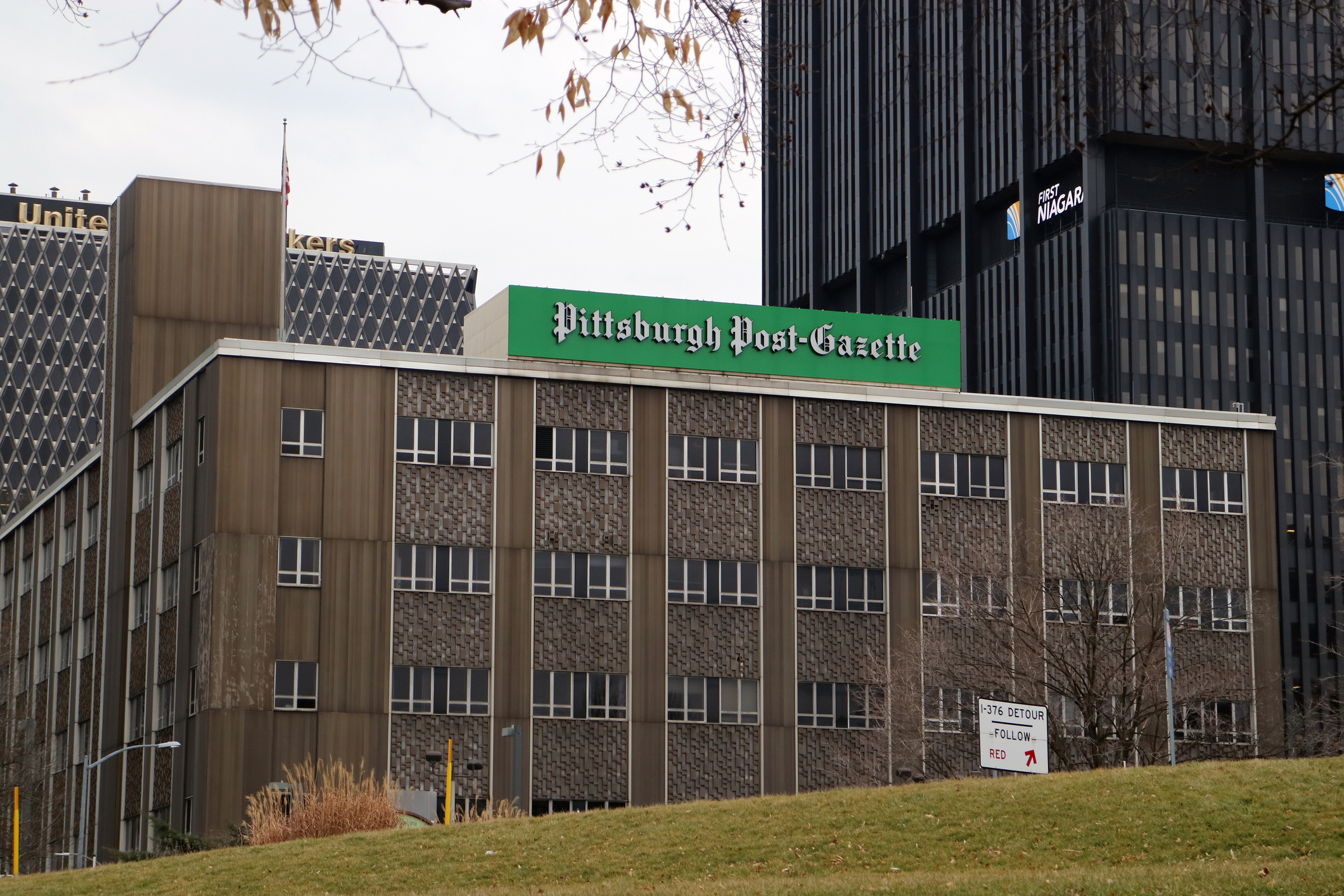
The beautiful, old Goss Uniliner presses that have run like a locomotive for generations at the Pittsburgh Post-Gazette will be grinding to a halt as the newspaper announced this month it will stop printing altogether on May 3.
That event will make the “Steel City” the largest major metropolitan area in the United States to lose its daily newspaper and will put it one step closer to becoming a news desert.
One of the oldest newspapers in the country, dating back to 1786, the Post-Gazette’s shutdown comes on the heels of its slowing publication to only three days a week and a crippling three-year strike. The Pulitzer Prize-winning paper’s demise runs parallel to the decline of a rival, the Tribune-Review, which stopped its print version altogether and now only covers city news online.
Every crisis is also an opportunity, and the question that hangs now like thick fog over the rivers that converge in Pittsburgh to form the head of the Ohio River is whether this moment will serve as a turning point in the steady collapse of local news in America? Will it at last spur the aggressive venture capital firms pouring investment into applied AI to recognize that the promise of AI depends on reliable and independent sources of journalism?
The Large Language Models that serve the AI platforms are built upon a flow of discernible facts that are the work of daily journalism, and that is the only way these platforms will function. It is high time that the AI platforms see this reality more clearly, and recognize they have a vested interest in solving the ongoing crisis in local news.
It has been said that if local journalism did not exist, AI would have to invent it. That’s because AI will not function with the accuracy and reliability it needs to deliver without on-the-ground reporters doing their jobs to find the news, to separate fact from fiction, to hold power accountable, to cover the municipal meetings where decisions are made and to be there to evaluate the health and welfare of communities who live in cities like Pittsburgh.
There is an oft-heard truism in discussions around AI: garbage in, garbage out. Without newspapers like the Post-Gazette bringing standards and practices to the gathering of facts in American cities, there is no guarantee that there will be trusted information for LLMs to train on. Those LLMs will then fail to accurately inform the answer engines of the increasingly popular ChatGPT, Gemini, Perplexity and other generative AI tools where more and more internet users are going with increasing frequency to understand the world around us.
It seems worth noting that the use of AI in the newsroom played something of a role in this chapter of the Pittsburgh Post-Gazette. During a three-year labor dispute, management drew strong union criticism for attempting to AI. The Newspaper Guild of Pittsburgh was quick to condemn any attempts to employ AI tools as an effort to replace humans in the newsroom and devalue skilled staff which added to worker grievances.
The family-owned Post-Gazette said the benefits of using AI as a cost-saving measure were necessary given the financial dire straits of their parent company, Block Communications, Inc. (BCI.) According to a BCI press release,
“Over the past 20 years, Block Communications has lost more than $350 million in cash operating the Post-Gazette. Despite those efforts, the realities facing local journalism make continued cash losses at this scale no longer sustainable.”
As a result, the paper “plans to publish its final edition and cease operations on May 3, 2026” because of severe losses. Looking for labor savings by using AI appears to have backfired for the Post-Gazette and it seemed to prove the following: While AI tools can serve to automate tasks like data processing and pattern recognition and thereby free up reporters to focus on analysis and context in under-staffed newsrooms, it can also be part of a downward spiral without human-centered reporting in local communities that results in unreliable information being published and a collapse of trust in the news organization.
Newspaper Guild of Pittsburgh president Zack Tanner issued a statement, declaring, “The Post-Gazette‘s attempt to replace our labor with artificial intelligence is a serious concern to journalists not just in Pittsburgh, but all across the country.”
“As newsroom jobs continue to disappear due to corporate greed and mismanagement, we stand firmly against any use of AI that takes work out of union members’ hands,” Tanner added
“AI will not scab us,” the Newspaper Guild defiantly declared, using the colloquial labor term usually reserved for human beings who cross picket lines.
To understand what this all means for the landscape of local news in Pittsburgh and surrounding communities, it is important to point out that there are new and vital voices of independent media emerging in Pittsburgh. They include the non-profit PublicSource, a digital-first news organization that has garnered a strong reputation for enterprise reporting. And for more than six decades, there has long been WQED, a stalwart local public radio station, which even with struggles caused by federal cuts to the PBS network, continues to remain a consistently fair and balanced source of news. Join the GroundTruth community
That said, there is no question that the closure of the Post-Gazette, which seems inevitable unless a new buyer comes forward, will leave Pittsburgh’s population less informed. And that loss will fray the ties that bind a community together. As we know from solid research, three things happen in news deserts: increased polarization, a steady decline in voter participation and a lower bond rating for the city which, simply put, means banks do not want to invest in cities and towns where no one is watching the store. This downward spiral fosters greater municipal corruption as the watchdog function of local news is no longer there to expose it. And equally important, it robs communities of the more uplifting stories of local heroes and great accomplishments that bind communities together and inspire them to do better.
Beyond this downward spiral, there is a growing sense among AI platforms and the venture firms that their own value is diminished when cities the size of Pittsburgh lose their trusted sources of news. Without that trusted news gathering, the reality is that the LLMs that serve generative AI models end up littered with inaccuracies, often devolving into what are called “hallucinations.” And amid the digital clutter spurred by AI’s preference for speed over accuracy comes the pervasiveness of what is rightly known as “AI slop.” That slop is degrading to civic dialogue and even further reinforces that documented downward spiral of increased polarization and declining voter participation in emerging news deserts like Pittsburgh. To answer these challenges, there are projections that the AI platforms themselves will start building networks of their own reporters to verify content and/or simply acquire distressed news organizations to have a vehicle that will allow them to reliably train their models.
In a piece for Nieman Lab about predictions for 2026, Jennifer Brandel, CEO of the audience engagement company Hearken, reports that some AI companies are already starting to offer financial support for some news organizations to safeguard the information supply that their LLMs depend on.
She writes, “AI companies cannot afford degraded inputs at the exact moment their valuations hinge on delivering stable, trustworthy outputs. And with the tech industry already jittery about an AI bubble, and investors being uneasy about long-term revenue models, regulators circling and consumers getting burned by hallucinations — this seems somewhat inevitable.”
But while we all hold out hope for AI platforms and the heavily funded venture firms that sustain them to wake up to the rising peril, great newspapers like the Pittsburgh Post-Gazette will continue to face extinction.
This closing of the Post-Gazette, if indeed it takes place, will occur on Sunday, May 3, which also marks World Press Freedom Day.
The owners of the Post-Gazette surely did not intend the terrible irony in this fact. But one has to think they might have looked the date up using AI, and seen that it coincided with World Press Freedom Day. Had they done so, they would have quickly seen the dark coincidence in the date of the planned closure falling on the one day of the year that is dedicated around the world to marking the importance of press freedom in ensuring democracy.
It serves as a stark reminder of the times we live in when the threat to the freedom of the press is imperiled not by the usual suspects in history that have long come in the form of autocrats and dictators, but by the influence and impact of AI platforms. This does not have to be the case, of course, if the AI economy recognizes the value in investing in reliable journalism, particularly in local news markets where it is evaporating right before our eyes. What will it take to get AI platforms to recognize the role they can play in saving local journalism in a moment of crisis. It should be clear by now that AI platforms and all of us who rely on them have a vested interest in doing so.
Related:
- A look at an Israeli checkpoint in the Palestinian town where Jesus was born
- Searching for light in the dusk of local news
Like MediaFeed’s content? Be sure to follow us.
This article originally appeared on Charlessennott.substack.com.com and was syndicated by MediaFeed.org