
Objective ABA outcomes measurement: A clinician’s guide for 2026
Objective ABA outcomes measurement is changing how some providers think about documenting progress, supporting medical necessity, and communicating developmental change to families and payers. Many of the standardized outcome measures used across the field today were designed for purposes that don’t fully match some of the documentation demands emerging now — and the regulatory, clinical, and economic context appears to be evolving faster than the toolkit.
This is a guide for clinical directors, BCBAs, BCBA-Ds, and practice owners who want to understand what objective measurement actually means in an ABA setting, where the existing assessment stack stops, and what role FDA-cleared biomarker measurement plays alongside the tools you already use. It is not a pitch to replace anything you do today. It is a guide to what the next layer of evidence looks like and how to think about adding it.
Quick Answer
Objective ABA outcomes measurement refers to device-recorded developmental data that does not depend on rater interpretation. The most prominent example in autism care today is eye-tracking-based measurement of social visual engagement. Objective measurement does not replace skill-based assessments like VB-MAPP or ABLLS-R, adaptive behavior scales like the Vineland-3, or the clinical observation BCBAs already rely on. It complements them by adding a standardized, repeatable developmental layer that the existing tools were not built to produce.
What “Objective Measurement” Actually Means in ABA
The word “objective” gets used loosely in clinical settings. In a strict sense, an objective measurement is one in which the data point does not depend on the person taking it. Two well-trained clinicians, given the same patient and the same tool, would arrive at the same number. The data is recorded by an instrument, not interpreted by a human in the moment.
Most of what ABA practices use today is, by this definition, semi-objective at best. Skill-based assessments such as the VB-MAPP and ABLLS-R rely on clinician observation against criterion benchmarks — rigorous, but ultimately filtered through the observer. Adaptive behavior scales like the Vineland-3 are parent or caregiver interviews that a clinician scores; the underlying data is recall. Continuous measurement during therapy sessions — frequency, duration, percentage correct — is the most objective layer in the typical ABA assessment stack, but it captures behavioral output, not developmental status.
There is value in every one of these. They have been the backbone of ABA outcomes documentation for decades, and they are not going anywhere. But none of them measures developmental status the way an instrument-recorded biomarker does. That is the gap a new category of measurement is starting to fill.
The Current ABA Outcomes Stack
A modern ABA practice typically draws on four layers of measurement, each doing different work:
Skill-based criterion-referenced assessments. VB-MAPP, ABLLS-R, AFLS, PEAK, Essential for Living. These tools track mastery of specific skills against developmental or curricular benchmarks. They drive program planning, placement, and goal selection. They are also the data BCBAs use to demonstrate skill acquisition in progress reports.
Adaptive behavior scales. The Vineland-3 is the most widely used in ABA, with the ABAS-3 also common. These measure adaptive functioning across domains — communication, daily living, socialization — and are accepted by many payers as standardized outcome measures for medical necessity documentation, though acceptance varies by plan.
Standardized rating scales requested by payers. Cadences vary by payer, and the specifics matter. Many commercial and Medicaid plans authorize ABA in roughly six-month blocks and commonly ask for a standardized outcome measure at reauthorization, though requirements differ from plan to plan and should be confirmed against each payer’s current policy. Industry guidance describes a common pattern, noting that some payers expect standardized outcome measures at intake and periodically thereafter (often around every six months). Where a standardized outcome measure is requested, the Vineland-3 is among the more commonly administered options. TRICARE’s Autism Care Demonstration is structured differently and publishes its own schedule — generally including the Pervasive Developmental Disorder Behavior Inventory (PDDBI), the Vineland-3, the Social Responsiveness Scale (SRS-2), and a parenting stress measure (PSI-4 or SIPA) at defined intervals. Practices should verify the exact cadence and required measures with each payer they work with rather than assuming a single universal standard.
Direct session data. Frequency, duration, percentage correct, latency, and other continuous measurements collected during therapy. This is the most granular and most behaviorally objective data in the stack, but it is bounded to the operationalized targets of the treatment plan.
This stack is sufficient for most clinical and operational purposes. What it does not contain — and was never designed to contain — is a standardized, device-recorded measurement of developmental status. That is where objective biomarker measurement enters the conversation.
Where the Existing ABA Measurement Stack Is Being Stretched
The pressure on ABA documentation appears to be shifting in ways that are worth naming directly. A few patterns tend to come up in conversations with practices.
Comparability across cases. Some payers reviewing reauthorization submissions appear to be looking for outcomes data that is comparable across a provider’s caseload — not just narrative descriptions of individual progress. Skill-based data, by design, is highly individualized. Vineland scores are standardized but rest on parent recall and clinician scoring. Practices that can show standardized, comparable developmental data across their entire caseload are better positioned to support medical necessity arguments at scale.
Sensitivity to change. Even at a six-month Vineland cadence — a common cadence under many commercial and Medicaid plans — the data is parent-reported and clinician-scored, with known rater variability between administrations. For children whose Vineland scores fluctuate around a stable range while clinical teams continue to observe meaningful gains in session, the documentation can feel thin against payer scrutiny. The challenge is not the cadence; it is that the underlying measurement is recall-based.
Rater variability. Standardized outcome measures administered by different clinicians — or by the same clinician at different points in time — carry known rater variability. This is not a critique of the tools; it is a property of any clinician-administered interview or observation. When the same instrument is used to demonstrate change over years of treatment, that variability accumulates.
None of this means the existing tools are wrong, or that they should be set aside. It suggests the bar for evidentiary documentation may be rising, and that the existing stack alone can be difficult to stretch to meet it.
How Objective Biomarker Measurement Complements Existing Tools
Eye-tracking devices measures something the existing ABA assessment stack does not: a child’s moment-by-moment visual attention to social and non-social scenes, captured by an eye-tracking device that records at 120 data points per second. The output is a set of three indices — language, cognition, and social engagement — that the FDA has cleared as objective measurements aiding the diagnosis and assessment of Autism Spectrum Disorder.
This is not a competitor to VB-MAPP, ABLLS-R, AFLS, PEAK, Essential for Living, or the Vineland-3. It is a different category of evidence.
A skill-based tool tells you what a child can do under structured conditions. A parent interview tells you what a parent observes day-to-day. Direct session data tells you how a target behavior is changing. An objective developmental biomarker tells you something else: how a child’s social-visual attention compares to expected developmental patterns, measured the same way today as it will be measured six months from now.
The clinical research underpinning this is not new. The pivotal JAMA study and its companion paper in JAMA Network Open, both published in September 2023, reported on validation studies involving more than a thousand children. The pivotal trial in 1,089 children reported sensitivity of 78.0% and specificity of 85.4% for the device’s diagnostic indication. The replication cohort reported a similar performance profile.
The Role of FDA Clearance in Clinical Outcomes Measurement
It is worth being precise about what FDA clearance means, because it is sometimes overstated and sometimes underestimated.
FDA 510(k) clearance is a regulatory pathway in which a medical device manufacturer demonstrates substantial equivalence to a legally marketed predicate device, against the FDA’s standards for safety and effectiveness. It is not the same as FDA approval, which applies to a different class of devices and drugs and follows a different process.
The relevance for ABA outcomes documentation is that no other tool in the current standard stack is FDA-regulated as a medical device. The VB-MAPP, ABLLS-R, AFLS, PEAK, Essential for Living, Vineland-3, ABAS-3, PDDBI, and SRS-2 are clinical instruments and rating scales — valuable, widely used, and well-validated in their own right, but not regulated medical devices.
This matters for two reasons. First, FDA clearance signals that the device has met regulatory standards for the reliability and reproducibility of its output. Second, in conversations with payers, accreditors, and health system buyers, the FDA-cleared status is a meaningful credential — particularly as the conversation shifts toward objective, comparable outcome data.
What a Modern ABA Assessment Stack Looks Like in 2026
A modern stack does not throw out what came before. It adds a layer.
A reasonable composition for a 2026 ABA practice serving children in the age range:
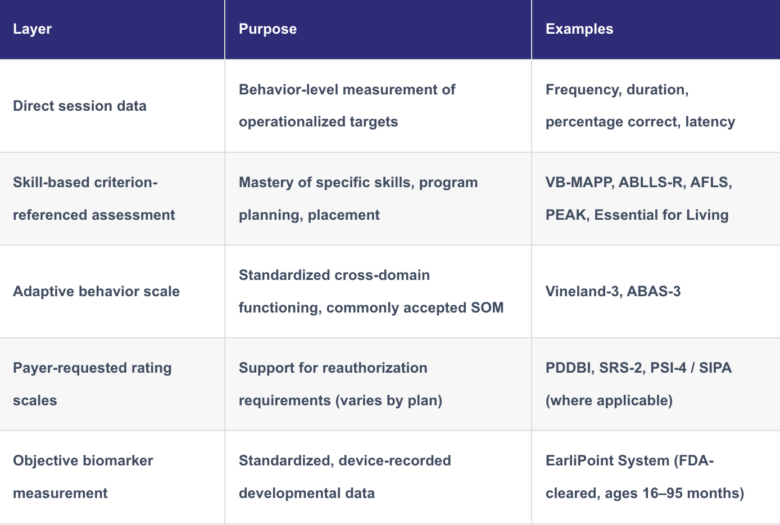
The stack is additive. Direct session data continues to drive intervention decisions in real time. Skill-based assessments continue to guide program structure. Adaptive behavior scales continue to serve as a commonly accepted SOM that many reviewers look for. Payer-specific rating scales continue to be administered per each plan’s requirements. Objective biomarker measurement is the new layer — added where the practice has children in the cleared age range and where the documentation case for objective developmental data is strongest.
This is the picture for diagnostic and reassessment workflows specifically. For real-time treatment decisions and within-session adjustments, the existing stack remains the right tool.
Building Longitudinal Developmental Records Across the Six-Month Reauthorization Cycle
The six-month progress assessment cycle is one of the most consequential operational rhythms in an ABA practice. It is when treatment plans are reviewed, when reauthorization submissions are built, and when the question “is this child progressing in a way that supports continued medical necessity” gets answered, in writing, for a payer reviewer.
The traditional documentation set at this point typically includes: updated direct session data, narrative progress descriptions written by the BCBA, results from any standardized outcome measures administered during the period, and goals updated for the next authorization period.
What this set lacks, generally, is a comparable developmental data point taken at consistent intervals across the full course of treatment. The Vineland-3 is sometimes administered annually or biennially. The PDDBI under TRICARE is administered every six months but is parent-reported. Skill-based assessments are repeated as clinically indicated, but their data is, by design, tied to individualized programs and not directly comparable across children or across time in a standardized way.
Implementation: Bringing Objective Measurement Into Your Clinical Workflow
For practices considering how to integrate objective biomarker measurement, a few practical observations.
Decide on administration ownership. The device can be administered by trained staff who are not BCBAs. Many practices designate a behavior technician or assessment coordinator to administer eye-tracking technology, freeing BCBA time for interpretation, clinical decision-making, and treatment-plan work. Interpretation must remain with a qualified clinician.
Integrate the report into existing documentation workflows. An EarliPoint report sits alongside the Vineland-3 standard scores, the skill-based assessment summary, and the BCBA’s narrative progress description. It does not replace any of them. Practices that try to substitute objective measurement for existing tools tend to encounter friction; practices that add it as a parallel record do not.
Set a clear cadence. The most operationally clean cadence is initial diagnostic evaluation, intake reassessment, and every six-month reauthorization point. This creates the longitudinal record that strengthens both clinical decision-making and payer documentation.
Use the data in conversations with families. Beyond the payer documentation case, objective developmental data is often easier to communicate with parents than skill checklists. Parents understand that their child looks at certain things and not others; an EarliPoint report makes those patterns concrete. This is not the primary clinical purpose of the tool, but it is an outcome practices consistently mention.
Be clear about what the data does and does not say. Objective measurement supports clinical decision-making. It does not replace it. The mandatory positioning, and the FDA indication itself, is that the device aids qualified clinicians. Communicate this internally with the same precision the indication requires.
Frequently Asked Questions
How is progress measured in ABA therapy?
ABA practices typically measure progress through a combination of direct session data (frequency, duration, percentage correct), standardized outcome measures administered periodically — often around every six months, depending on the payer (Vineland-3, ABAS-3, PDDBI, SRS-2) — and skill-based criterion-referenced assessments such as VB-MAPP and ABLLS-R. Practices are increasingly adding objective biomarker measurement to this stack to capture standardized developmental data the existing tools were not designed to produce.
What is the difference between subjective and objective measurement in autism?
Subjective measurement relies on clinician observation, parent or caregiver report, or scored interviews — the data is filtered through a human interpreter. Objective measurement uses device-recorded data that does not depend on a rater’s interpretation. Eye-tracking captures how a child visually engages with social and non-social scenes, producing standardized indices across language, cognition, and social engagement.
How often should ABA reassessment happen?
Formal progress assessments are commonly conducted around every six months in many ABA programs, which tends to align with payer reauthorization cycles. Many commercial and Medicaid plans ask for a standardized outcome measure (often the Vineland-3 or equivalent) at reauthorization, though requirements vary by plan and should be confirmed with each payer. TRICARE publishes its own schedule: under the Autism Care Demonstration, the PDDBI and Vineland-3 (among other measures) are administered at defined intervals.
What is a biomarker in autism?
A biomarker is an objectively measured indicator of a biological state. In autism research, social visual engagement — measured by where and how a child looks at social scenes — has been studied for more than two decades as a biomarker of developmental differences.
How does the Vineland measure adaptive behavior?
The Vineland-3 is a semi-structured parent or caregiver interview that yields standard scores across communication, daily living skills, socialization, motor skills (for younger children), and an adaptive behavior composite. A clinician administers the interview and scores the responses.
Where This Is Heading
The shift toward objective outcomes measurement in ABA is real, but it is also early. There are reasonable open questions about how payers will weight objective biomarker data over time, how CPT and reimbursement pathways will develop, and how the published evidence base will evolve as more practices generate longitudinal records. None of those are settled.
For practices thinking about where to invest in their assessment stack over the next two to three years, the question is no longer whether objective developmental measurement belongs in the mix. It is how to add it in a way that complements what already works.
Related:
- Understanding the alcohol-breast cancer link: What women need to know
- Florida hospitals act fast to discharge gun victims — especially if they’re not insured
Ask us! What questions do you have about content, strategy, pop culture, lifestyle, wellness, history or more? We may use your question in an upcoming article!
Like MediaFeed’s content? Be sure to follow us.
This article originally appeared on EarliPoint Health and was syndicated by MediaFeed.co.