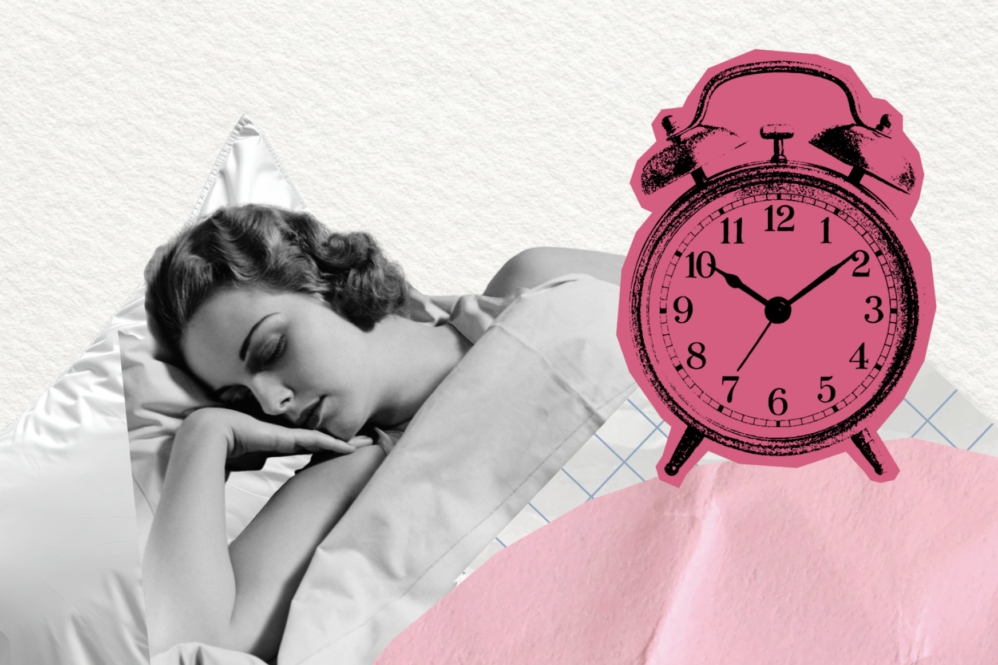
2:54 a.m.
Wide awake again.
My husband snores peacefully next to me after taking a full four minutes to fall asleep, I might add, while I lie awake reviewing next week’s menu and drafting the speech I’ll deliver to my high school best friend if we ever speak again.
For those feeling “seen” right now, this is midlife: lying awake while your brain runs a late-night group chat about family, groceries, and every conversation you should have handled better.
And while NYDJ jeans may be a good solution for the latter, the 10-3-2-1 sleep method just might be a better answer than buying another sleep tracker and then losing sleep over what it says.
Not because it’s the latest sleepmaxxing biohack—it isn’t—but because it repackages familiar sleep-hygiene advice into a formula even a tired woman can remember.
Here’s what the numbers actually mean—and why they might be the combination code to a better night’s sleep.
When Did Sleep Become ‘A Thing’?
I’ve been a Certified Sleep Science Coach for a few years, and with all the writing and research I’ve done on the topic, I’ve found two indubitable truths about sleep:
- It ebbs and flows throughout a lifetime.
- No one is immune to its imperfections.
When you’re young, footloose, and fancy-free, sleep tends to come easy. The hardest thing we had to do was get up for work after staying out until 3 a.m.
Two or three decades down the line, however, all the grown-up stuff kicks in and exacts its heavy toll. And while adulting is hard all around, it’s especially hard for women as we bear the mental and emotional load for our families. And we’re required to do so while riding the roller coaster that’s menopause with a smile on our face.
And to add to the mix, we’re constantly bombarded with information (sometimes solicited, sometimes not) about how important it is to get the thing we’re not getting. Understandably, sleep becomes … slippery.
Current messaging is that sleep is the key to greater longevity, keeping menopausal weight gain in check, and staving off dementia. It’s all the things that matter to us now, but reaping those rewards seems virtually impossible when we’re lying awake night after night, deliberating over our grocery lists.
The good news is this isn’t how your story ends. You can sleep peacefully again. It just takes a little work.
Want more? Get PROVOKED’s free Thursday newsletter. Sign up at PROVOKEDMagazine.com.
So, What’s the 10-3–2–1 Method?
Popularized online by Dr. Jess Andrade, the 10-3–2–1 sleep method is a time-based wind-down routine—not a magic spell, not a sleep-tracking competition, and not another subscription waiting to renew. It’s short, it’s catchy, and it’s an easy way to remember some of the most important aspects of sleep hygiene. Essentially, you think of it as a countdown before bed that offers a more structured way to help your body and mind transition from high energy to a more restful state. Each number in the sequence represents a specific lifestyle recommendation and when practiced consistently, it may help you fall asleep faster and stay asleep longer. The countdown goes something like this:
- 10 hours before bed – Start your caffeine cutoff
- 3 hours before bed – Stop eating large meals and drinking alcohol
- 2 hours before bed – Stop working
- 1 hour before bed – Stop using screens and devices
10 Hours: Cut Caffeine
Say goodbye to that afternoon coffee—or to sleep.
A cup of coffee with dessert may hit the spot and round out your meal, but for many of us, a cup of joe that late can turn bedtime into a negotiation. Caffeine works by blocking adenosine—the brain chemical that makes you feel sleepy. And while blocking adenosine is a good way to get past the 3 p.m. slump, caffeine has a half-life of about five to six hours. Come 9 p.m., only half of that caffeine is out of your system, so you’re staring down the barrel of another night of delayed sleep onset and poor sleep quality.
With the 10-3-2-1 method? Your last hit of caffeine is 10 hours before hitting the hay. More time for caffeine levels to drop means less effect on your sleep.
3 Hours: No Big Meals or Alcohol
What you eat late messes with your sleep more than you think.
Most of us probably don’t think much about our meals once we get up from the dinner table, but digestion can be pretty taxing on our systems. Heavy meals too close to bedtime can cause heartburn and indigestion, and ultimately make it harder to fall and stay asleep.
“In our evolution, large meals were never consumed at night, so our systems aren’t primed for them [at that time],” said Dentist and Sleep Expert Dr. Stephen Carstensen. “Digestion of a large meal requires a lot of energy, which makes other systems work harder. Ultimately, it’s the spikes in blood sugar and insulin that disrupt our sleep cycles and circadian rhythm.”
And while most people think that alcohol’s sedative effects are good for sleep, the opposite is true as the night wears on. (Related: My Feet Are Filing a Harassment Complaint)
“Alcohol, in the short term, can induce sleepiness, so many people think alcohol will help them sleep,” said Carstensen. “Unfortunately, a short time later, the breakdown products of alcohol become stimulants, so very often the person will wake up and have difficulty falling asleep again. Even if they don’t become fully awake, their sleep is fragmented and of poor quality.” At the end of the day (no pun intended), disrupted sleep architecture, reduced REM sleep, and short sleep are what you’re left with aside from the empty glass.
2 Hours: Step Away from Work
Your brain needs time to wind down so give it a head start.
Working late into the evening and burning the midnight oil are not uncommon in a world where we’re “always on,” but the practice can have a detrimental effect on your sleep.
Neuroscientist Matt Walker brilliantly said most people think of sleep and wake as binary (it’s either off or it’s on). But that’s just not how our bodies and minds work. Walker explained that sleep is a process and if we have any expectation of getting some shuteye, we need time to wind down before bed.
“Work, especially cognitively demanding tasks, can keep your brain in a state of alertness,” said Alex Dimitriu, MD, a dual board-certified in psychiatry and sleep medicine physician. “Your brain cannot go from 100 mph to zero quickly. Stepping away from work-related stress well before lights out helps signal to your brain that it’s time to wind down.”
According to the 10-3-2-1 method, two hours is the sweet spot.
1 Hour: Shut Down the Screens
Blue light isn’t your bedtime friend.
Research shows that as much as 95 percent of us chill out on our phones before bed—a habit Dimitriu said can do more harm than good. “Scrolling news stories, social feeds, or shopping is quite activating for the brain, and should ideally be avoided well before sleep.”
Beyond the excitement (or deep rage) that may keep us up, Dimitriu explained that “Electronics have a double impact; the blue light they emit suppresses our melatonin production.” Why does that matter? Melatonin is the hormone that regulates sleep. “It’s like playing a slot machine right before sleep,” Dimitriu added. “The idea sounds as terrible as it is—and that’s what your screen is for your sleep.”
Enjoyed this story? Read more from PROVOKED at provokedmagazine.com.
Sleepmaxxing Brought Us Here…
When our sleep comes under attack from every direction during midlife, it’s only a matter of time before we hit the web in search of answers. From apps that track our sleep cycles and overpriced weighted blankets to mouth tape, cooling mattresses, meditation podcasts, and a supplement cabinet that looks like a small pharmacy, we are overloaded with advice.
We’re not dumb. We’re just tired.
And if we strip away the marketing and the noise around sleep, a back-to-basics approach may be all we really need. That’s why 10-3-2-1 isn’t sexy or revolutionary—but it might actually work.
Because we can remember it.
Because it costs nothing.
Because it makes sense.
No app to download. No subscription to cancel. No scrolling for the answer at 2:47 a.m. with one eye open.
Just four simple numbers that might help you reclaim your night—and your sanity.
10. 3. 2. 1.
Keep it simple. Keep it doable.
And maybe—finally—keep sleeping.
Related:
- Confused About Your Food? That’s by Design.
- Smart Women are Going Fractional After 50—and Taking Control
- I Did the Work. Now I’m Supposed to Do My Face.
Ask us! What questions do you have about content, strategy, pop culture, lifestyle, wellness, history or more? We may use your question in an upcoming article!
Like MediaFeed’s content? Be sure to follow us.
This article originally appeared on PROVOKED and was syndicated by MediaFeed.co.