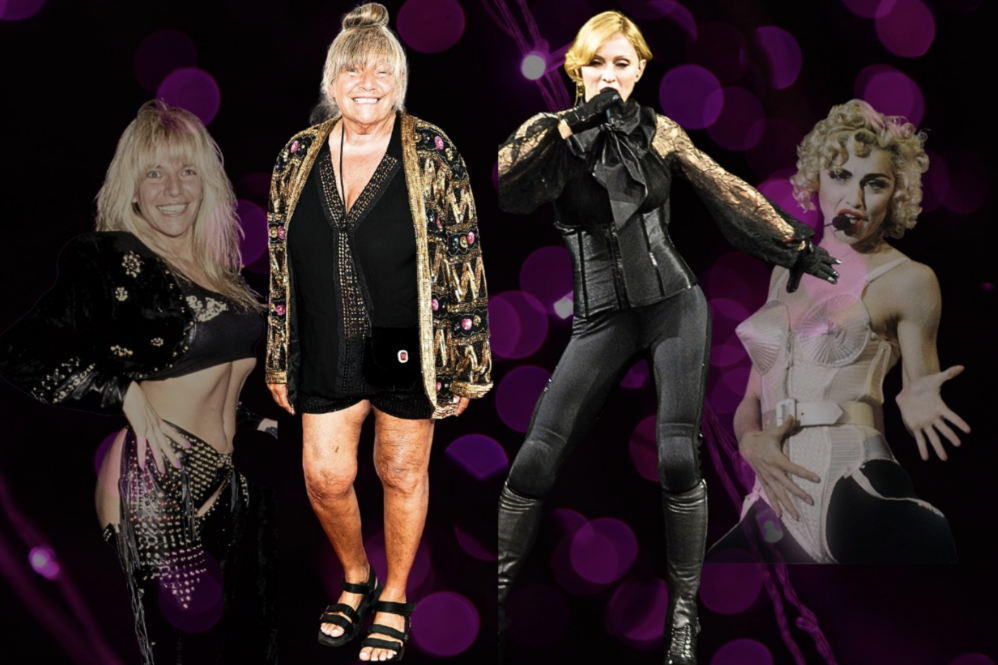
Two intimacy-positive, shame-free icons of my youth, now 67 and 70. Watching them age sent me looking for a third option.
One day when I was little, I sat on the floor coloring while my grandmother and her friends played cards at the living room table. “Have you all seen Martha?” one friend asked the group while fanning the cards in a fancy shuffle. “She’s really let herself go.” That’s how, at age five, I realized there was a right and wrong way to get older.
Later, during my teens in the ‘80s in New York, I spent late Friday nights toggling between MTV and Channel J. One played videos of Madonna in pointed bustiers or diamonds, daring to mingle religion and intimacy, dancing with a handsome coterie of male dancers. The other featured Robin Byrd, a former adult star with a homespun, “intimacy”-positive call-in show, dancing with any combo of straight, queer, and transgender dancers in her signature black crocheted bikini. Both women were belles of the ball at Danceteria, the downtown club I snuck into wearing Madonna-inspired black rubber bracelets and flashing a fake ID. Yes, they were different. But they transmitted the same message right into my developing psyche: Express your intimate self; it’s good for the soul. Be free.
Years Later
In the 40-odd years since, I’ve built a career working primarily with women. I led intimacy empowerment workshops throughout the 2000s. In short, I heard Madonna and Byrd’s message and I ran with it. Now Madonna has just released her latest album—along with a 10-minute film—”Confessions II,” and HBO Max is airing the Sarah Jessica Parker-produced Bang My Box: The Robin Byrd Story. Both of these icons have been pioneers of intimate freedom, strong voices in the fight for AIDS, and advocates for LGBTQ+ visibility. They’re close in age: Madonna, an internationally known and celebrated pop star, is 67, and Byrd, known to a handful who remember her impact, is 70. And together, they reveal radically different approaches to aging.
Two Paths Through Time
When I first heard about letting yourself go, I knew only that it was bad. Today, I view that sticky phrase as a trope of capitalist patriarchy. But one thing’s clear: No one would ever accuse Madonna of it. Rather than let go, she has curated every corner of her physicality. Like many, I find myself with complex and contradictory emotions around the body and femininity that Madonna has adopted. I’m impressed with her stamina, but also saddened. Her new heart-shaped visage and outsize lips sometimes remind me of the cartoon character Jessica Rabbit.
While I’m used to the shock and awe that comes from more than 40 years of watching Madonna reinvent and preserve herself, I wasn’t expecting to feel shock when I saw Robin Byrd after not seeing her for decades. It took me a few moments to reconcile the woman I remember with the one on the screen. Her signature blond locks have been replaced by a gray top knot. Once known for her self-proclaimed “bangin’ body,” she has gained weight. Although Byrd, as a minor New York celebrity, never had Madonna’s pressures to keep up with industry standards, she’s still done something radical. As a former adult performer, Byrd hasn’t preserved the image of her heyday; she’s allowed herself to look 70. While I would never say she’s let herself go, she has let her former self go, and it’s inspiring.
Then There’s My Face
When I stare at my 56-year-old face in the mirror, I can’t help thinking about Madonna and Byrd. They so embody my conflicted feelings about my own aging that I’ve come up with a new term: the Madonna-Byrd complex. When I see my eyelids and jawline submitting to gravity, I regularly feel grief for what my face used to look like, and quickly fantasize about getting the money and time to fix it, as if it’s broken. This part of me believes I need to be more like Madonna and fight it. Then comes the Robin rebuttal: Stop feeding patriarchy and looking at yourself critically, don’t fear aging, wear your years proudly—the part that wants to be free. If the Madonna-Harlet complex represents how, for centuries, men have divided women into those they love and those they desire, my Madonna-Byrd complex represents dueling philosophies about how women are supposed to age: either with focused preservation or not caring much about it at all. (Related: Screw Main Character Energy. I’m Embracing My Side Character Vibe)
Of course there’s some middle ground, but the media—particularly social media—obscures it. When scrolling Instagram, Justine Bateman, filmmaker and author of Face: One Square Foot of Skin, pops up as the fearless aging warrior. Then comes Dolly Parton, who makes plastic surgery seem like a rite of passage for anyone who can afford it. My approach to aging can either be pure, with no dyes, injections, or procedures, or full of filler and vanity. Trying to escape the whole racket by using the old trope, “You just need to do what makes you feel good and healthy,” only works for a bit. The bind sucks me in.
A New Question
But after watching Bang My Box a second time, I felt a shift. Toward the end, in response to the producers’ invitation to walk naked in a shot, Byrd admits to not wanting others to see her older, heavier body. But then she catches herself. “What kind of hypocrite am I?” she asks, and obliges, baring her majestic 70-year-old self to the camera. A few moments later she reflects: “We all have a mission … mine was to make people happy, to give them the love that I wanted.”
The documentary illustrates how Byrd—dancing in the streets, taking care of her beloved and ailing husband, and remaining a staunch LGBTQ+ ally—is still clearly living out her mission and life to its fullest, spreading happiness to herself and others. Whether or not she looks young by society’s standards doesn’t alter her impact. In Madonna’s role as a pop star, by contrast, looking and acting youthful is arguably part of her mission.
I thought: What if instead of fighting aging or the patriarchy, I could connect with my mission, which is helping people experience more freedom and mastery? I decided that when I catch myself locked in the complex, I’ll ask: What’s important for me to preserve, and why?
I recently thought about letting my hair grow into its natural salt and pepper. I like the idea of lowering costs, time, and toxins without hair dye, but getting there, with messy gray roots and a mop of dueling textures (my gray is coarser), makes me anxious. When I think about leading corporate retreats on the way to gray, I know I would feel self-conscious. I want to put my energy into work, not self-acceptance—and color my roots in support of that mission.
Madonna and Byrd are still my icons. I’ll keep asking what’s worth preserving, and why—starting with my own roots.
Blair Glaser is a writer and leadership consultant with bylines in Quartz, The Muse, Huffington Post, Longreads, and Yes!, among others. Her debut memoir, This Incredible Longing, was published in February 2026.
Related:
- ‘Aging Gracefully’ Is Code for Disappearing. I Opted Out.
- Is Relenting to Botox at 58 Anti-Feminist?
- How to Live Artfully in the Age of Digital Slop
Like MediaFeed’s content? Be sure to follow us.
This article originally appeared on PROVOKED and was syndicated by MediaFeed.co