
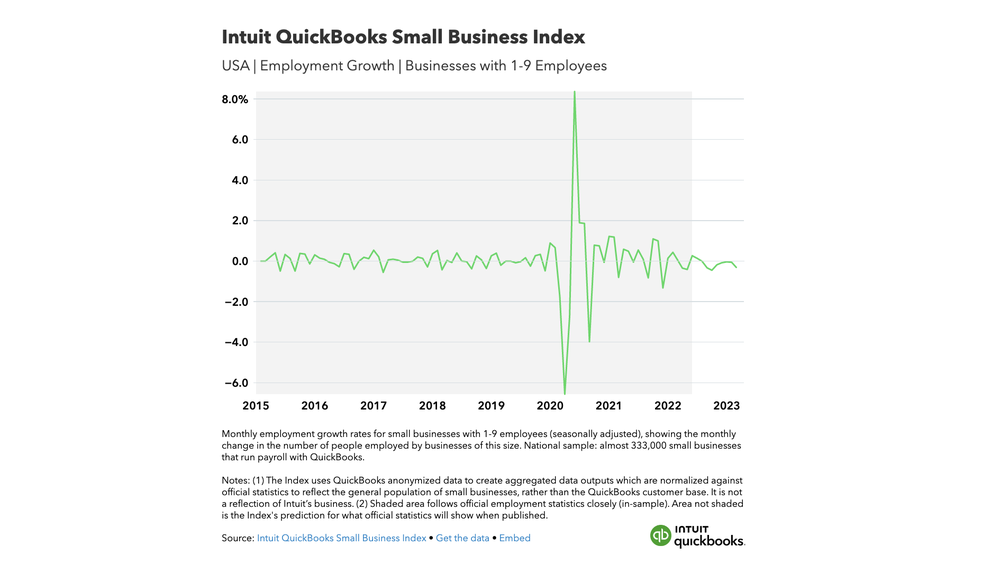
In the US in March, small businesses with one to nine employees employed 39,600 fewer people nationally compared to the previous month. That’s a monthly decrease of -0.31% to 12,773,100 jobs — a larger decrease than the Index predicted in February, when employment was predicted to drop by -0.06%.
US Index | Small Business Employment
-39,600 jobs | -0.31%
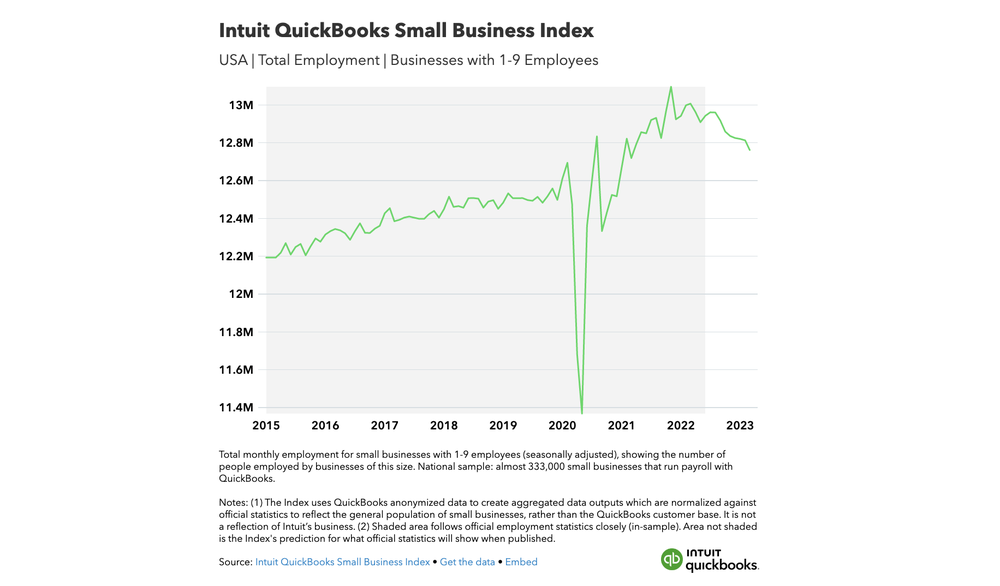
In the US in March, small businesses with one to nine employees employed 39,600 fewer people nationally compared to the previous month. That’s a monthly decrease of -0.31% to 12,773,100 jobs — a larger decrease than the Index predicted in February, when employment was predicted to drop by -0.06%.
Sectors with the largest decreases in small business employment were:
- Information (NAICS 51) with a drop of -0.79% to 285,400 jobs
- Construction (NAICS 23) with a drop of -0.78% to 750,400 jobs
- Leisure and hospitality (NAICS 71-72) with a drop of -0.78% to 1,510,200 jobs
Sectors with the smallest decreases in small business employment were:
- Utilities (NAICS 22) with a drop of -0.22% to 658,800 jobs
- Natural resources and mining (NAICS 11; 21) with a drop of – 0.23% to 180,000 jobs
- Retail (NAICS 44-45) with a drop of -0.28% to 1,523,900 jobs
Regionally, the Southwest (Arizona, New Mexico, Oklahoma, Texas) had the largest decrease in small business employment, with a drop of -0.67% to 1,566,900 jobs. The Rocky Mountain region (Colorado, Idaho, Montana, Utah, Wyoming) had the smallest decrease, with employment down by just -0.03% to 500,700 jobs.
Ufuk Akcigit, the Arnold C. Harberger Professor of Economics at the University of Chicago, said: “Small businesses are most sensitive to macroeconomic conditions. The current high inflationary environment, coupled with rising interest rates is expected to have an adverse effect on small business activities, which could explain the drop in the Index in March from February.
“Parallel to this observation, in March 2023, the Intuit Quickbooks Small Business Index shows a -0.31% decline in small business employment, which corresponds to 39,600 job losses among businesses with at most nine employees. The information sector experienced the sharpest decline by -0.79% and utilities observed the mildest decline by -0.22%. It’s also notable that leisure and hospitality was among the highest growth sectors in last month’s Index, but is now among those experiencing the largest decrease in employment, which reflects some of the volatility we’re seeing in other statistics.
“While small business employment continues to hold above pre-pandemic levels, it is essential to monitor the small business statistics closely to ensure their health during this unusual episode of economic and financial disturbances.”
Get all the details from the interactive Small Business Index dashboard.
Canada Index | Small Business Employment
-22,000 jobs | -0.42%
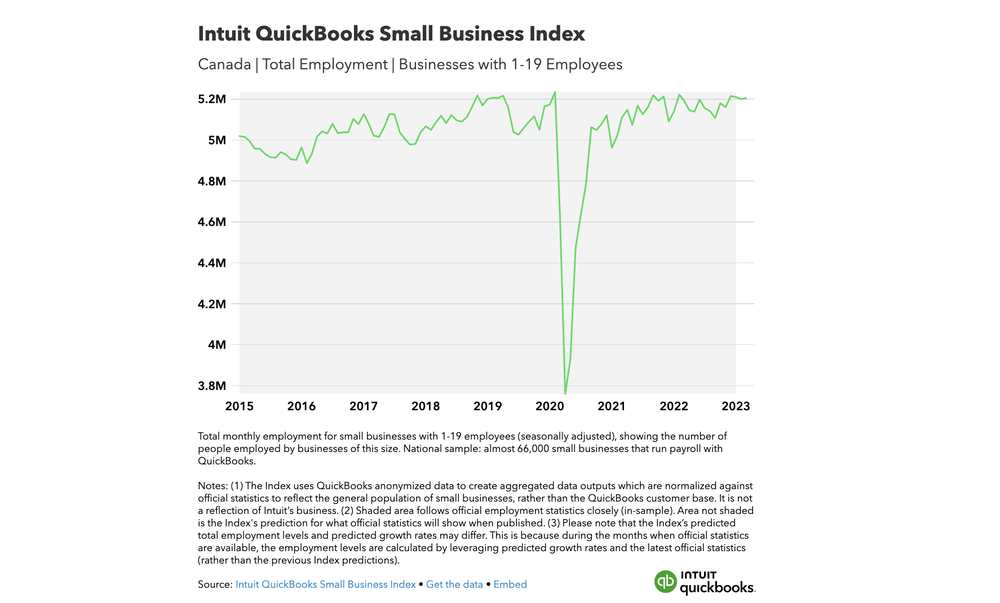
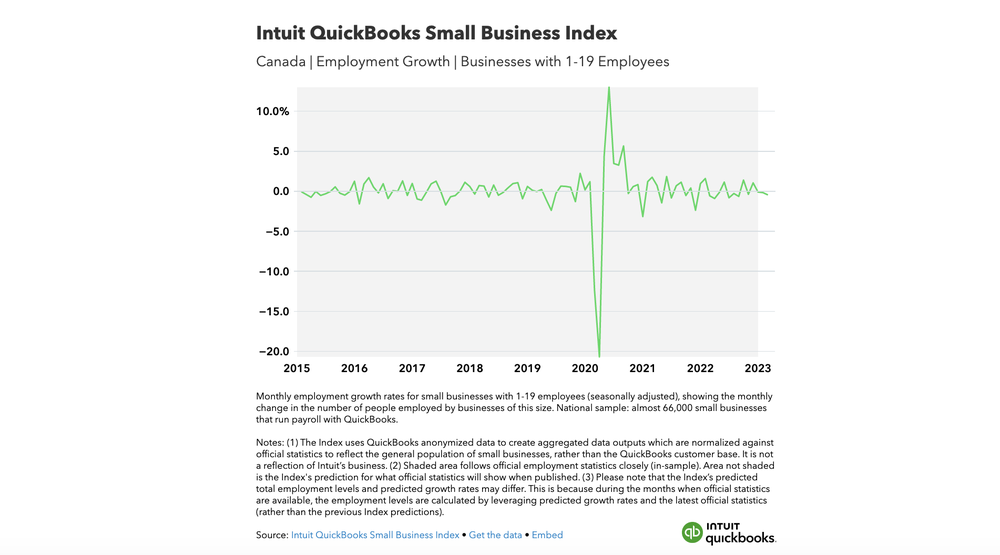
In Canada in March, small businesses with one to 19 employees employed 22,000 fewer people nationally compared to the previous official benchmark of 5,227,000 in February’s Labour Force Survey, published by Statistics Canada. That’s a monthly decrease of -0.42% to 5,205,000 jobs — a larger decrease than the Index predicted in February, when employment was predicted to drop by -0.17%.
Sectors with the largest decreases in small business employment were:
- Accommodation and food services (NAICS 72) with a drop of -1.63% to 495,800 jobs
- Natural resources and mining (NAICS 11; 21) with a drop of -1.39% to 136,900 jobs
- Education (NAICS 61) with a drop of -0.93% to 168,700 jobs
One sector saw an increase in small business employment:
- Health care and social assistance (NAICS 62) with an increase of 0.35% to 665,900 jobs
Regionally, the Atlantic region (Newfoundland and Labrador, Prince Edward Island, Nova Scotia, New Brunswick) had the smallest decrease in small business employment, down by -0.22% to 384,400 jobs. Québec had the largest decrease, down by -0.66% to 1,046,000 jobs.
Ufuk Akcigit, the Arnold C. Harberger Professor of Economics at the University of Chicago, said: “Over the past year, the Canadian Central Bank raised the interest rate eight times in order to combat the high inflationary environment, which could explain the drop in the Index this month compared to the previous month. Small businesses always react to economic and financial disturbances first and therefore it is very important to keep a close eye on their near real-time statistics.
“In March 2023, the Intuit QuickBooks Small Business Index showed a -0.42% decline in employment, which corresponds to 22,000 job losses among businesses with at most 19 employees. Accommodation and food services experienced the sharpest decline by -1.63% — a significant change from last month’s Index when it was the fastest growing, which reflects some of the volatility we’re seeing in other statistics. Health care and social assistance showed a 0.35% increase in employment.
“The negative trends make it even more essential to monitor the small business statistics closely, as small businesses are early indicators of aggregate economic activity in Canada.”
Get all the details from the interactive Small Business Index dashboard.
UK Index | Small Business Job Vacancies
-7,400 vacancies | -4.98%
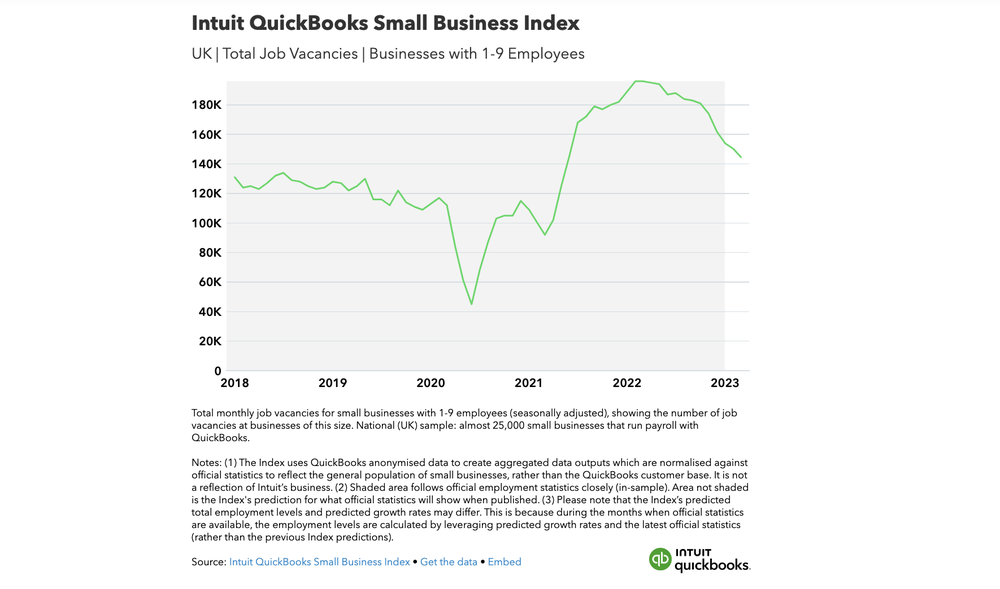
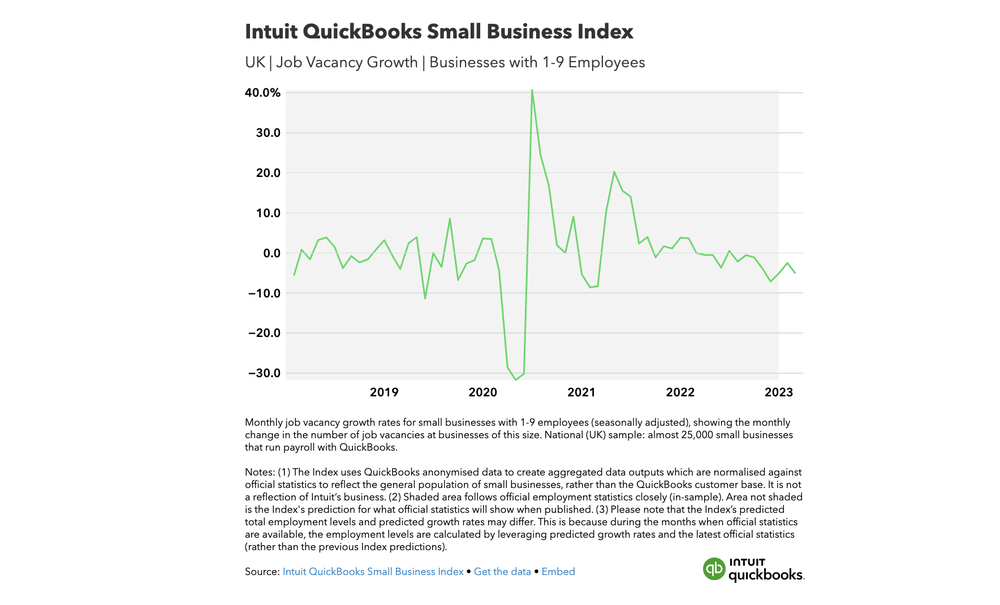
In the UK in March, small businesses with one to nine employees had 7,400 fewer job vacancies compared to the previous official benchmark of 152,000 in February’s Vacancy Survey, published by the Office for National Statistics. That’s a monthly decrease of -4.98% to 144,600 job vacancies — a larger decrease than the Index predicted in February, when job vacancies were predicted to drop by -2.5%.
Sectors with the largest decreases in small business job vacancies were:
- Arts, entertainment, and recreation (SIC R) with a drop of -11.43% to 4,800 job vacancies
- Construction (SIC F) with a drop of -9.17% to 900 job vacancies
- Transport and storage (SIC H) with a drop of -7.35% to 9,600 job vacancies
Sectors with the smallest decreases in small business job vacancies were:
- Education (SIC P) with a drop of -0.65% to 15,400 job vacancies
- Health care and social work (SIC Q) with a drop of -0.96% to 9,700 job vacancies
- Finance and insurance (SIC K) with a drop of -1.02% to 6,700 job vacancies
Regionally, Northern Ireland had the largest decrease in the UK, with a drop of -9.54% to 2,100 small business job vacancies. England had the smallest decrease, down by -3.26% to 130,600 job vacancies.
Ufuk Akcigit, the Arnold C. Harberger Professor of Economics at the University of Chicago, said: “Inflation remains high in the UK and therefore the Bank of England hiked the interest rate again in March 2023. Small businesses are the first to be affected by difficult macroeconomic conditions.
“The Intuit QuickBooks Small Business Index shows that the UK economy had a -4.98% decline in vacancies compared to the previous month, which corresponds to 7,400 less vacancies among small businesses with at most nine employees. While the decline was observed in every sector, the arts, entertainment, and recreation sector experienced the sharpest drop by -11.4%. The education sector observed the mildest decline by -0.65%. The negative trends make it even more essential to monitor the small business statistics closely, as small businesses are early indicators of aggregate economic activity in the UK.”
Get all the details from the interactive Small Business Index dashboard.
About the Index
The Intuit QuickBooks Small Business Index is a timely new measure of small business employment and hiring in the US, Canada, and the UK. The Index launched in March 2023 and is updated monthly. The Index uses purpose-built economic models to normalize anonymized QuickBooks data to reflect the general population of small businesses in each country; it is not a reflection of Intuit’s business. The Index was developed in collaboration with leading economist Professor Ufuk Akcigit and an international team of researchers and academics.
Methodology
The Intuit QuickBooks Small Business Index creates aggregated data outputs from a sample of anonymized QuickBooks Online Payroll customer records which are calibrated using statistical methods to create modeled results which better reflect the general population of small businesses in each country, as represented by published official statistics. Statistical adjustment ensures the Index truly reflects employment and job vacancy changes rather than trends in the QuickBooks customer base. Get the full methodology here.
Rounded values
Total and monthly changes in employment and job vacancies have been rounded to the nearest hundred. Monthly changes and growth rates are calculated before total employment or job vacancy values are rounded. Rates have been rounded to the nearest hundredth.
Seasonal adjustments
The Index’s data insights are seasonally adjusted to limit the effect of seasonal patterns in employment and hiring throughout the year, which lead to regular fluctuations in workforce growth and contraction.
Employment growth formula
Employment growth(t) = [Employment(t)-Employment(t-1)]/[0.5*Employment(t)+0.5*Employment(t-1)]
Employment levels
The Index produces a monthly prediction of employment growth rates by country, region and sector. In order to translate these growth rates into the number of jobs/vacancies gained or lost, the growth rates are multiplied by the prior month’s predicted employment levels, except during the months when official statistics are published. During those months, the latest official employment levels that have been reported are used in the calculation instead of the Index’s prior month’s predicted employment levels. Official statistics are published at different frequencies depending on the country.
Time series
The Index uses data going back to January 2015 in the US and Canada and to January 2018 in the UK. Published at the earliest opportunity every month, the Index shows the number of people employed by small businesses (in the US and Canada) or the number of job vacancies at small businesses (in the UK) in the previous month and how that number has changed since the month before. The Index helps to eliminate almost all of the time lags in official statistics by providing estimated projections of what those statistics will ultimately show when they are published.
Sample sizes
The total sample across all three countries is around 424,000 small businesses. The US sample is almost 333,000 small businesses. The Canadian sample is almost 66,000 small businesses. The UK sample is almost 25,000 small businesses. The minimum sample sizes for regions or sectors to be included in the Index are 1,000 small businesses in the US, 800 small businesses in Canada, and 200 small businesses in the UK.
Target populations
In the US and UK, the Index targets the populations of small businesses with one to nine employees. In Canada, the target population is small businesses with one to 19 employees. The differences ensure the Index’s data insights are consistent with official statistics in each country, which are used for benchmarking during the calibration process. Timely data insights for these populations of small businesses are particularly valuable since most datasets fail to cover this portion of the economy well. Please note: Unlike in the US and Canada, the UK Index uses job vacancy data for calibration rather than employment data because official employment statistics are not currently available for small businesses on a monthly basis.
External data sources
External data sources used alongside the samples of anonymized QuickBooks Online Payroll customer data include:
- U.S. Bureau of Labor Statistics Business Employment Dynamics (BED) and Job Openings and Labor Turnover Survey (JOLTS)
- U.S. Bureau of Economic Analysis regions
- Statistics Canada Labour Force Survey and regions
- UK Office for National Statistics job vacancy data
Geographic regions
- USA data insights are divided into Bureau of Economic Analysis (BEA) regions
- Canada data insights are divided into Statistics Canada regions
- UK data insights are currently available at the country level (England, Scotland, Wales, Northern Ireland) — not regionally within countries.
Industry sectors
- UK data insights are available by UK Standard Industrial Classification of Economic Activities (SIC) sectors (known as “sections”).
-
Related:
- How to create a website for my business: 8 steps and tips
- How to start an e-commerce business and succeed in 2023
This article originally appeared on the Quickbooks Resource Center and was syndicated by MediaFeed.org.
More from MediaFeed:
5 tips for organic business growth

It’s no secret that startups have a prodigious failure rate. In fact, according to a recent Entrepreneur.com study, the four-year survival rate for a startup is just 49%.
With demoralizing stats like this in mind, entrepreneurs may be tempted to grow their profits through any means necessary, including inorganic strategies like acquisitions or mergers. However, the truth is that business owners can achieve impressive growth through organic strategies as well, allowing them to retain control of the companies they built from the ground up.
DepositPhotos.com

Also known as “true growth,” organic growth refers to the process of growing a business by reducing costs and increasing sales, either by finding more customers or enhancing output to current clients. On the other hand, inorganic growth occurs when a company merges with or is acquired by a second business. Entrepreneurs should take the time to familiarize themselves with the advantages of organic and inorganic growth, as well as some of the top strategies for execution, so they can decide which is the best choice for their business.
As a new business owner, you’ll likely want to increase profits as quickly as possible. By employing inorganic strategies like mergers and acquisitions, startups can grow their businesses more quickly while taking advantage of resources such as stronger credit lines and expanded market resources. Additionally, joining with another company lets you take advantage of its expertise and experience in the industry to develop your own brand.
DepositPhotos.com

By merging with another business, you agree to hand over some of your control and equity to another company. Not only can your initial vision become diluted, but you may also be forced to take on new business and managerial challenges before you’re truly ready. In some cases, you may have to rush to grow your staff and production capabilities to keep up with demand.
On the other hand, organic growth techniques allow you to grow your business on your own timeline. Because you aren’t sharing control with another company, you can hire employees and expand sales at your own pace. Additionally, entrepreneurs who maintain their autonomy now can sell for a larger profit later when the company is fully developed.
While retaining control of your company offers many advantages over the long haul, it can make business growth challenging in the short term. Some entrepreneurs struggle to grow beyond their current marketplace, while others find themselves cut down by the competition. Additionally, new businesses must often fight to make ends meet from month to month. Fortunately, strategies exist to help startups grow their profits without handing over control to partners or investors.
Here are just a few of those strategies to help you grow your business organically:
DepositPhotos.com

Want to grow a business that will feed your family and employees for years to come? The first step on the road to entrepreneurial success is starting the right kind of company.
With home-based and e-commerce businesses, you can avoid expenses like rent and commuting during the early, lean years of your company. As an added bonus, working out of the home lets you write off parts of your mortgage and electric bill. You can then invest these savings back into the business to help you grow in the long term.
DepositPhotos.com

A common conundrum for new business owners is whether to take your full cut of the profits or invest the money back into your company. While you may be tempted to keep some of those hard-earned dollars for yourself, you should aim to reinvest gross profits whenever possible to help your business grow. Investing your own money shows prospective clients and lenders that you are confident in your company’s long-term potential.
Not sure where to put profits? When in doubt, invest in marketing, SEO and other tactics likely to generate more business for your startup. If your income permits it, you may also want to invest in employee training and technological improvements, as these can yield large profits down the line for your company.
DepositPhotos.com

No matter how happy your current clients are with your offerings, you will have trouble growing your business organically if you don’t put effort into finding new sales channels. If you don’t currently sell your goods online, you should definitely consider starting a website to expand your reach to other regions. Additionally, you can introduce new products, cross-market services to your existing clients and expand to different markets. For example, a company that specializes in SEO may want to expand its services to include social media and search engine marketing.
Finally, business owners should employ market segmentation to customize their strategies according to the specific channels they are leveraging and the specific markets they are trying to reach. This way, you can create unique campaigns based on customer location and demographics and watch your sales rates skyrocket.
DepositPhotos.com

As a new business owner, you may feel the urge to micromanage everything that happens at your company. However, the truth is that macro-management is a far more effective way of enabling organic growth for your startup.
To keep your company moving forward, you should train top employees to take over some of your daily responsibilities. While you may be tempted to keep costs down by hiring employees who will work for less, in the long run these staff members could end up costing you more if their efforts aren’t up to par. Find people you can trust to get the job done—even when you’re not around—so you can focus on growing and developing your business in the years to come.
DepositPhotos.com

From minimizing spending, to reinvesting profits back into the business, organic growth strategies help ensure that you will retain control of the company you worked so hard to build. Do your research, and consider all the growth strategies available in order to give your business the best shot at success.
Do you know how sales taxes are impacting your bottom line? Check out our sales tax calculator.
This article originally appeared in the QuickBooks Resource Center and was syndicated by MediaFeed.org.
DepositPhotos.com
Featured Image Credit: DepositPhotos.com.