
If you’ve spent time around someone on the autism spectrum, you’ve probably learned the basics: use people-first language, be empathetic, hold space. Understanding where these guidelines come from, however, is a different kind of education entirely. The history of autism in America is a story of wrong turns, determined parents, and science slowly catching up with what families already knew.
The early years (1940s)
It all started with two researchers working independently and arriving at the same place. In 1943, Johns Hopkins psychiatrist Leo Kanner published a landmark paper describing children with “extreme autistic aloneness.” His observations were precise and important, but buried in them was a troubling note about emotional coldness in the parents he studied, a seed that would take root in the worst possible way. A year later, in Vienna, Hans Asperger described a group of children he called “Little Professors,” who were highly verbal, intensely focused, and socially adrift. Both men had mapped the same spectrum without knowing the other existed.
The blame years (1950s–1970s)
Bruno Bettelheim, an Austrian psychologist who taught at the University of Chicago, took Kanner’s seed and ran with it. His 1967 book “The Empty Fortress” declared autism the product of cold, unloving mothers, and a generation of families drowned in guilt for something that was never their fault. Children during this era were frequently misdiagnosed with Childhood Schizophrenia. Therapy focused on compliance. Institutions were a common outcome. Meanwhile, Dr. O. Ivar Lovaas was developing early ABA therapy, which at the time included the use of aversive methods that are not considered acceptable today. Success was measured by how well a child could pass for neurotypical.
The institutional years (1960s–1980s)
Under Bettelheim’s influence, institutions became the default answer for families who had run out of other options. Many children were institutionalized throughout the 1960s and 1970s, effectively rendering the condition invisible to the general public and freezing the estimated prevalence at around one to four years of age in 10,000 children. Families were told this was the compassionate choice, but there was more to the official storyline.
The most notorious example stood on Staten Island. Willowbrook State School opened in 1948 as the largest institution in the world for people with developmental disabilities, built on the premise that a productive, fulfilling life was simply not possible for this population. At its peak, it held over 6,000 residents. In 1972, investigative reporter Geraldo Rivera smuggled a camera inside and broadcast what he found to a national audience. The outcry triggered landmark legal action, court-ordered reforms, and the institution’s eventual closure in 1987.
The backlash reshaped federal policy. Over the two decades that followed, hundreds of state hospitals and residential centers closed as deinstitutionalization moved people from long-term facilities into community settings. Group homes replaced wards, but funding was inconsistent, and community support was thin. In 1975, Congress passed the Education for All Handicapped Children Act, which later became the Individuals with Disabilities Education Act (IDEA) in 1990, guaranteeing every child with a disability a free appropriate public education in the least restrictive environment possible. Before that law existed, U.S. schools educated only one in five children with disabilities. The act drew a line. A child with autism now had a legal right to a classroom.
Getting closer (1980s–2012)
Parents pushed back, researchers followed, and the picture slowly sharpened. Advocacy groups founded by families began pressuring institutions to reexamine the science, and the refrigerator mother theory was formally discredited by the late 1970s. The DSM-IV, published in 1994, introduced separate diagnostic categories including Asperger’s Disorder and PDD-NOS, giving clinicians a broader toolkit. As awareness spread, diagnosis rates climbed sharply, and headlines warned of an epidemic. What was actually happening, researchers now understand, was better recognition of a condition that had always been there, finally being seen for what it was.
Watch our webinar: How Two Researchers Turned Eye-Tracking Science Into a Breakthrough for Autism Diagnosis and Assessment
One overarching umbrella (2013–today)
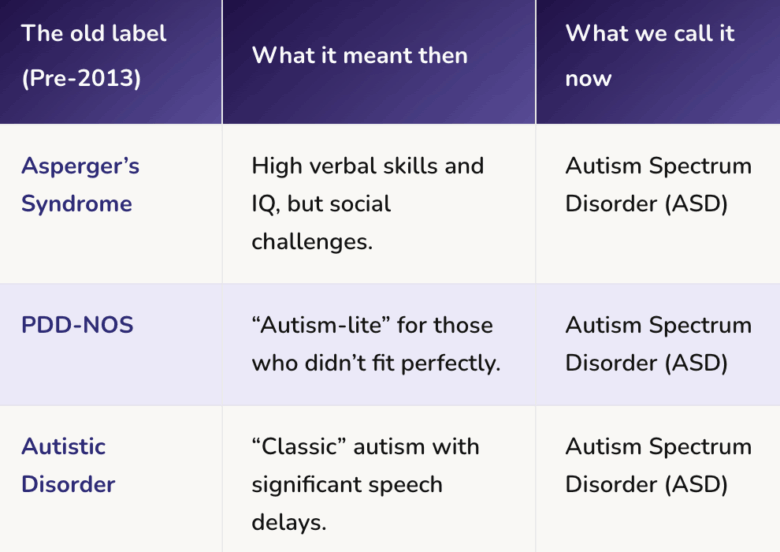
In 2013, the DSM-5 merged Autistic Disorder, Asperger’s, and related diagnoses into a single Autism Spectrum Disorder, replacing broad functioning labels with three support levels tied to actual needs. The change was controversial in some corners of the community, particularly among people who identified strongly with the Asperger’s label, but it reflected a growing scientific consensus that the spectrum was exactly that. ABA therapy shifted away from compliance and toward genuine wellbeing, asking not how to make a child appear typical but how to help that child thrive on their own terms.
To better explain these changes, here’s a quick reference guide to explain the major vernacular changes post 2013:
Like MediaFeed’s content? Be sure to follow us.
This article originally appeared on Earlipointhealth.com and was syndicated by MediaFeed.org