
The cost of going to college can vary dramatically depending on where you go. The average cost of tuition and fees for the 2023-2024 school year is $42,162 at private colleges, $23,630 for out-of-state students at public universities, and $10,662 for in-state residents at public schools, according to U.S. News. Based on those numbers, the average tuition and fees to attend an in-state public college are nearly 75% less than the average sticker price charged at a private institution.
But should you choose a college based on price? Maybe. While there are a number of things you’ll want to consider when choosing a college, including its location, reputation, and even the vibe on campus, price is often near the top of the list for many families. Here’s a look at how to compare schools by cost, plus tips for making a school that seems economically out of reach more affordable.
Understanding Net Price vs Sticker Price
Choosing a college based on price begins with knowing what the actual price is. But this isn’t as simple as it sounds. That’s because there is a difference between the sticker price published by the college and the actual price you will pay if you are admitted to that school. Indeed, colleges with the highest sticker prices sometimes end up costing far less than a college with an affordable sticker price.
The sticker price is a school’s published cost of attendance (COA), including tuition, fees, room and board. It can vary anywhere from $3,000 to $75,000-plus. But don’t let those upper ranges frighten you off — few students end up paying the full sticker price.
Net price, on the other hand, is what you will actually pay. It is sticker price (COA) minus any financial aid provided by the college and the federal government.
Financial aid is based on financial need, a student’s merit (achievements), or a combination. Aid is offered in the form of grants, scholarships, work-study, and sometimes federal student loans.
Before you apply to a school, it’s a good idea to use the net price calculator available on the school’s website. This can give you a better indication of the actual cost of attending that college.
3 Reasons to Choose a College Based on Price
While price likely isn’t the only factor you’ll want to weigh when choosing a school, here are some reasons why you may want to make it a key consideration.
You Can Avoid High Debt
The average student borrows over $30,000 to pursue a bachelor’s degree, according to the Education Data Initiative. Students who used their federal loans to attend public institutions owe an average of $27,884, while the average student who attended a private, nonprofit institution owes $40,607. Attending a lower-cost school can mean borrowing less, and graduating with a smaller student loan balance.
You’ll Help Your Parents Out
If your parents plan to help you with college costs, choosing a less expensive school can help them avoid having to tap their savings, home equity, or retirement to cover your education expenses. While there are many different types of student loans you can tap, there is no such thing as a retirement loan.
Along with using income and savings for college costs, parents might also need to take on private loans or federal PLUS loans to pay for your college education, which come with higher interest rates than federal student loans. Generally, it’s cheaper for you to borrow money for college than your parents. Plus, you’ll have more time to repay the debt.
You’ll Improve the Return on Your Investment
Return on investment (ROI) is a term borrowed from investing that tells you the average earnings you can expect when you compare the return to how much you invested. To consider ROI for a college degree, you need to look at how much you can expect to earn with your degree versus how much the degree costs. You likely won’t earn enough to offset the degree within one year, so you generally want to consider the potential return over 10 years.
The lower your college costs, the better the chance you’ll get a strong return on your investment. That means earning enough after graduating to justify the expense of attending school.
To figure out which schools have the best chance of setting you up for success, you might look at the U.S. Department of Education’s College Scorecard . It has key details including average net price, graduation rates, and typical salaries students earn after attending a college or university.
How to Lower the Cost of College
What you will have to pay to attend a particular college may differ from that school’s published cost of attendance. Here are some ways to significantly shrink the sticker price.
Fill out the FAFSA
Submitting the Free Application for Federal Student Aid (FAFSA) is a critical step when it comes to reducing the price of college. This form is a gateway to several forms of financial aid, including grants, scholarships, work-study, and federal student loans. Many colleges also use the FAFSA when awarding institutional (merit-based) aid, and some states use the form for certain state-based aid. So it’s worth filling out even if you don’t think you will qualify for aid.
Seek Out Local Scholarships
Submitting the FAFSA puts you in the running for many grants and scholarships. But there are other, smaller, sources of “free money” out there that can further chip away at the cost of college. You may be able to take advantage of local scholarships, which are typically offered by local organizations, nonprofits, or places of worship. You can do a national search for private scholarships using an online search engine. To find local scholarships, however, you may want to ask your high school guidance counselor what is available in your area. Some companies also give out scholarships to dependents of their employees.
Earn College Credits in High School
Taking Advanced Placement (AP) courses in high school and doing well on AP exams can help you save on college tuition. Some schools will award course credits based on AP scores, while others allow students with qualifying scores to place into higher-level courses, which could allow you to graduate a semester early.
Pay Less for a Four-Year Degree
You may be able to save on the cost of a four-year degree by starting at a community college for two years, then transferring to a pricier, four-year school for your remaining two years. However, you’ll need to make sure that the college you want to transfer to — and graduate from — will accept the credits from the community college. Some community colleges actually have reciprocity agreements with nearby four-year schools.
Pursue Federal Loans First
If you need to borrow money to pay for college, you generally want to tap all sources of financial aid, including federal student loans, before looking at private student loans. Then, if you still have gaps in funding, you might consider using private student loans ot fill them.
Available through banks, credit unions, and online lenders, private student loans typically come with higher interest rates than federal student loans and don’t offer the same borrower protections (like income-driven repayment plans and forgiveness programs). However, they come with higher borrowing limits. Typically, you can borrow up to the total cost of attendance, minus any financial aid received, every year, giving you more borrowing flexibility than you can get with federal government.
(Learn more: Personal Loan Calculator)
The Takeaway
There may be many colleges where you’d be happy and thrive academically, so it’s important to narrow the possibilities into a manageable list. To do this, you’ll want to consider size, location, available majors, makeup of the student body, and, of course, price. Going to a more affordable college can mean taking on less debt, giving your parents a break, and improving your return on investment.
This article originally appeared on SoFi.com and was syndicated by MediaFeed.org.
SoFi Loan Products
SoFi loans are originated by SoFi Bank, N.A., NMLS #696891 Opens A New Window.(Member FDIC). For additional product-specific legal and licensing information, see SoFi. Equal Housing Lender.
SoFi Private Student Loans
Please borrow responsibly. SoFi Private Student Loans are not a substitute for federal loans, grants, and work-study programs. You should exhaust all your federal student aid options before you consider any private loans, including ours. Read our FAQs. SoFi Private Student Loans are subject to program terms and restrictions, and applicants must meet SoFi’s eligibility and underwriting requirements. See SoFi for more information. To view payment examples, click here. SoFi reserves the right to modify eligibility criteria at any time. This information is subject to change.
Financial Tips & Strategies: The tips provided on this website are of a general nature and do not take into account your specific objectives, financial situation, and needs. You should always consider their appropriateness given your own circumstances.
External Websites: The information and analysis provided through hyperlinks to third-party websites, while believed to be accurate, cannot be guaranteed by SoFi. Links are provided for informational purposes and should not be viewed as an endorsement.
More from MediaFeed:
How much money do I really need to retire?

The amount you need to retire is a highly personal calculation that weaves in both the lifestyle you envision, the amount you’ve saved, your Social Security benefit, and a number of other factors.
While there are formulas and calculators that can help you determine a basic amount that you need to save for retirement, these are just ballpark numbers. In some cases it can be useful to game out a couple of different scenarios — using different assumptions about where you might live, whether you’ll work part time or travel, and so on.
This can help you, and your spouse or partner, decide on the retirement path that suits you best. And this can help you make the best estimate of how much you need to retire.
Srdjanns74/istockphoto

There isn’t a single number you need to retire that will work for everyone. As mentioned, every person’s situation is unique and comes with its own complications and assumptions for what retirement might mean.
Fidelity’s research shows that if a 30-year retirement is planned and annual spending is expected to be 4% to 5% of savings, adjusting for inflation, there is about a 90% chance of not running out of money.
The exact percentage of the retirement calculator formula can depend on the age of retirement and life expectancy. That number changes if a person retires at age 60 and plans a 35-year retirement — about 4.3% could be withdrawn per year to retain that 90% likelihood of financial security.
That said, there are a few rules of thumb you can consider.
Jacob Wackerhausen/istockphoto

One basic guideline is known as the 80% rule, which says you should aim to replace 80% of your pre-retirement income. So, if you earn $100,000, you’ll need about $80,000 per year when you retire.
This is only meant as a guideline, but it has been called into question by some experts as being too high. As the thinking goes, your expenses decline in retirement, largely because you’re no longer saving for retirement, nor are you commuting.
Others have said workers should aim to replace 100% of their pre-retirement income, owing to inflation.
Korrawin/istockphoto

Another popular rule of thumb is “the 4% rule“, which talks about how much money you’ll need to retire. The 4% rule says that you can take your projected annual retirement expenses and divide by 4% (0.04) to know how much money you’ll need before you can safely retire.
If you project annual expenses of $50,000, you’ll need $1,250,000 (which is $50,000 divided by 0.04). Then each year you could withdraw 4% (indexed for inflation), which would come mostly if not completely from the appreciation of the portfolio.
Since the 4% rule was introduced in 1994, other advisors have said that it is not conservative enough and have suggested 3.33% or 3.5% might be more appropriate.
Sofi
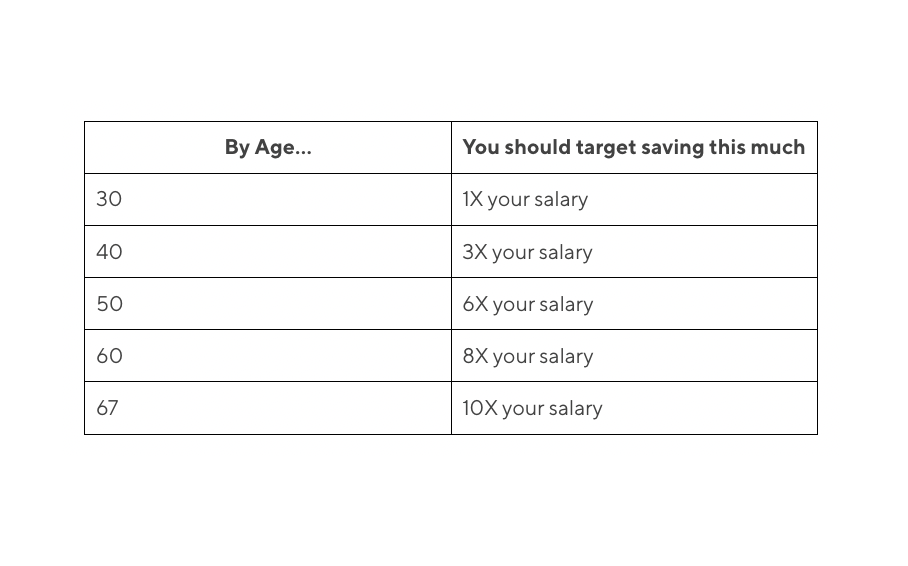
If you’re just starting out in life, you might think that with retirement decades away that you don’t have to worry about it. But the sooner you start saving for retirement, the better off you’ll be. Here are a few rough targets for how much you should have saved at certain ages:.
These should only be considered as very rough guidelines — for more detailed retirement targets, consider working with a financial advisor.
Sofi

When considering how much you’ll need to retire, here are a few things that you will want to keep in mind:
1. Age You Plan to Retire
In simple terms, your retirement age is the age when you decide to retire. For example, you might set your target retirement date as 62 or 65 or 66 — all of which are related to Social Security benefits in some way.
Social Security has largely shaped how we view retirement age in the U.S. because that monthly payout is what enables the majority of people to leave work. Some 92% of retirees age 65 and older say they depend on Social Security. While retiring at 62 is the earliest age when you can claim Social Security, that’s not your “full retirement age” – 67 is generally considered the full retirement age.
jacoblund/istockphoto

Some financial planners suggest that you base your retirement projections on your pre-retirement income. You might use 75% or 80% of your current income as a basis for estimating how much money you’ll need as retirement.
For a more detailed look, go through your budget and see how each type of expense will change in retirement. You may need more or less income than you think.
Elena Katkova/istockphoto

Another thing to think about is how your lifestyle overall might change in retirement. Consider whether you plan to move or make other big lifestyle changes that can impact both expenses and taxes. While some costs may go down (such as if you pay off the mortgage on your home), others might go up as you change your lifestyle.
As one example, if you want to explore the world or visit grandchildren, your travel budget may drastically increase from pre-retirement levels.
monkeybusinessimages/istockphoto

Social Security benefits can provide a vital supplement to your retirement income and help you get closer to financial security. However, it’s critical to understand that the amount of your benefit will vary depending on your age.
The earliest you can start receiving Social Security Benefits is age 62, but your benefits will be reduced by as much as 30% if you take them that early — and they will not increase as you age.
If you wait until your full retirement age (FRA) you can begin receiving full benefits. Your full retirement age is based on the year you were born. For example, if you were born in 1960 or later, your full retirement age is 67. You can find a detailed chart of retirement ages at ssa.gov.
But here is the real Social Security bonus: If you can put off claiming your Social Security benefits until age 70, perhaps by working longer or working part time, the size of your benefits will increase considerably. Typically, for each additional year you wait to claim your benefits up to age 70, your benefits will grow by 8%.
KenTannenbaum/istockphoto

Creating an estimated budget can help you get a sense of what your retirement expenses might be. For example, you may know how much you’ll pay for things like housing, utilities, and food. But it’s also important to consider any future expenses that could require you to spend more each month in retirement.
Healthcare can be a major cost in retirement, especially if you retire early. At age 65, you will qualify for Medicare, but if you retire before then, you’ll need to make sure that you have a plan for covering healthcare costs in retirement. Even after qualifying for Medicare, you may still have significant health-related costs, depending on your specific medical situation. While Medicare can pay for many health-related issues, it doesn’t pay for all of them. Long-term nursing care is a big exclusion.
Purchasing long-term care insurance or a long-term care annuity can provide you with the necessary funds to cover those expenses, should you need nursing care. But if you don’t have either of those options in place, you’ll need to consider how you’ll fit long-term care costs into your retirement budget.
Prostock-Studio/istockphoto

Inflation eats away at the value of each individual dollar, including savings and investments, so it’s important to keep in mind the inflation rate for retirement planning. There are several strategies you can use when investing during inflation.
It’s important to keep in mind that the cost of living in the future will be higher than it is today. For example, if rent costs $1,000 today but next year if there’s inflation, that cost could rise to $1,100. Over a decade or more, that price could double or triple.
(Learn more: Personal Loan Calculator)
primeimages/istockphoto

If you realize that you have a gap between your current savings and where you think you need to be when you retire, it’s important to make a plan to address the gap. If you choose to do nothing, the gap will only grow wider.
You have three main ways to close the gap — either start saving more of your money or find a way to increase the returns your investments are earning. You can also consider making different choices about the sort of retirement you want.
Doucefleur/istockphoto

You have many different ways that you can invest and save for retirement. Many employers have 401(k) accounts that give tax advantages for saving for retirement. On top of that, some employers offer matching funds when you contribute to a 401(k) account.
Another option can be opening an Individual Retirement Account (IRA), which you can set up on your own. There are two main types: a traditional IRA and a Roth IRA.
While both types let you contribute up to $6,500 yearly (as of 2023), with an additional catch-up contribution of $1,000 for those over age 50, one key difference is the way the two accounts are taxed: Traditional IRAs let you deduct your contributions up front and pay taxes on distributions when you retire, whereas Roth IRA contributions are not tax deductible, but you can withdraw money tax-free in retirement.
designer491/istockphoto
It would be nice if there was a simple way to calculate the exact amount you need to retire on. Instead, think of your retirement amount as an ongoing series of calculations that you’ll refine as you get older, and as your thinking gets clearer.
There are some things you can predict, but many that you can’t — including the state of your health (or your spouse’s), the turns the market might take, or a change in priorities. All you can do is start early and save steadily for the retirement you hope to have one day.
This article originally appeared on SoFi.comand was syndicated byMediaFeed.org.
SoFi Invest®
SoFi Invest refers to the two investment and trading platforms operated by Social Finance, Inc. and its affiliates (described below). Individual customer accounts may be subject to the terms applicable to one or more of the platforms below.
1) Automated Investing and advisory services are provided by SoFi Wealth LLC, an SEC-registered investment adviser (“SoFi Wealth“). Brokerage services are provided to SoFi Wealth LLC by SoFi Securities LLC.
2) Active Investing and brokerage services are provided by SoFi Securities LLC, Member FINRA(www.finra.org)/SIPC(www.sipc.org). Clearing and custody of all securities are provided by APEX Clearing Corporation.
For additional disclosures related to the SoFi Invest platforms described above, including state licensure of SoFi Digital Assets, LLC, please visit SoFi.com/legal.
Neither the Investment Advisor Representatives of SoFi Wealth, nor the Registered Representatives of SoFi Securities are compensated for the sale of any product or service sold through any SoFi Invest platform. Information related to lending products contained herein should not be construed as an offer or pre-qualification for any loan product offered by SoFi Bank, N.A.
Tax Information: This article provides general background information only and is not intended to serve as legal or tax advice or as a substitute for legal counsel. You should consult your own attorney and/or tax advisor if you have a question requiring legal or tax advice.
Financial Tips & Strategies: The tips provided on this website are of a general nature and do not take into account your specific objectives, financial situation, and needs. You should always consider their appropriateness given your own circumstances.
monkeybusinessimages/istockphoto

Drazen Zigic/istockphoto
Featured Image Credit: Drazen Zigic/istockphoto.